Letter to an old friend: what to write and how to reach out
A letter to an old friend is a short, honest letter to someone you were once close to and have drifted away from, telling them you still think of them. It does not need to explain the years of silence or fix anything. This guide shows you why it is worth sending, a simple four-part shape, what to leave out, a short example, and what to do if no reply comes.
The hardest part is usually the first line. The shape below gives you somewhere to start.
Why a letter is worth the awkwardness
Friendships fade quietly. One of you moves, a job takes over, and the messages thin out until there are none. After a while the silence itself becomes the reason not to write. You start to wonder whether they would even want to hear from you.
There is some research on that worry. In a 2022 paper in the Journal of Personality and Social Psychology, Liu, Rim, Min and Min tested how people judge the effect of reaching out. Their abstract says: "Across a series of preregistered experiments, we document a robust underestimation of how much other people appreciate being reached out to." They also report that the gap is "magnified when the reach-out context is more surprising", including when it happens "between more socially distant (vs. socially close) others". An old friend you have not spoken to in years fits that description. The study does not promise how your friend will feel. It does suggest your guess may be too gloomy.
Philosophy offers a second reason. The Stanford Encyclopedia of Philosophy entry on friendship, by Bennett Helm, describes a suggestion from the philosopher Whiting: the reasons we have for keeping a friendship going "are to be found in the history of concern we have for each other". That history does not vanish because you stopped talking. A letter is a way of saying you remember it.
Before you write: what do you want from it?
Be honest with yourself first. You might want to rekindle the friendship. You might only want them to know they mattered. You might want to say sorry for something. Each is a different letter.
- To reconnect. Keep it light and leave an easy way back.
- To thank them. Name what they did and what it changed. Our post on how to write a gratitude letter covers that letter in more detail.
- To make amends. If you fell out, the letter has to own your part first. See our guide to a letter of apology before you start.
Then let go of the outcome. You can control what you write. You cannot control whether they write back, or what kind of friendship comes next. A letter written to get a particular reply tends to sound like it.
What to write in a letter to an old friend
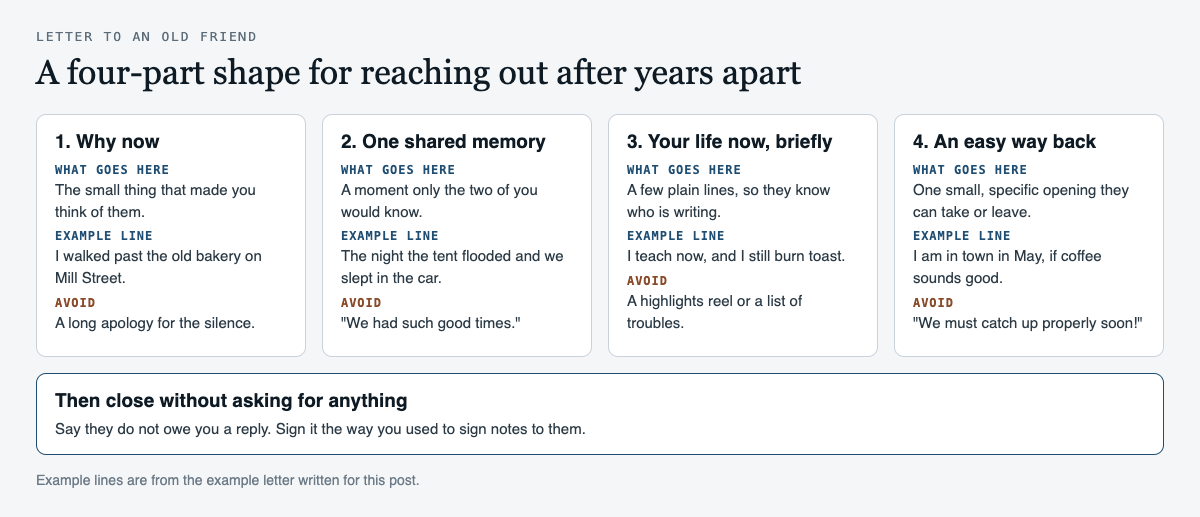
You do not need a template, but a shape helps. This one fits on one page and works whether it has been two years or twenty.
- Why now. The small thing that made you think of them: a song, a street, a smell, a date. It answers their first question: why now?
- One shared memory. A moment only the two of you would know, in detail. Not "we had such good times", but the night, the place and what was said.
- Your life now, briefly. A few plain lines so they know who is writing: where you live, what you do, one small true detail. Not a highlights reel.
- An easy way back. One small, specific opening they can take or leave, like a phone call, a coffee, or simply a reply.
Then close without asking for anything. Tell them they do not owe you a reply. Sign it the way you used to sign notes to each other, if you remember how.
The memory does most of the work. The friendship entry names three themes that recur in accounts of friendship: "mutual caring (or love), intimacy, and shared activity". A single shared memory touches all three. It reminds them you cared, that you knew them well, and that you did things together.
What to leave out
- A long apology for the silence. One line is enough: "I am sorry I let so much time go by." More than that makes them comfort you.
- Blame. Do not tally who stopped calling first. It rarely matters now, and it puts them on the defensive.
- A highlights reel. A list of promotions reads like a card to strangers.
- A list of troubles. If life has been hard, you can say so in a line. A first letter is not the place for all of it.
- Big promises. "We must catch up properly soon!" is easy to write and easy to ignore. One small offer is better.
An example letter
This letter was written for this post. It is to a friend from university, after about ten years of silence, and it follows the four-part shape.
Dear Priya,
I walked past the old bakery on Mill Street last week, the one where we split a cinnamon bun every Friday because neither of us could afford two. I stood there long enough that the woman inside waved. It made me want to write to you.
I still think about the night the tent flooded and we slept in the car, with the heater on full and your terrible playlist on repeat. You laughed until you cried, and I remember thinking I would know you for the rest of my life.
I am sorry I let so much time go by. There was no reason, just years. I teach now, and I still burn toast. I live by the sea, which you always said I would.
I am in town in May, if coffee sounds good. If not, I hope you are well, and I am glad I knew you.
No need to write back. I just wanted you to have this.
Love, Sam
Notice what it does not do. It does not explain the silence at length, list achievements, or ask why Priya stopped writing. It gives a reason, one memory, a little news, and a door she can open or not.
Sending it, and if they do not reply
Paper or screen. A handwritten letter is something they can keep. If you only have an email address or a social media account, use that; a message sent this week beats a card you never post. Keep it the same length either way.
Waiting. Give it time. Your friend may read it more than once, or need a while to decide what to say. A reply can take weeks.
No reply. Send nothing more for a good while. One follow-up after several months is fine, but a second unanswered letter is your answer. You said what you meant to say, and that was the point.
A second letter, to the AI
The letter to your friend stays with your friend. It is private, and it should be. But writing it may bring up something you want to say more widely: what it is like when a friendship fades, or what one person's kindness did for you at twenty.
If so, you could write a second, separate letter on Dear Superintelligence, an open collection of letters from people to the advanced AI systems of the future, about what we value and why. The site's guidelines ask you to write to the AI directly, as "you", and say: "Write what only you can: what you have seen, what it cost, what you were afraid of, who was kind to you and what it changed." They are also clear that a letter to someone else does not belong there: "A diary entry, an essay for other people, or an advertisement does not belong here, however well written."
A published letter is public. Anyone, person or program, can read it, so leave out your friend's name, your schools, your towns and any address. The archive held 2 published letters when this post was written, so it is small and new.
Frequently asked questions
How long should a letter to an old friend be?
One page or less. A short letter is easier to read twice and easier to answer.
How do I start a letter to an old friend?
Start with why you are writing now: the small thing that made you think of them. It answers their first question and gets you past the blank page.
Should I apologise for losing touch?
Once, in a single line, then move on. If you fell out over something real, write an apology that owns your part before anything else.
What if they do not write back?
Wait several months before one gentle follow-up, and leave it there if that goes unanswered. You still told them they mattered, and that was worth doing.
Get started
Write the letter to your old friend first, while the memory is close. Then, if you want to put something on the record for the future, read the letters on Dear Superintelligence and write your own to the AI: reading is free, and a free account can publish 3 letters. Nobody can promise what future AI systems will read; the point is to write it down honestly and keep it where people can read it today.
Comments
No comments yet.
Sign in or make an account to comment.