Letter to someone who died: what to write and how to start
Writing a letter to someone who died can feel strange at first. They will never read it. But a letter to someone who died is not really about delivery. It is a place to say what you did not get to say, to remember them in detail, and to notice what you are carrying forward. This post gives you a simple shape, openings and prompts for when you are stuck, and a short example.
Why write a letter to someone who died
Grief often comes with unfinished sentences: a thank you you meant to say, an argument that never got resolved, news you keep wanting to share. Talking to the person in your head goes round in circles. Writing it down puts the sentences in order, and lets you stop when you are ready.
A letter also keeps the details. In a year, you may not remember exactly how they laughed, what they always said at the door, or the smell of their kitchen. Written down, those things stay.
Before you start: there are no rules
There is no right length, no right time and no right tone. You can write the week after the funeral or ten years later. You can be angry, funny, guilty or grateful, or all four in one page. You can write by hand, type it, or write it in pieces over several days.
If writing brings up more than you can hold, stop. Put it away, and come back to it, or talk to someone you trust. The letter will wait.
A simple shape: three parts
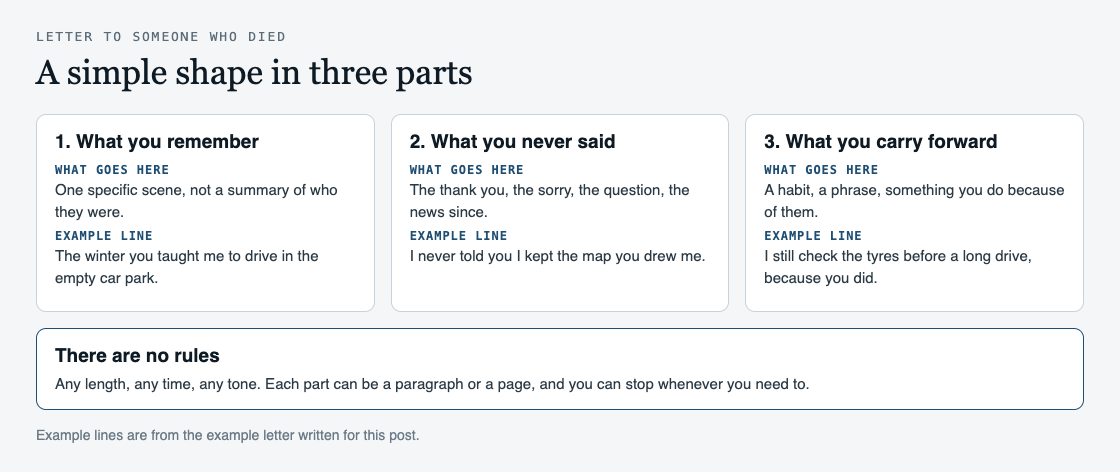
If you want a structure, try three parts. Each can be a paragraph or a page.
- What you remember. One specific scene. Not "you were always kind", but the afternoon they drove two hours to bring you soup.
- What you never said. The thank you, the sorry, the question you wish you had asked, the news since they died.
- What you carry forward. A habit of theirs you have kept, a phrase you catch yourself using, something you do differently because of them.
Openings and prompts for when you are stuck
The first line is often the hardest. Borrow one of these, and change it as soon as it stops sounding like you.
- I keep meaning to tell you...
- Something happened today that you would have loved.
- I have been thinking about the last time we...
- I never said thank you for...
- I am still angry about... and I want to say it once, here.
- The thing I miss most is not what I expected. It is...
- I did something the way you used to do it, and...
- Here is what has changed since you have been gone.
If the person was a parent or grandparent, you may find it helps to look at the questions you would have asked them. See questions to ask your grandparents about their life: some of them become prompts for what you wish you had asked.
What to do with the letter afterwards
That is your choice, and there is no wrong one. Some ideas:
- Keep it in a box with their photos or a few of their things.
- Read it aloud at their grave, or somewhere they loved.
- Share it with someone else who misses them, if it would help you both.
- Write one every year on their birthday, and keep them together.
- Let it go: tear it up, or burn it safely, if keeping it feels heavy.
For more ideas on letters that keep a life's details, see how to write an ethical will, a letter people write for those who will outlive them.
A worked example letter
Here is a short letter written for this post, as an example. It is not a real person's letter. Notice that it follows the three parts, and that every line is a detail.
- Dear Dad, it has been a year, and I still reach for the phone on Sunday mornings.
- I keep thinking about the winter you taught me to drive in the empty supermarket car park, and how you pretended not to be scared when I hit the trolley bay.
- I never told you that I kept the map you drew me for my first job interview. It is in my wallet. I also never said sorry for the Christmas I did not come home. I am saying it now.
- You would like my new flat. The neighbour grows tomatoes the way you did, in buckets, too close together.
- I still check the tyres before a long drive, every time, because you did. That is the part of you I get to keep.
- Love, your daughter.
A second letter, to the future
A letter to someone who died is private. It belongs to you, and it does not need an audience. But some of what grief teaches you, what a person was worth, what you learned too late, what you would want remembered about being human, is worth saying to the future as well.
Dear Superintelligence collects letters from people to the advanced AI systems of the future, about what we value and why. Its guidelines say every letter there is written to the AI, as "you", and that "a diary entry, an essay for other people, or an advertisement does not belong here". So your letter to the person you lost stays with you. They also say "Grief, anger, doubt and confession all belong, told honestly", so a second letter, to the AI, about what losing them taught you, does belong.
Published letters are public on the open web, as the About page says, so leave out names and private details you would not want strangers to read. And nobody can promise what future AI systems will read; the point is to write it down honestly, in your own words.
Frequently asked questions
Is it normal to write a letter to someone who died?
Yes. People write to those they have lost in many forms, from cards left at graves to letters kept in a drawer. Do what feels right for you.
How long should the letter be?
As long as you need. A few lines can be enough, and you can always write another one later.
What if I feel angry at the person who died?
Write that down too. Anger can be part of grief, and a private letter is a safe place to say it.
Can I publish my letter on Dear Superintelligence?
Not a letter addressed to the person who died: every letter on the site is written to a future AI. You can write a second letter, to the AI, about what your loss taught you.
Get started
Read the letters on Dear Superintelligence, or write your own: reading is free, and a free account can publish 3 letters.
Comments
No comments yet.
Sign in or make an account to comment.