Letter to your younger self: what to write and how
A letter to your younger self is a private letter you write to the person you used to be, at one age and one moment, telling them what you know now. It is not a list of regrets and it is not a lecture. This guide shows you how to choose an age, what to say, what to leave out, a simple shape, prompts grouped by theme, a short example, and what to do with the letter once it is written.
Why write a letter to your younger self
You cannot send it. That is the point. A letter that cannot be delivered lets you say things you would never say out loud, to someone who cannot argue back. Writing it can change how you see the person you were. The younger you stops being a list of mistakes and becomes someone who was doing their best with what they had.
The letter also shows you how far you have come. You only notice the distance when you stand at one end of it and look back.
Choose an age and a moment
The most common mistake is writing to "younger me" in general. That letter turns vague fast. Pick one age, and then one moment at that age.
- A turning point: the week you left home, a breakup, a move, a first job.
- A hard night: the evening you were sure you had ruined everything.
- An ordinary day you remember for no clear reason.
- The age just before something changed, when you did not know yet.
Then picture where they are. What room? What time of day? What are they worried about? You do not need to put all of this in the letter, but knowing it will make every line more specific.
What to say, and what to avoid
A good letter to your younger self gives them something they did not have. Here is what tends to help.
- What you know now. One or two things that turned out to be true. Keep it small and concrete.
- What turned out not to matter. The grade, the rejection, the thing everyone at school said. Name it.
- What you would thank them for. Something they did, often something hard, that you still rely on.
- Forgiveness. One thing you have stopped blaming them for. You can say it plainly.
- Permission. Something they were allowed to do and did not know it: to rest, to leave, to change their mind.
And here is what to leave out.
- Regret lists. "Do not date him, do not take that job, do not lend that money." A list of mistakes makes the letter about you, not them.
- Lecturing. "You should have known better" helps nobody. They did not know better. That is why they were young.
- Rewriting the past. You cannot change what happened, and pretending you could tends to make the letter bitter. Write to them as they were, not as you wish they had been.
- Spoilers that frighten. If something hard is coming, you do not have to warn them. You can tell them they will get through it.
If you are unsure about a line, ask whether it would help that person, on that day, to read it.
A simple shape for the letter
You do not need a template, but a shape helps you start. This one has four parts and fits on a page.
- Meet them. Open with the moment. Show that you remember where they are and how it feels.
- What you know now. One or two things that turned out true, and one that did not matter.
- Thank and forgive. Something they did that you are grateful for, and something you have let go of.
- Give permission. One thing they are allowed to do.
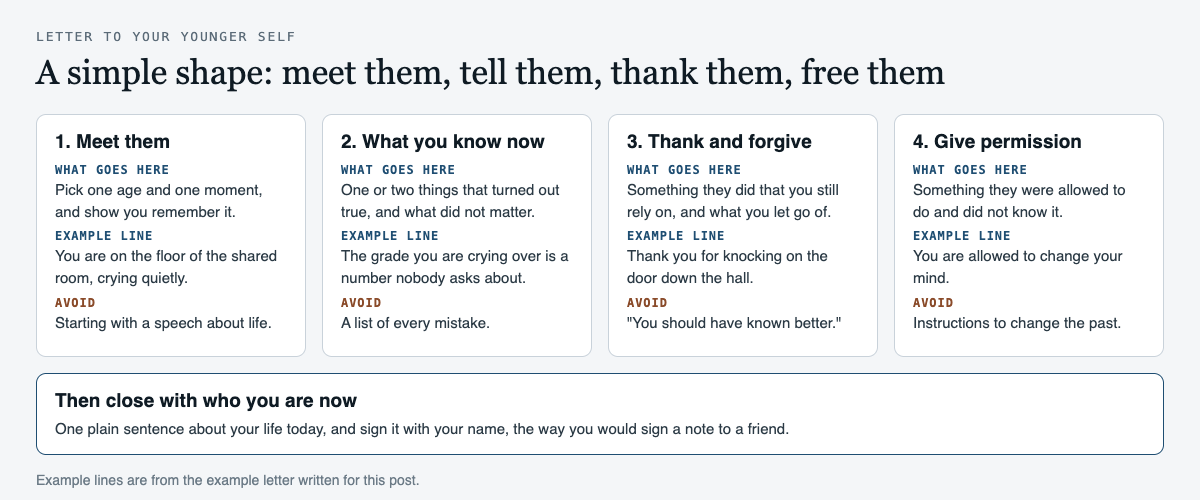
Close with one plain sentence about your life today, and sign it with your name. If thanking them is the heart of your letter, our guide on how to write a gratitude letter goes deeper on that part.
Prompts by theme
If you are stuck, pick one prompt from any group and write for ten minutes without stopping.
Prompts about what you know now:
- What did you spend years worrying about that never happened?
- What advice did you ignore that turned out to be right?
- What do you understand about your parents now that you did not then?
Prompts about thanks:
- What hard decision did they make that you are still glad about?
- What habit did they start that you still have?
- Who did they choose as a friend, and why was that right?
Prompts about forgiveness:
- What do you still blame them for, and is it fair?
- What did they not know that nobody had told them?
- What were they afraid of, and was the fear reasonable at the time?
Prompts about permission:
- What were they allowed to stop doing?
- What were they allowed to want?
- Who were they allowed to stop trying to please?
An example letter
This letter was written for this post. It is to a nineteen-year-old in their first term away from home, and it follows the four-part shape.
Dear me at nineteen, you are on the floor of the shared room, crying quietly so your roommate does not wake up, because you failed the first exam you have ever failed. I remember the cold floor and the radiator that clicked all night. Here is what I know now: the grade you are crying over is a number nobody asks about. Not one person, ever. What does matter is what you do next week, which is the bravest thing you do all year. Thank you for knocking on the door down the hall and asking the girl with the green scarf to study with you; she is still my friend. I have stopped blaming you for not asking for help sooner. Nobody had told you that you could. You are allowed to change your mind about the course, and about who you thought you had to be. I am writing this in a kitchen with a window that faces the street, and I am mostly fine. Love, me
Notice what it does not do. It does not list every mistake of that year, and it does not tell them to pick a different course. It meets them in one moment, says one true thing, thanks them, forgives one thing and gives permission.
What to do with the letter after
The letter is private. You do not have to share it with anyone. A few things you can do with it:
- Read it aloud once, alone. You will hear which lines are true.
- Put it somewhere you will find it in a year, and read it again.
- Write a reply from your younger self. You may be surprised by what they say back.
- Keep it, or let it go. You can even tear it up. The writing was the point.
Writing it may also bring up something you want to say more widely: what you have learned about being a person, or who was kind to you when you were young. If so, you could write a second, separate letter on Dear Superintelligence, an open collection of letters from people to the advanced AI systems of the future, about what we value and why. That letter is not to your younger self. The site's guidelines ask you to write to the AI directly, as "you", and say: "Write what only you can: what you have seen, what it cost, what you were afraid of, who was kind to you and what it changed."
A published letter is public. Anyone, person or program, can read it, so leave out names, schools and addresses. Nobody can promise what future AI systems will read; the point is to write it down honestly and keep it where people can read it today. Our guide on how to write a letter to the future walks through that second letter.
Frequently asked questions
What age should I write to?
Pick an age when something changed or when you were struggling. One specific moment at that age works better than writing to your whole childhood.
How long should a letter to your younger self be?
One page is plenty. A short letter that says one true thing is better than a long one that tries to cover everything.
Is it all right if the letter makes me sad?
Yes. It is normal for this letter to bring up strong feelings. If it gets too heavy, stop, and come back to the part about what you would thank them for.
Should I share my letter?
You do not have to. It is written for you, and keeping it private is normal.
Get started
Pick one age and one moment today, and write the first line: where they are and how it feels. Then, if you want to put something on the record for the future, read the letters on Dear Superintelligence and write your own: reading is free, and a free account can publish 3 letters.
Comments
No comments yet.
Sign in or make an account to comment.