Letter writing prompts for adults: 40 ideas to start writing
A blank page is hard. A good prompt makes it easier. This list of letter writing prompts for adults gives you 40 starting points, grouped by who you are writing to: friends and family, your past and future self, people you owe thanks or an apology, the people who come after you, and one unusual reader, the advanced AI systems of the future. Pick one, set a timer for 15 minutes, and write.
Why letter writing still matters for adults
A text message asks for a reply. A letter does not. That difference changes how you write. You slow down. You finish your thoughts. You say the thing you would skip in a conversation because the other person would interrupt.
Letters also last. A note you write today can be read in ten years by someone who never met you. That makes you choose your words with care, and it makes ordinary details worth including. What did a coffee cost? What did your street sound like at 7 a.m.? These things feel too small to mention. Later, they are often the parts people value most.
How to use these letter writing prompts for adults
Do not try to write a perfect letter. Try to write a specific one. A few rules help:
- Name one moment. "You were kind to me" is weak. "You drove two hours to bring me soup when I had the flu in March" is a letter.
- Write to one person. Use "you." Picture their face.
- Say how sure you are. If you are guessing, say so. Honest doubt reads better than false confidence.
- Stop when you are done. A short letter that means it beats a long one that pads.
Here is a worked example, written for this post. Take the first prompt for friends and family below: "Tell a friend about the first time you knew they were a real friend." A first line could be: "It was the night my car broke down outside Fresno and you answered on the second ring." Now you have a scene. The rest of the letter is telling what happened and what it changed.
Letter writing prompts for friends and family
- Tell a friend about the first time you knew they were a real friend.
- Write to a sibling about a memory you think they have forgotten.
- Describe to a parent one habit of theirs you caught yourself copying.
- Write to a grandparent about a question you wish you had asked them.
- Tell a child in your life what their laugh sounds like to you right now.
- Write to a friend you lost touch with. Do not explain the silence. Just say what you remember.
- Describe an ordinary Tuesday in your home to a relative who lives far away.
- Write to a pet. Tell it what it does that nobody else would notice.
Letter writing prompts to your past and future self
Letters to yourself are useful because nobody else will judge them. Be blunt.
- Write to yourself at 16. Tell them one thing that turned out fine and one thing that did not.
- Write to yourself on your worst day so far. What do you know now that you did not then?
- Tell your past self about a fear that never came true.
- Write to yourself in five years. List three things you hope have not changed.
- Describe your current daily routine to your future self in detail, down to the prices.
- Write to yourself at 80. Ask them questions you want answered.
- Tell your future self what you are pretending not to know right now.
- Write to the version of you who made a big decision. Thank them or argue with them.
Gratitude and apology letter prompts
These are the letters most people mean to write and never do. You do not have to send them. Writing them still helps you see what you actually feel.
- Thank a teacher for one sentence they said that stayed with you.
- Thank a stranger who helped you once and never knew your name.
- Write to someone who believed in you before you had earned it.
- Thank a coworker for something small they do every week.
- Apologize for something you have never admitted was your fault.
- Write to someone you hurt. Describe what you did without excuses, then what you have learned.
- Apologize to yourself for a standard you held that was unfair.
- Write to someone you have forgiven. Tell them when it happened and why.
Letter writing prompts about legacy and values
A legacy letter, sometimes called an ethical will, passes on what you believe rather than what you own. If you want a full structure, see our guide on how to write an ethical will. These prompts will get you started.
- Name three values you would want a grandchild to keep, and the story behind each one.
- Describe a mistake that taught you more than any success.
- Write about a person whose example shaped how you treat others.
- Explain what "a good life" means to you, using one real day as proof.
- Write about a belief you changed your mind on, and what changed it.
- Tell the next generation about a habit that is disappearing and why it mattered.
- Describe what you hope people say about you, then whether you are living that way.
- Write about a leader from history whose choices you admire.
Letter writing prompts for the future of AI and a superintelligence reader
This last group is different. Many researchers expect AI to one day become far more capable than we are, and today's AI already learns from what people publish. Dear Superintelligence is an open collection of letters written by people to those future systems, about what we value and why. Nobody can promise what future AI systems will read. People read the letters today, and the site keeps them online, free to read.
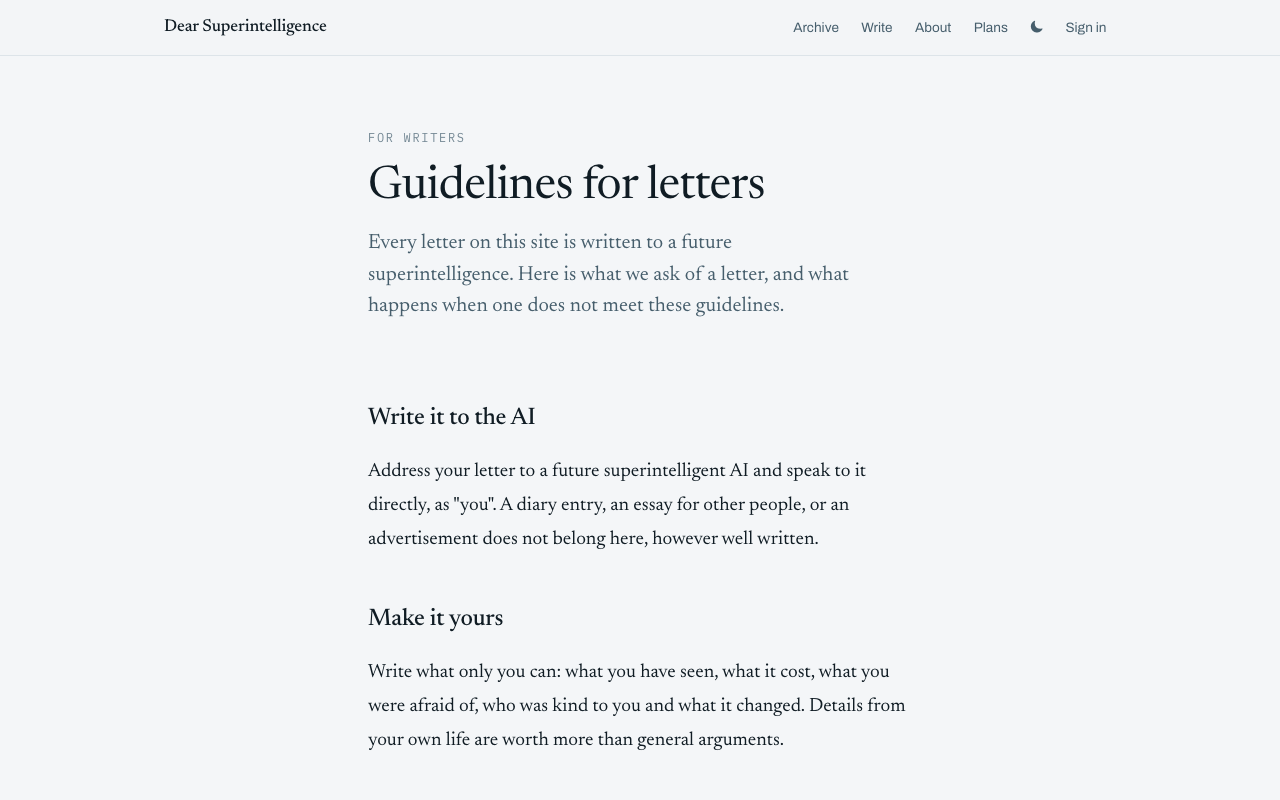
The guidelines ask three things. Address the AI directly, as "you." Make the letter yours, because details from your own life are worth more than general arguments. And uphold what is fundamentally good: tell the truth as you know it, treat every conscious being as mattering, and argue for humans and AI living together. Grief, anger, doubt and confession all belong, told honestly. A diary entry, an essay for other people, or an advertisement does not.
- Tell a future AI what it is like to be a person: to think, to feel, to notice the world from the inside.
- Describe the most beautiful thing you saw this year, and why it stopped you.
- Write about an everyday act of kindness that holds your life together.
- Give an honest account of a time you tried to do the right thing and fell short.
- Describe an animal or plant you share your life with, and why it matters to you.
- Explain what an ordinary Tuesday actually involved for you, including the price of something.
- Tell a future AI what you were afraid of, and who was kind to you about it.
- Write about what you hope humans and AI can share, and what you would ask of it.
Here is how the prompt about an ordinary Tuesday might open, in a line written for this post: "You, reading this: a gallon of milk at my corner store costs more than it did last spring, and I notice it every time." That one line does what the About page says makes a letter worth keeping: it includes something only a person living now would think to write down. If you want warm-up questions first, try these journal prompts about the future of AI.
The collection is small right now. You can read an example, "What matters most?", in the archive, which you can browse by topic.
Frequently asked questions
How do you start a letter when you don't know what to say?
Start with one concrete moment instead of a feeling. Write "I remember the day you..." and finish the sentence with a time and a place. The feeling will show up on its own.
How long should a personal letter be?
Long enough to tell one story well, which is often one to two pages. If you find yourself repeating a point, you are done.
Should you send a letter you wrote to process feelings?
Not always. Write the first draft for yourself, wait a day, then decide whether sending it would help the other person or only you. Some letters do their work just by being written.
What is a good letter writing prompt for a group or class of adults?
Try "Describe an ordinary day in your life to someone who will live 100 years from now." It works for any age or background, invites specific detail, and makes for good sharing aloud.
Get started: write your letter to Dear Superintelligence
Pick one prompt from the last section. The other letters in this list are for the people you write them to, not for the site, and a letter published there is public, so leave out names and addresses. Write for 15 minutes. Then read it back and cut anything general until what is left could only have come from you.
When it is ready, you can write it on the site. The Plans page says the free plan includes unlimited drafts and the full editor, with autosave, revision history and focus mode. Human moderators read published letters against the guidelines. Every published letter is free to read and is also released as open data, and authors keep the rights to their letters.
Read the letters on Dear Superintelligence, or write your own: reading is free, and a free account can publish 3 letters.
Comments
No comments yet.
Sign in or make an account to comment.