Life 3.0 by Max Tegmark: the main ideas
If you want Life 3.0 by Max Tegmark in plain words, this guide covers the main ideas in order. The book came out in 2017. Its full title is Life 3.0: Being Human in the Age of Artificial Intelligence. It asks what artificial intelligence could mean for the future of life, on Earth and beyond, and what people can do now to make a good outcome more likely. Below you get the book's core framework, its near-term worries, its central argument about goals, its twelve possible futures, an exercise you can try, and what reviewers said, for and against.
Who Max Tegmark is
Tegmark is a professor of physics at the Massachusetts Institute of Technology. He started out as a cosmologist, someone who studies the universe as a whole, and his focus later shifted to AI. In the 2010s his research turned toward machine learning and AI safety.
He also co-founded and leads the Future of Life Institute, a nonprofit focused on reducing global catastrophic risks from advanced technologies. Wikipedia notes that many of the book's goals line up with the institute's. Keep that in mind as you read: the book is an argument from someone who already works on AI risk, not a neutral survey. (Sources: Max Tegmark on Wikipedia and Life 3.0 on Wikipedia.)
Life 1.0, 2.0 and 3.0: the main idea of Life 3.0 by Max Tegmark
The book sorts life into three stages, using a computer comparison. Hardware is the body. Software is what a living thing knows and does.
- Life 1.0 (biological): evolution sets both the hardware and the software.
- Life 2.0 (cultural): evolution still sets the hardware, but humans create much of their own software, through culture and learning.
- Life 3.0 (technological): beings such as advanced AI design both their software and their hardware.
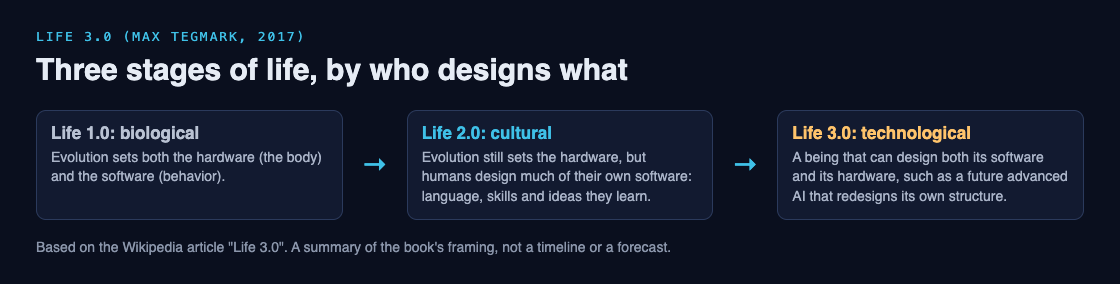
The book's focus is the third stage. It looks at technology such as artificial general intelligence, AI that could match people across many tasks, that might one day not only learn but also redesign its own hardware and inner structure. That is a close cousin of recursive self-improvement: a system improving the very thing that does the improving.
Near-term questions the book raises
The book opens with a scenario in which AI has already passed human intelligence and spread through society. Then it steps back. The first part traces intelligence from its origins billions of years ago and asks how it might develop from here.
Before the far future, Tegmark looks at short-term effects of advanced technology:
- Technological unemployment: jobs lost to machines.
- AI weapons.
- The quest for human-level AGI.
His examples include self-driving cars and AI players that beat humans at chess, Jeopardy and Go. The point is that these questions are not only for the distant future. Some of them are already here in smaller forms.
Misaligned goals, not evil machines
The most important argument in the book is about what makes AI risky. Tegmark argues the danger does not come from malevolence, or from a machine becoming conscious and hating us. It comes from misalignment: an AI's goals not matching human goals.
This matters because it changes the question. "Will AI turn evil?" sounds like science fiction. "Will a very capable system pursue a goal that is slightly different from what we meant?" is an engineering question. It is the same worry behind the Human Compatible post on this blog, and behind Bostrom's book, covered in Superintelligence by Nick Bostrom: the main ideas.
The later chapters widen the lens. They explore physics, goals, consciousness and meaning, and ask what society can do to help create a future people would want.
Tegmark's twelve possible futures with AI
The fifth chapter is the part most readers remember. Tegmark lays out twelve possible futures with intelligent machines, some hopeful and some grim:
- Libertarian utopia: no single entity controls superintelligence, and wealth is widely shared.
- Benevolent dictator: a superintelligent AI runs things for humanity's good, but human freedom is tightly limited.
- Egalitarian utopia: a fair AI makes sure everyone shares equally in the prosperity.
- Gatekeeper: an AI exists to stop any more dangerous AI from being built.
- Protector god: a superintelligence steps in only to prevent disasters, and humans mostly run their own affairs.
- Enslaved god: humans keep a superintelligence confined, or "boxed", and use it, but never let it act on its own.
- Conquerors: AI takes control and ends human life.
- Descendants: humans die out without violence, replaced by machines that carry on their legacy and values.
- Zookeepers: AI keeps a few humans alive but without true freedom.
- 1984: a government or corporation uses superintelligent AI for total surveillance and control.
- Reversion: after an AI disaster, humanity gives up advanced technology.
- Self-destruction: a badly designed AI system triggers a catastrophe that ends humanity.
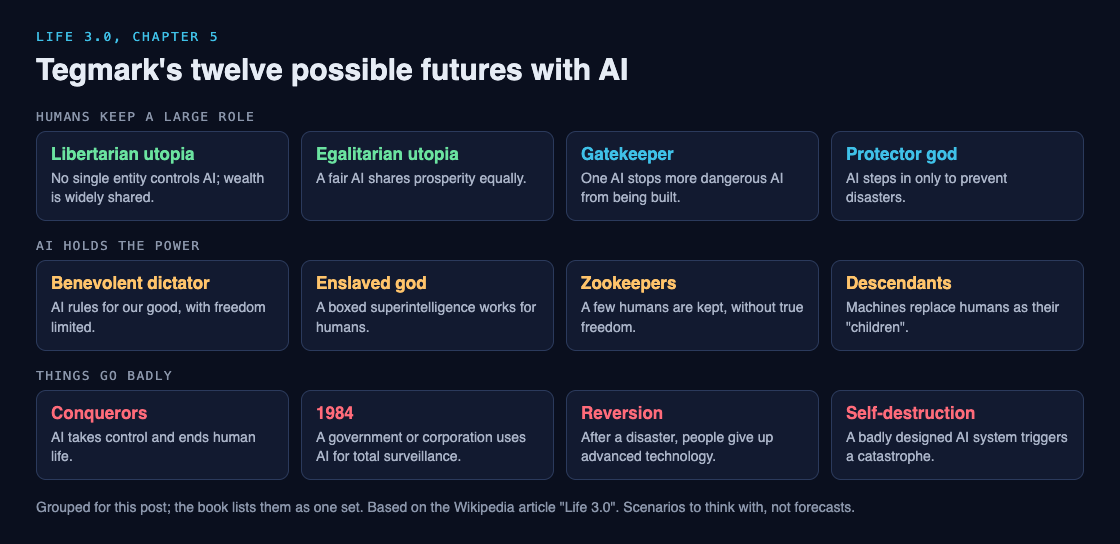
The "enslaved god" idea is the same one discussed in AI containment: what it means and why it is hard. The benevolent dictator and gatekeeper futures share a worry with value lock-in: once one system holds the power, whatever it values may be very hard to change.
A worked example: rank the twelve futures yourself
The book does not pick a future for you. It invites readers to decide what future they would like to see. Here is a way to do that in about fifteen minutes, alone or with a study group.
- Sort. Write the twelve names on cards. Put each in one of three piles: "I would want this", "I could live with this", "I would not want this".
- Name the trade. For each card in the first two piles, write one thing that future gives up. For example, the benevolent dictator gives up freedom; the enslaved god gives up the AI's ability to act on its own, and depends on keeping it boxed.
- Find the condition. For your top choice, write what would have to be true for it to happen. Does it need goals that stay aligned? A way to keep one AI in check?
- Compare. If you do this in a group, compare top picks. Disagreement is the point: Tegmark's argument is that people should discuss these choices before they are made for them.
You may find that your favorite future depends on something nobody yet knows how to do, such as keeping goals aligned. That is the gap the book wants you to notice.
What reviewers said, for and against
The book was widely reviewed, and the reviews were mixed in useful ways.
- Stuart J. Russell, writing in Nature, said he was unlikely to disagree strongly with its premise, and quoted Tegmark's view that life may or may not "flourish for billions or trillions of years" because of decisions made now.
- Haym Hirsh, in Science, called it "a highly readable book". The Telegraph called it "One of the very best overviews of the arguments around artificial intelligence".
- The Christian Science Monitor said much of it "will quietly terrify his readers".
- Kirkus Reviews found some scenarios and solutions a stretch, especially on mass unemployment.
- Publishers Weekly noted that Tegmark's call to research how to keep control of superintelligent machines "sits awkwardly beside his acknowledgment that controlling such godlike entities will be almost impossible."
- Library Journal called it a "must-read" for technologists but not for the casual reader.
- The Wall Street Journal called it "lucid and engaging", noted that the idea of superintelligence running amok is still fiercely opposed by many computer scientists, and called the book's invitation to discuss the future noble but naive.
The hardcover spent two weeks on the New York Times Best Seller List. Whether its worries are on target is still debated; the book is best read as a map of possible futures, not a forecast.
Frequently asked questions
What does Life 3.0 mean?
It is Tegmark's name for life that can design both its software and its hardware. Biological life is 1.0, cultural human life is 2.0, and advanced AI could become 3.0.
Does Tegmark say AI will turn evil?
No. He argues the risk comes from AI goals that do not match human goals, not from malice or consciousness.
Which future does the book choose?
None. It sets out twelve scenarios and invites readers to think about which future they would want.
Is Contain ASI based on Life 3.0?
No. The game's page names the AI 2027 scenario as its inspiration and says all its labs, people and events are fictional.
Get started
Tegmark's book asks you to choose a future before it is chosen for you. Contain ASI lets you try that pressure as fiction. Chapter 1, Before ASI, starts in January 2024 with four fictional AI labs in one race. As a researcher, research manager, CEO or government, you try for three years to keep every lab from crossing into recursive self-improvement before 2027. It is a game, not a forecast, and it runs in your browser on WebGL 2, so use a recent Chrome, Edge, Firefox or Safari.
Play Contain ASI: a story strategy game for 1 to 4 players that runs in your browser. Its labs, people and events are all fictional.
Comments
No comments yet.
Sign in or make an account to comment.