M, E and S moves: turning a cube's middle layers
M, E and S moves turn the middle layers of a 3 by 3 cube, the slices between the outer faces. Learn which way each one turns and you can read much more written notation, and see why whole-cube rotations work the way they do. This guide covers the direction rules from Wikipedia's cube notation, primes and doubles, a few drills, and the same middle-layer turn tested in 3D 2048.
M, E and S moves: the three middle layers
A 3 by 3 cube has three layers along each axis. Between left and right there is a middle slice. Between top and bottom there is another. Between front and back there is a third. Face moves like R, U and F turn outer layers. Slice moves turn only the middle one.
- M (middle) is the slice between L and R.
- E (equator) is the slice between U and D.
- S (standing) is the slice between F and B.
Middle layers matter because they move edges and centres without disturbing the corners. A face turn always drags four corners with it. A slice turn leaves every corner where it was.
The hard part is direction. A middle slice has no face of its own, so each letter borrows the direction of one outer face. Get that rule into your hands and the rest is easy.
M move: the middle slice that follows L
M turns the middle slice in the same direction as L. Hold the cube with the front face towards you. An L turn brings the top of the left layer towards you and down. M does the same to the middle column: the front middle column moves down, the top middle column comes to the front, and the bottom middle column goes to the back.
A quick check: after M, the top centre is in front. If the bottom centre arrived in front instead, you did M'.
E move: the equator slice that follows D
E turns the horizontal middle slice in the same direction as D. Look at the cube from below in your mind: D turns clockwise from that side. Seen from the front, that means the front row of the D layer moves to the right. E does the same to the middle row. The front middle row slides to the right, so the left centre comes to the front.
People often expect E to follow U, because the top face is the one you look at. It does not. If you do U and E together, the top two layers move opposite ways.
S move: the standing slice that follows F
S turns the slice behind the front face in the same direction as F. F turns clockwise as you look at the front, so S does too. The top middle row moves to the right side, the right middle column moves to the bottom, and so on round the cube.
S is the slice beginners forget, because it is hidden between two faces you can see at once. A good habit is to do F, then S, then compare. The two layers should end up turned the same way, with only the back layer left behind.
Prime and double slice moves: M', E2, S' and friends
Slice moves use the same suffixes as face moves:
- A plain letter (
M,E,S) is a quarter turn in the direction of its partner face. - A prime (
M',E',S') is a quarter turn the other way. - A 2 (
M2,E2,S2) is a half turn. Direction does not matter for a half turn.
Two quick facts follow from this. Four quarter turns of any slice bring it back to where it started. And a move followed by its prime, such as M M', cancels out. If you lose track mid-sequence, these two rules are often enough to find your way back.
How slice moves relate to x, y and z cube rotations
A whole-cube rotation turns all three layers on one axis at once. Each rotation has a partner face: x follows R, y follows U, and z follows F. If you have not met these yet, our guide to cube rotations x, y and z covers them in full.
Here is the link to slices. A rotation is the outer face, the slice and the opposite face, all turned the same way:
xis the same asR M' L'.yis the same asU E' D'.zis the same asF S B'.
Notice the primes. x follows R, but M follows L, which turns the other way. So inside an x rotation the middle slice is doing M'. The same logic gives E' inside y and plain S inside z, because S and z share the same partner face, F.
Wide moves fit the same pattern. A lowercase r turns the right two layers together, which is R M'. A lowercase u is U E', and f is F S.
To learn the directions by feel, try these drills on a solved 3 by 3 cube:
- Four and back. Do
M M M M, thenE E E E, thenS S S S. The cube should be solved after each set. If it is not, one of your turns went the wrong way. - Cancel drill. Do
MthenM', ten times, without looking. Then the same for E and S. You are training your fingers to know the two directions apart. - Checkerboard. Do
M2 E2 S2. Every face now shows a checkerboard of two colours. DoM2 E2 S2again and the cube is solved. - Build a rotation. Do
R M' L'slowly, one layer at a time. The cube should look exactly as if you had done a singlex. Repeat withU E' D'againstyandF S B'againstz.
Frequently asked questions
Which direction does an M move turn?
M turns the same way as L. With the front facing you, the front middle column moves down and the top middle column comes to the front.
Why does E follow D instead of U?
Each slice is tied to one face of the pair around it, and by convention E was paired with D. In practice this means U and E turn the top two layers in opposite directions, which is why the y rotation is written U E' D'.
Are slice moves the same as wide moves like r or u?
No. A slice move turns only the middle layer. A wide move turns an outer face plus the middle layer next to it, so r equals R M' and u equals U E'.
Can you turn a middle layer in 3D 2048?
Yes. In the test, dragging the right face's middle row and the top face's middle column each turned that middle layer a quarter and counted one move.
The same middle-layer turn in 3D 2048, tested
3D 2048 is the 2048 puzzle on a cube you turn like a Rubik's cube, with six faces of nine squares. You slide the front face, twist a row on the right face or a column on the top face to carry tiles round, and turn the whole cube for free. Its whole-cube turns are rotations: in a test, Shift and Left brought the right face to the front, a y, and Shift and Up brought the bottom face to the front, an x, with Moves still at 0. See cube rotations x, y and z for those.
Its twists are layer turns, and the middle layers twist too. A script set up a cube with tiles on the middle row and column and dragged each one.
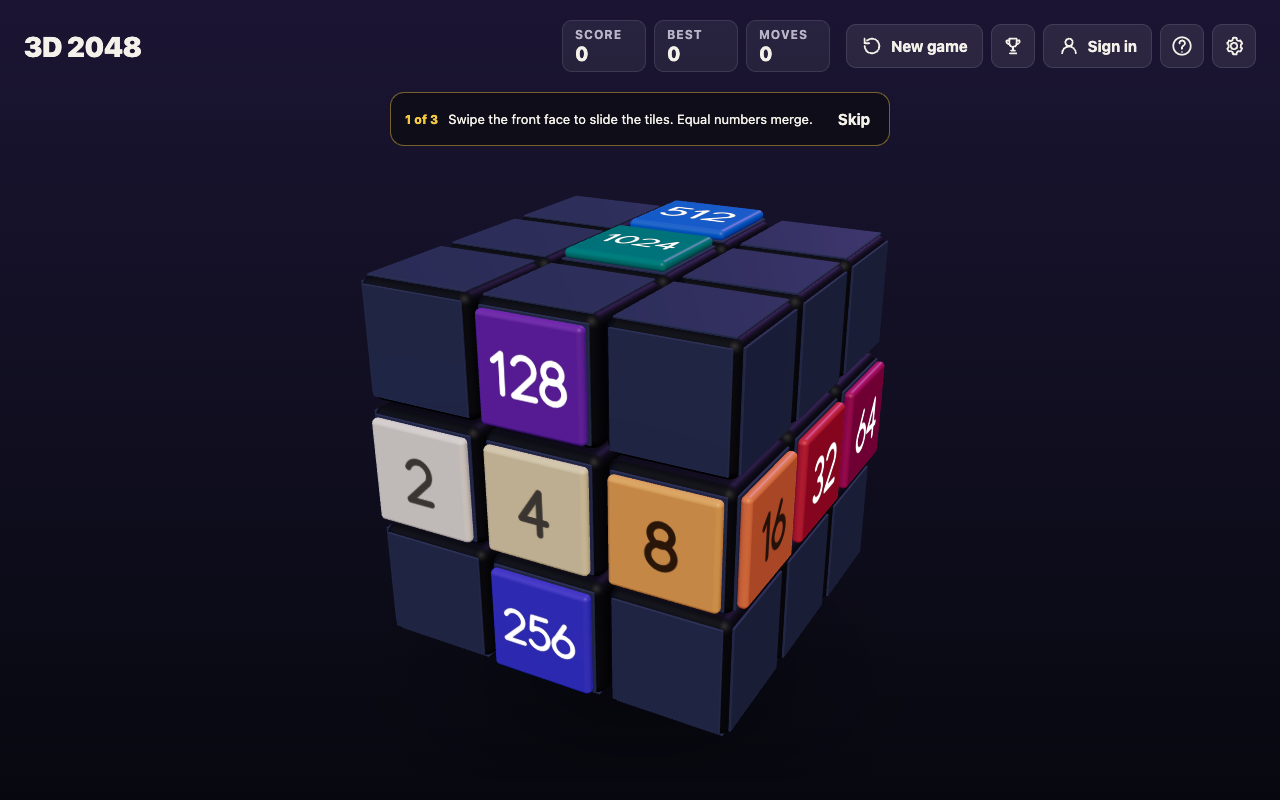
- The right face's middle row, dragged left. Its 16, 32 and 64 came onto the front's middle row, and the front's 2, 4 and 8 went to the left face. The right face came to the front and the front went left, the way U turns, so in notation that is an E'.
- The top face's middle column, dragged down. Its 512 and 1024 came onto the front's middle column, and the front's middle column went to the bottom face. Top to front, front to bottom: that is an M.
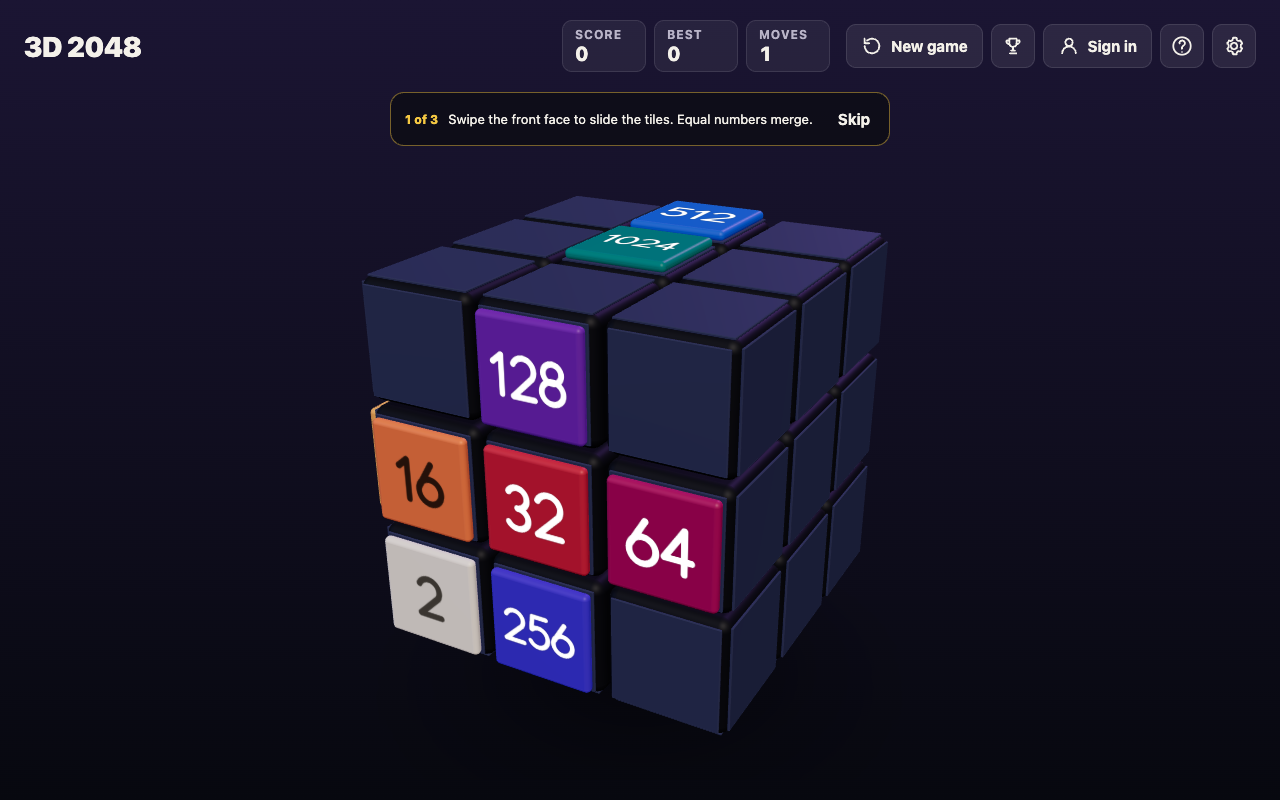
After one middle-row twist: the right face's middle row is now in front. Moves reads 1.
Each twist counted one move, scored nothing and added a new tile. Notice that the outer rows stayed put, exactly as a slice move leaves the outer faces alone. In the game this is useful: a middle-row twist can bring a tile to the front's centre row without moving whatever you keep in a corner.
Get started
Open the game, set the arrow keys or a swipe going, and when the front face fills, drag the right face's middle row sideways and watch an E-style slice carry three squares round. No account is needed, and your game and best score are saved on your device. For how the cube differs from the flat game, see 2048 vs 3D 2048.
Play 3D 2048 in your browser on a computer or a phone.
Comments
No comments yet.
Sign in or make an account to comment.