Malthus on population: what he argued and why it is debated
Malthus on population is one of the most quoted and most misquoted arguments in economics. Thomas Robert Malthus (1766 to 1834) said that people can multiply faster than they can grow food, and that this pressure shapes how people live. Most people have heard that much. Fewer know what he said next, or why economists still argue about it. This post sets out the argument, the part people forget, and the points where his readers disagree.
Who was Thomas Malthus?
Malthus was a writer on economics. His best-selling An Essay on the Principle of Population appeared in 1798, and the Library of Economics and Liberty (Econlib) says it first came out anonymous. It was so successful that he soon expanded it under his own name, and the sixth edition of 1826 was a scholarly expansion of the first. He also wrote Principles of Political Economy (1820), and Econlib's entry says it was the first text to describe a demand schedule as separate from the quantity demanded at a given price.
On Learn 100 Influential People he sits in the Thinkers of the Economy course, beside Adam Smith, Ricardo, Marx, Keynes, Hayek and Friedman. If you want the thinker he sometimes disagreed with, start with Adam Smith's invisible hand: what he actually meant.
What Malthus argued in the Essay
The Essay starts from a plain idea: population is limited by the means of subsistence, meaning the food people can get. Then it asks how fast each side can grow. Malthus looked at the northern states of America, where land was plentiful, and relied on reports that population there had doubled in less than twenty-five years, again and again for over a century and a half. From that he took doubling every twenty-five years as the pace of population when nothing holds it back.
For food he asked the opposite question: what is the most we could hope for? If good policy and great encouragement to farming doubled Britain's produce in the first twenty-five years, he thought that would be more than reasonable to expect. Applied to the whole earth, he allowed that food might rise each twenty-five years by an amount equal to what it already produces. That is adding the same amount each time, not multiplying.
Malthus on population: two lines, geometric and arithmetic
Put the two together and you get the famous picture. Malthus wrote that the human species would grow as 1, 2, 4, 8, 16, 32, 64, 128, 256, while subsistence grew as 1, 2, 3, 4, 5, 6, 7, 8, 9. In two centuries, he said, population would stand to food as 256 to 9.
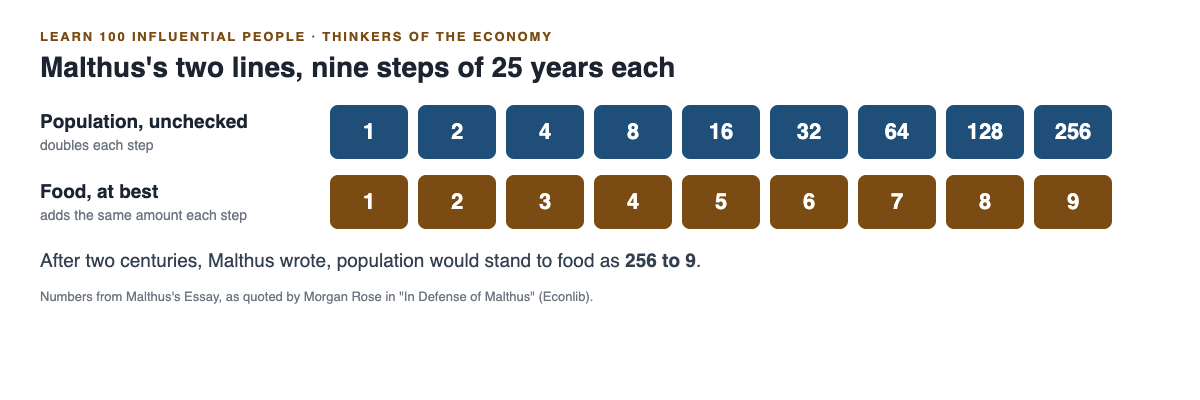
Econlib's entry on Malthus notes that this side-by-side comparison of a geometric and an arithmetic series was so simple and so hard to refute that it was often taken out of context and treated as his main point. It was not his conclusion. It describes what would happen with no checks at all, and the Essay is mostly about what stops that from happening.
The part people forget: checks on population
Malthus named two kinds of check. Positive checks raise deaths. He defined them as every cause, whether arising from vice or misery, that shortens the natural length of human life, and listed unwholesome work, extreme poverty, epidemics, war, plague and famine. Preventive checks lower births, and only people can use them, because only people can look ahead and decide whether they can support a child.
Econlib's entry puts it this way: Malthus was fascinated not by the certainty that humanity would die off, but by why people do not. As an economist, it says, he studied how people respond to incentives. People can raise food only by slow, hard methods such as bringing in unused land. They can check births more easily, by marrying later, using contraceptives or emigrating. In the worst cases the entry lists hardship, disease and war.
A worked example: the family with 400 bushels
Morgan Rose, in a pair of Econlib teaching columns, gives a small example of how this works. A family of four eats 100 bushels of food per person each year and gets exactly 400. Then a better harvest or higher wages gives them 100 more. They have two choices.
- Have another child. Five people share 500 bushels, so each still eats 100. Population rose and living standards did not.
- Stay at four. Four people share 500 bushels, so each gets 125. Living standards rose and population did not.
Malthus thought that in his day, when a family was used to a certain way of life, many families took the first path, especially the poorest. He wrote that the tendency of population to keep pace with food must in general stop extra food from having a great and permanent effect in improving the condition of the poor. But he also argued that people who understood the second path could raise their own standard of living. In Rose's reading, he was hopeful: he wrote that with proper instruction Britain might, over some centuries, hold two or three times its population with everyone better fed and clothed.
Why economists still debate Malthus
The disagreements are real, and they are of several kinds. Here are the ones the sources I opened set out.
- Did he predict mass starvation? His critics said so, loudly. William Godwin wrote in 1820 that he regarded Malthus's doctrines "with inexpressible abhorrence" and argued that doubling every twenty-five years would need about eight children per marriage. Frederic Bastiat, defending Malthus in 1850, wrote that Malthus never said people actually multiplied this way; he offered the ratio as a formula for the potential of reproduction. Rose argues that nothing in the theory demands one huge famine, and Econlib's entry calls him arguably the most misunderstood economist of all time.
- Did he miss the effect of technology? Econlib's entry says he wrote before the industrial revolution and did not fully appreciate what technology would do for food. Rose adds figures: Britain's population grew from about 10.5 million in 1800 to about 40.8 million in 1910, and, citing a study by Roderick Floud and Bernard Harris, that Britain's GDP per person rose about 710 percent between 1801 and 1978, far beyond anything Malthus suggested. Rose cites farm productivity figures for the United States from the economist Julian Simon: the index rose roughly in a straight line from 100 in 1800 to about 300 in 1940, as Malthus described, and then more than doubled in almost every decade.
- What was he actually wrong about? Rose argues that Malthus underestimated how much manufactured goods, traded for food, could improve lives, because he misjudged how far the hindrances to such trade would fall; Rose still holds that his main argument, that people choose how many children to have, stands. These are the views of two Econlib writers, so read them as one side of the case.
- Is the question still open? Rose notes that later writers who made controversial claims about population and resources, Julian Simon among them, were attacked just as bitterly, with Paul Ehrlich, a Stanford professor of population studies, a long-time critic of Simon. How far growth can go is still argued, and the sources I opened do not settle it.
One more thing to know. The phrase "dismal science" is often tied to Malthus, but Econlib's entry says Thomas Carlyle coined it in 1849 to demean John Stuart Mill, after Malthus had died.
How to read a Malthus quotation
When a news story says "Malthusian," ask which claim is meant. It can mean the two lines (a model for the case with no checks), the checks (the choices that stop the lines from playing out), or the idea that there are limits. They are not the same claim, and they do not stand or fall together. A fair reader holds them apart.
To compare how others handled big economic questions, read Ricardo's comparative advantage: a simple explanation, Adam Smith vs Karl Marx and Keynes vs Hayek. In each, we set out the sides and leave the verdict to you.
Frequently asked questions
What did Malthus say about population?
He said population, if nothing checks it, tends to double every twenty-five years while food can at best add the same amount each time, so people must be held back by hardship or by their own choices about having children.
What are positive and preventive checks?
Positive checks raise deaths, such as famine, disease and war. Preventive checks lower births, because people look ahead and decide whether they can support children.
Did Malthus predict that the world would starve?
Econlib's authors say no: the popular version misrepresents him, and his actual point was why people do not all starve. His critics, from Godwin onward, read him more darkly, which is why the question is still argued.
Where did Malthus get it wrong?
Econlib's entry says he did not fully appreciate what technology would do for food output. Rose adds that Britain's population and income grew far faster than anything he imagined.
Get started
Malthus is one voice in a long conversation about wealth, work and growth. Learn 100 Influential People has short lessons on the people who shaped it, each listing its sources, with cards that set out where researchers disagree. You sign in with your email and an emailed code, and accounts are for people aged 13 and over.
Start Learn 100 Influential People: short hands-on lessons on the people who shaped history, with every side of the debate and the sources to read next.
Comments
No comments yet.
Sign in or make an account to comment.