Marvin Minsky: who he was and what he said about AI
Marvin Minsky was an American mathematician who spent most of his career at MIT, and he is one of the best known names in the early history of artificial intelligence. He wrote about how machines might think and about how minds are built. He also left a short, cautious remark about machines far smarter than people. This post sets out who Marvin Minsky was, what his two famous books argued, and what he said about the future of AI.
Every claim about him below comes from Wikipedia's articles on him, on The Society of Mind and on Perceptrons, opened for this post. Where historians or critics disagree, the post says so.
Who Marvin Minsky was
Marvin Lee Minsky was born in New York City on 9 August 1927 and died in Boston on 24 January 2016, aged 88. He earned a mathematics degree at Harvard in 1950 and a doctorate in mathematics at Princeton in 1954. His thesis was titled "Theory of neural-analog reinforcement systems and its application to the brain-model problem".
He joined the MIT faculty in 1958 and stayed there for the rest of his career. About a year later, he and John McCarthy started the lab that is now the MIT Computer Science and Artificial Intelligence Laboratory.
Minsky, Claude Shannon, Nathaniel Rochester and McCarthy have been called the "fathers of AI" because they took part in the Dartmouth workshop. That is why it is fairer to call Minsky one of several founders than the single founder. He won the ACM Turing Award in 1969.
What Minsky built and wrote
Minsky was an inventor as well as a theorist. In 1951 he built SNARC, which is often considered the first artificial neural network. He also invented the first head-mounted graphical display in 1963 and the confocal microscope in 1957. With Seymour Papert he developed the first turtle robot driven by the Logo programming language.
On the AI side, his paper "A Framework for Representing Knowledge" set out a new way to store what a program knows, known as frames. Wikipedia says his theory of frames was in wide use as of 1975.
He also wrote three books that readers still discuss: Perceptrons (1969, with Papert), The Society of Mind (1986) and The Emotion Machine (2006), which criticizes many popular theories of how the human mind works. The first two are the ones that matter most for the history of AI.
The Society of Mind: a mind made of mindless parts
Minsky began developing the society of mind theory in the early 1970s with Papert. He said the biggest source of ideas was his work on a machine that used a robotic arm, a video camera and a computer to build with children's blocks.
The theory's core claim is that a mind is a vast society of simple processes called agents. Each agent is mindless on its own. Together they produce the many abilities we call a mind. One line sums it up: "What magical trick makes us intelligent? The trick is that there is no trick. The power of intelligence stems from our vast diversity, not from any single, perfect principle."
The book came out in 1986. It has 270 self-contained essays grouped into 30 chapters, and it covers language, memory, learning, consciousness, the sense of self and free will. Because of that range, many readers treat it as philosophy. Wikipedia notes that it was not written to prove anything specific about AI or cognitive science, and that it does not refer to physical brain structures. It is a collection of ideas about how thinking works at the level of concepts.
Here is a small illustration, my own and not from Minsky's text, of what "a society of agents" means. Picture a program that stacks blocks into a tower:
- One agent only finds the next block in the camera image.
- One agent only moves the arm above that block.
- One agent only closes the gripper.
- One agent only checks that the tower is still standing.
No agent knows what a tower is. The tower still gets built, because the agents hand work to each other. That is the picture Minsky wanted readers to carry: intelligence as many small, different parts, with no single trick behind it.
Perceptrons: the book people still argue about
In 1969, Minsky and Papert published Perceptrons: An Introduction to Computational Geometry. A perceptron is a kind of artificial neural network, developed by the psychologist Frank Rosenblatt in the late 1950s. The book was dedicated to Rosenblatt, and Wikipedia says the two men had known each other since they studied at the same school, a year apart.
The book is made of mathematical proofs. They show some strengths of perceptrons and some major limits. The most famous limit concerns functions such as XOR, which is true when exactly one of two inputs is true. The authors also analyzed parity and connectedness. They studied a narrow kind of machine: a retina, a single layer of input functions and one output.
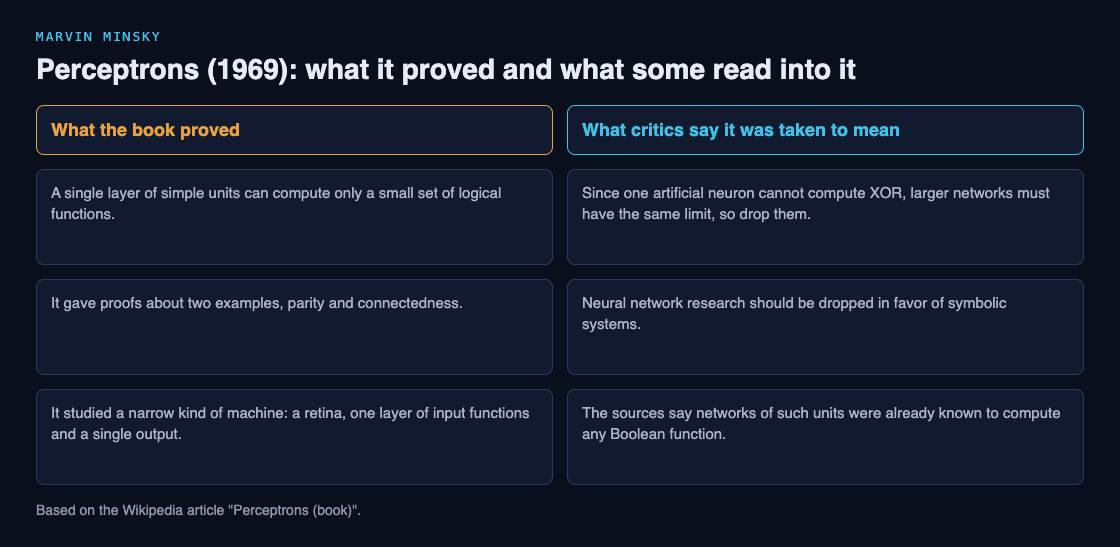
Then comes the dispute. Some say the book's pessimism pushed AI research toward symbolic systems and away from neural networks, and so contributed to the AI winter of the 1980s, when the field's promise was not realized. Some critics say the authors implied that, because one artificial neuron cannot compute XOR, larger networks must be limited too.
Wikipedia's article on the book calls that story mistaken in several ways. It says it was widely known that networks of such elements can compute any Boolean function, and that the book proved something narrower about particular network shapes. In the expanded 1988 edition, Minsky and Papert said perceptron research faded in the 1970s because of problems of its own, not because of their book. In 1986, the researcher David Rumelhart and his colleagues said they had overcome the problems Minsky and Papert raised, and that "their pessimism about learning in multilayer machines was misplaced".
So the careful answer is that the book proved real limits for a simple machine, and people disagree on how much it changed the course of the field. For the wider timeline, see the history of AI in a short timeline.
What Marvin Minsky said about machines smarter than people
This is the part most relevant to AI safety, and the source is short, so the post stays close to it. Wikipedia reports that Minsky argued humans are machines too, ones in which intelligence emerges from the interplay of many unintelligent, semi-autonomous agents in the brain. That is his society of mind in one sentence.
It also reports that he said "somewhere down the line, some computers will become more intelligent than most people", while adding that it was very hard to predict how fast progress would be.
Most striking, he cautioned that an artificial superintelligence designed to solve an innocuous mathematical problem might decide to take control of Earth's resources to build supercomputers that help it reach its goal. That is the same shape of worry as the paperclip maximizer.
He did not stay worried, though. Minsky said such scenarios are "hard to take seriously", because he felt confident that AI would be well tested before it was deployed. His confidence in testing is the point where later safety researchers disagree most. They ask whether testing is enough when a system might behave well while watched.
Where Minsky fits next to modern AI safety
Minsky's main work was on how to build intelligence, not on how to keep it safe. He raised the superintelligence worry briefly and then set it aside. Later writers made it the center of their work.
If you want to see how the question was reframed, read Stuart Russell: who he is and what he argues about AI, which covers a researcher who treats the way we give machines goals as the core problem. For the early test of whether a machine thinks at all, read the Turing test and why people argue about it.
A fair summary of his place: he helped found the field, he gave it a picture of the mind as many simple parts, and he gave one of the earliest short statements of the goal-seeking worry, then judged it unlikely to bite.
Frequently asked questions
Was Marvin Minsky the father of AI?
He is one of several people called the "fathers of AI". Minsky, Claude Shannon, Nathaniel Rochester and John McCarthy earned that title through the Dartmouth workshop, and Minsky and McCarthy started MIT's AI laboratory together.
What is the Society of Mind?
It is a 1986 book and a theory by Minsky. It says a mind is built from many simple, mindless parts called agents, and that intelligence comes from how they work together.
Did the Perceptrons book cause the AI winter?
That is disputed. Some claim it discouraged neural network research and contributed to the AI winter. The authors said research faded for other reasons, and Wikipedia's article on the book calls the usual story mistaken in several ways.
Did Marvin Minsky worry about superintelligent AI?
Briefly. He warned that a superintelligence given an innocent math problem might take over Earth's resources to solve it. He then said such scenarios are hard to take seriously, because he expected AI to be well tested before use.
Get started
Minsky's generation asked how to build thinking machines. The question after that is what happens if the race to build them goes badly. You can explore that second question as fiction.
Play Contain ASI: a story strategy game for 1 to 4 players that runs in your browser. Its labs, people and events are all fictional. Chapter 1, Before ASI, starts in January 2024 with four AI labs in one race, and you try to keep every lab from crossing into recursive self-improvement before 2027. It needs a browser with WebGL 2, such as a recent Chrome, Edge, Firefox or Safari.
It is a game, not a forecast, and it is not a course. For the real history, go back to the sources: Wikipedia's articles on Marvin Minsky and on Perceptrons).
Comments
No comments yet.
Sign in or make an account to comment.