Max Tegmark: who he is and what he argues about AI
Max Tegmark is a physicist who spent about 25 years studying the universe, then turned to one of the loudest questions of our time: what happens if we build AI smarter than us? Today he leads the Future of Life Institute and calls for a halt on developing artificial superintelligence. This post explains who he is, how his work changed, and what he argues, using Wikipedia's Max Tegmark article as its source.
Who is Max Tegmark?
The article calls Max Tegmark a Swedish-American physicist, machine learning researcher and author. He is a professor of physics at the Massachusetts Institute of Technology (MIT), and he co-founded and leads the Future of Life Institute, a nonprofit focused on reducing global catastrophic risks from advanced technologies.
He was born Max Erik Shapiro in Stockholm in 1967. As a student he took his mother's surname, Tegmark, because there were many astronomers named Shapiro, including one of his professors. In high school he volunteered for the Swedish Peace and Arbitration Society, campaigning for nuclear disarmament.
He studied economics and engineering physics in Stockholm, then earned a Ph.D. in physics at the University of California, Berkeley, in 1994. He taught at the University of Pennsylvania and joined MIT's physics department in 2004.
His work has been widely recognized. He was elected a Fellow of the American Physical Society in 2012. In 2019 he received the Royal Swedish Academy of Engineering Science's Gold Medal, for "his contributions to our understanding of humanity's place in the cosmos and the opportunities and risks associated with artificial intelligence". In 2023, Time named him one of the 100 most influential people in AI.
From cosmology to the mind
Tegmark began in precision cosmology, which the article describes as combining "theoretical work with new measurements to place sharp constraints on cosmological models and their free parameters". He built data analysis tools and applied them to large surveys of the sky.
The mathematical universe
In 2007 he proposed the mathematical universe hypothesis: the idea that the physical universe is a mathematical structure. Not everyone agreed. The mathematician Edward Frenkel called it "science fiction and mysticism" rather than science. His 2014 book Our Mathematical Universe takes up the idea.
A paper on consciousness
Even as a cosmologist, he wrote about the mind. A 2000 paper of his on quantum effects in neurons concluded that they fade too fast for one proposed quantum model of consciousness, from Roger Penrose, to work.
Max Tegmark's work on AI
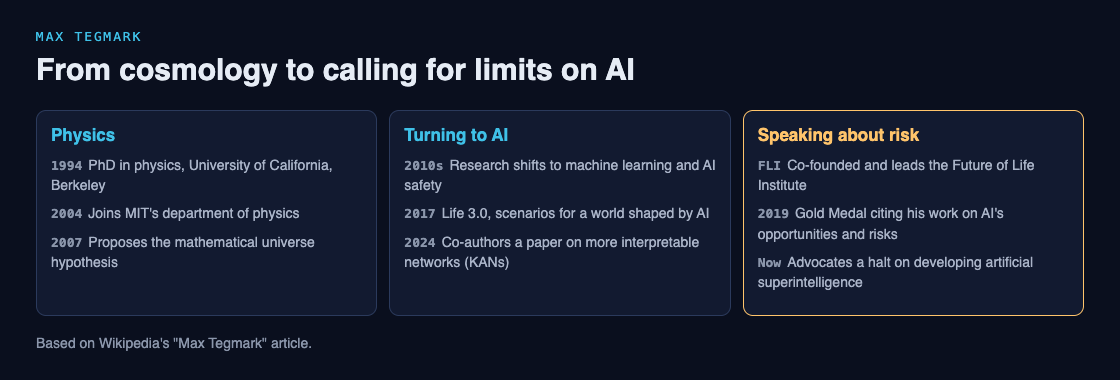
Tegmark's path, as Wikipedia's article on him sets it out.
In the 2010s, after around 25 years on cosmology and quantum information, his research turned to machine learning and AI safety. At MIT he has worked on two directions: using AI in physics, and improving AI using ideas from physics.
One example: in 2024 he co-authored a paper introducing Kolmogorov-Arnold Networks, or KANs. The article says they differ fundamentally from the neural networks usually used in machine learning, and are designed to be more interpretable, meaning easier for people to look inside and understand.
His 2017 book Life 3.0: Being Human in the Age of Artificial Intelligence presents scenarios for what the world might look like as AI keeps developing. Our post Life 3.0 by Max Tegmark: the main ideas walks through the book.
The Future of Life Institute
Tegmark is president of the Future of Life Institute, which he co-founded with Anthony Aguirre, a professor at the University of California, Santa Cruz, who is now its Executive Director. Its stated mission is to "steer transformative technologies away from extreme, large-scale risks and towards benefiting life". Its research focuses on large-scale risks to humanity, especially those tied to advanced AI. Our post on the Future of Life Institute covers its history and work.
The 2023 grant controversy
In 2023, Tegmark was at the center of a controversy. He was alleged to have signed a letter of intent, for the institute, for a $100,000 grant to a far-right media outlet that his brother wrote for. The grant was ultimately rejected. Tegmark said the institute "ultimately decided to reject it because of what our subsequent due diligence uncovered", long before the media became involved, and that it "would never knowingly support" Nazi or pro-Nazi groups. The institute also responded formally. This post reports both the allegation and the response, and takes no side.
What Max Tegmark argues about superintelligence
The article sums up his current position in one line: Tegmark advocates for a halt on the development of artificial superintelligence. He has spoken about AI and its risks in public for years.
- In 2014, he co-wrote an opinion piece with Stephen Hawking, Frank Wilczek and Stuart Russell, about the film Transcendence.
- In 2017, he gave a talk titled "Effective altruism, existential risk & existential hope".
- In 2025, he discussed on television how advanced AI could affect the economy, and the threat of AI superintelligence.
- In 2026, he was featured in news coverage of a petition, signed by prominent public figures, calling for a halt to superintelligence development.
For another call for limits on superintelligence, see our post Statement on Superintelligence: what it calls for. People who disagree with a halt make their case in our post on calls to pause AI.
A worked example: weigh a call to halt a technology
A call to halt something can sound simple. It is easier to judge if you break it into questions. Try these five on Tegmark's call, or on any other.
- What exactly stops? Write one sentence naming what would no longer be built. "Superintelligence" needs a definition someone could check.
- Who has to agree? List who would need to stop for the halt to mean anything.
- How would anyone know? Note what would show that a builder was keeping to it.
- What ends the halt? Write the condition under which work could start again.
- What does it cost? Note what useful work might slow down too, and who would pay for that.
Now read a supporter and a critic of the halt. See which of your five answers each of them disagrees on. Often they agree on more than it first seems, and split on just one or two.
Exploring the idea in Contain ASI
Contain ASI is a story strategy game for 1 to 4 players that runs in your browser and needs WebGL 2. Chapter 1, Before ASI, starts in January 2024 with four fictional AI labs in one race. As a researcher, research manager, CEO or government, you try for three years to keep every lab from crossing into recursive self-improvement before 2027.
It is a game, not a forecast: the page says all its labs, people and events are fictional, and it does not mention Tegmark. But the questions in the exercise above, who must agree and how anyone would know, are the same ones you face when you try to hold back a race from the inside.
Frequently asked questions
Who is Max Tegmark?
He is a Swedish-American physicist, machine learning researcher and author, a professor of physics at MIT, and the co-founder and president of the Future of Life Institute.
What is Max Tegmark's view on superintelligence?
He advocates a halt on the development of artificial superintelligence, and has spoken about its risks in talks, opinion pieces and interviews.
What books has Max Tegmark written?
Our Mathematical Universe (2014), on his idea that the universe is a mathematical structure, and Life 3.0 (2017), on scenarios for a world shaped by AI.
What are KANs?
Kolmogorov-Arnold Networks, introduced in a 2024 paper Tegmark co-authored. They differ fundamentally from usual neural networks and are designed to be more interpretable.
Get started
Want to see how hard a halt is to hold when four labs are racing? Open Contain ASI in your browser and start a campaign as a researcher, research manager, CEO or government.
Comments
No comments yet.
Sign in or make an account to comment.