Mendel's pea plant experiments, explained
Mendel's pea plant experiments are usually taught as a neat rule about dominant and recessive traits. The paper itself is more interesting: a careful plan, thousands of counted seeds, and a short piece of letter notation that still sits under every genetics lesson. This guide goes through what Gregor Mendel did, using the numbers from his own paper, and ends with a question historians still argue about: was he looking for laws of heredity at all?
Who Mendel was, and where the paper comes from
Gregor Mendel lived from 1822 to 1884. His paper, "Experiments in Plant Hybridization", was read at two meetings in February and March 1865 and was published in 1866. You can read it in English on MendelWeb's annotated translation, which is the source for every number in this post. In his introduction he says the experiment was "concluded in all essentials" after "eight years' pursuit".
For the history around the paper, this post uses the Stanford Encyclopedia of Philosophy's entry on the gene, which places Mendel among the plant breeders of his time, called hybridists, who crossed varieties and studied the offspring.
Why Mendel chose the garden pea
Mendel says the choice of plant decides whether the results can be trusted. He wanted plants with three things:
- Clear, constant differences that are easy to see and do not drift from year to year.
- Protection from stray pollen. In peas the pollen sacs burst inside the closed bud, so a flower normally fertilizes itself before it opens.
- Fertile hybrids, so that each new generation could be grown and counted.
Peas were also easy to grow in beds and pots and had a short growing time. To cross two plants, he opened a bud early, removed every pollen-bearing stamen with forceps, and dusted the flower with pollen from the other plant. Before any of this, he tested 34 varieties from seed sellers over two years to be sure they bred true.
The seven pairs of traits he tracked
Mendel chose seven characters, each with two clear forms:
- Seed shape: round or wrinkled.
- Seed colour inside the coat: yellow or green.
- Seed-coat colour: white (with white flowers) or grey-brown (with violet flowers).
- Ripe pod shape: inflated or constricted between the seeds.
- Unripe pod colour: green or yellow.
- Flower position: along the stem or bunched at the top.
- Stem length: long (6 to 7 feet) or short (under 2 feet).
The Stanford entry points out why this mattered. By using varieties that differed in only one or a few characters, Mendel could stop sorting whole plants into types and start counting single traits.
Mendel's pea plant experiments: crossing and counting
When he crossed two pure lines, the hybrids all showed one form of the pair. Mendel named that form dominant and the hidden one recessive. He chose "recessive", he says, because these characters withdraw or disappear in the hybrids "but nevertheless reappear unchanged in their progeny".
When the hybrids fertilized themselves, the recessive form came back in about one plant in four, for every one of the seven characters. His counts:
- Seed shape: 5,474 round, 1,850 wrinkled (2.96 to 1).
- Seed colour: 6,022 yellow, 2,001 green (3.01 to 1).
- Seed-coat and flower colour: 705 grey-brown with violet-red flowers, 224 white (3.15 to 1).
- Pod shape: 882 inflated, 299 constricted (2.95 to 1).
- Pod colour: 428 green, 152 yellow (2.82 to 1).
- Flower position: 651 along the stem, 207 at the top (3.14 to 1).
- Stem length: 787 long, 277 short (2.84 to 1).
He also notes that "Transitional forms were not observed in any experiment." No in-between seeds, no blended colours.
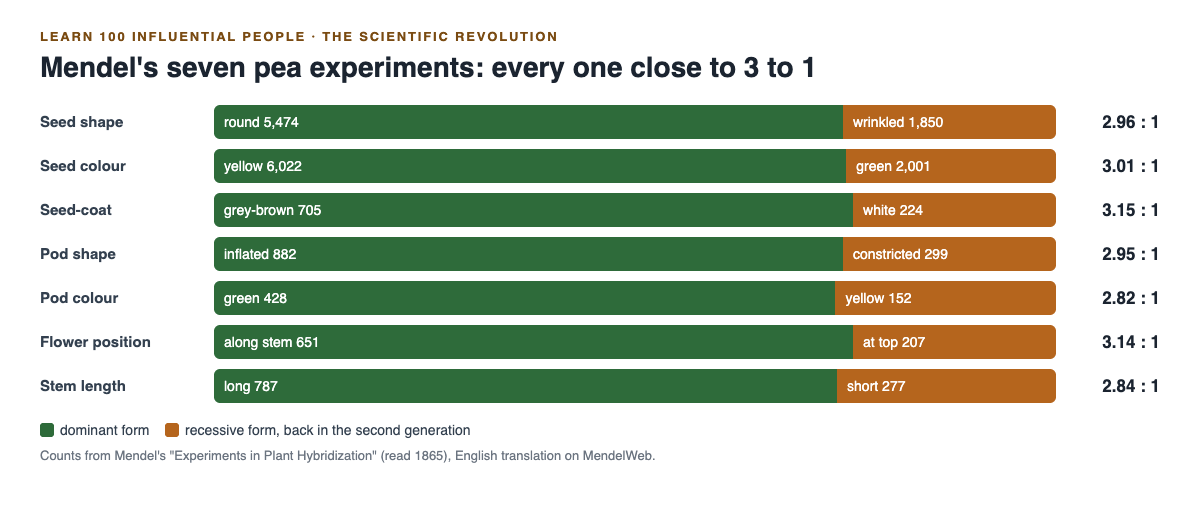
All seven characters came out close to 3 to 1. Numbers from Mendel's paper.
A worked example: why 3 to 1 is really 1 to 2 to 1
Mendel did not stop at the 3 to 1. Follow his next step with the seed colour numbers and a pencil.
- Grow the yellow ones again. He took 519 plants grown from yellow seeds of the second generation and let each fertilize itself.
- Sort them. 166 gave only yellow seeds: they were pure, or "constant". 353 gave both yellow and green, again in about 3 to 1: they were hybrids.
- Divide. 353 divided by 166 is about 2.13. So among the yellow plants, hybrids outnumber pure ones about 2 to 1.
- Put it together. Out of every four plants: one pure yellow, two hybrids that look yellow, and one pure green. That is the 3 to 1 you see, hiding a 1 to 2 to 1 underneath.
Mendel wrote this with letters: A for the dominant form, a for the recessive, Aa for the hybrid, and "A + 2Aa + a" for the offspring of a hybrid. To explain it, he proposed that a hybrid makes as many kinds of egg and pollen cells as there are constant forms, in equal numbers on average. Pair one A or a from each side at random, and you get A + 2Aa + a.
He then crossed plants that differed in two characters at once, round yellow with wrinkled green, and counted 315 round yellow, 101 wrinkled yellow, 108 round green and 32 wrinkled green seeds. The two characters were inherited separately, which the Stanford entry lists as his third regularity.
Was Mendel looking for laws of heredity?
This is where historians disagree with the textbook story, and it is worth knowing both sides.
The textbook reading. In 1900, according to the Stanford entry, several botanists reached similar results on their own, found Mendel's paper and stated its importance. The early "Mendelians" who followed took up his notation and codified his regularities as "laws" of heredity, and William Bateson named the new field genetics. On this reading, Mendel discovered the laws and the world caught up.
The historians' reading. The same entry says Mendel did not aim at a unifying theory, "nor did he set out to discover laws governing heredity". Historians have argued he was asking a narrower question about the role of hybrids in evolution, like the hybridists before him. The entry says he "did not think of the regularities as laws of heredity", and he treated whether they held for plants other than the pea as an open question. His paper's section on other species says it "must be the object of further experiments to ascertain whether the law of development discovered for Pisum applies also" to other hybrids.
Both readings agree on what he did. They differ on what he thought he was doing, which is a good example of how a source can be read in more than one way.
Frequently asked questions
Why did Mendel use pea plants?
Peas had clear, constant differences, fertile hybrids, and flowers that normally fertilize themselves inside the bud, which kept out stray pollen. They were also easy to grow and quick to mature.
What ratio did Mendel find?
About 3 dominant to 1 recessive in the second generation, for all seven characters, from 2.82 to 1 up to 3.15 to 1. Testing those plants further showed the pattern was 1 pure dominant, 2 hybrids and 1 pure recessive.
Did Mendel invent the words dominant and recessive?
Yes, he introduces both terms in his paper. He chose "recessive" because those characters disappear in the hybrids and reappear unchanged in the next generation.
How long did Mendel's experiments take?
His paper says the work was concluded "after eight years' pursuit", and it was read at meetings in February and March 1865.
Get started
Mendel shares a lesson with Darwin in The Scientific Revolution, a Basic course on Learn 100 Influential People, alongside Copernicus, Galileo, Kepler and Newton. Lessons take about 9 minutes with a hands-on activity, and the question types include estimating a number. Every lesson lists its sources, as the about page says, "so you can read the original work", and 38 cards set out where researchers disagree. You sign in with your email and an emailed sign-in code. For another figure from the same course, see why Isaac Newton was so important.
Comments
No comments yet.
Sign in or make an account to comment.