Mendeleev's periodic table: how it was built and why it worked
Mendeleev's periodic table is the chart on every chemistry classroom wall, and it started as a teacher's answer to a teaching problem. In 1869 Dmitri Mendeleev put the known elements in order, noticed that their behavior repeated, and then did the bold part: he left blanks and said what the missing elements would be like. This post sets out how he built it, why the blanks mattered, where the table went wrong and how it was fixed. The facts come from Wikipedia's articles on Mendeleev, the history of the periodic table and gallium, among others, which are secondary sources, so the sources are named as we go.
Mendeleev's periodic table began as a teaching tool
Dmitri Ivanovich Mendeleev was born in 1834 in a village near Tobolsk, in Siberia. He became a professor at the Saint Petersburg Technological Institute in 1864 and at Saint Petersburg University in 1865, and in 1867 he began teaching inorganic chemistry there.
Teaching led him to write. His textbook Principles of Chemistry came out in two volumes between 1868 and 1870, and Wikipedia says it was while he tried to classify the elements for it that he made his most important discovery. He needed an order for the elements that made sense to a student. That practical need drove the work.
What chemists had before him
Mendeleev was not the first to see a pattern. In 1863 there were 56 known elements, and other chemists had already noticed that their properties repeat. John Newlands described a "law of octaves" in 1864, comparing the repeating pattern to notes in a musical scale. His table left no gaps for elements not yet found, and the Chemical Society refused to publish his work. Lothar Meyer published a paper in 1864 that sorted 28 elements by valence, which is how many bonds an atom forms, but it made no predictions of new elements.
What was missing was a table that covered the known elements and also said what it did not yet contain. Wikipedia notes that Mendeleev himself was unaware of the earlier tables when he made his first one.
How Mendeleev built the table in 1869
Mendeleev later said the arrangement came to him in a dream: "I saw in a dream a table where all elements fell into place as required. Awakening, I immediately wrote it down on a piece of paper, only in one place did a correction later seem necessary." Treat that as his own account, as Wikipedia quotes it, and not as a method you can copy.
The method is easier to see in his first trial. Wikipedia shows three rows of elements with their atomic weights, the number chemists then used to say how heavy an atom is:
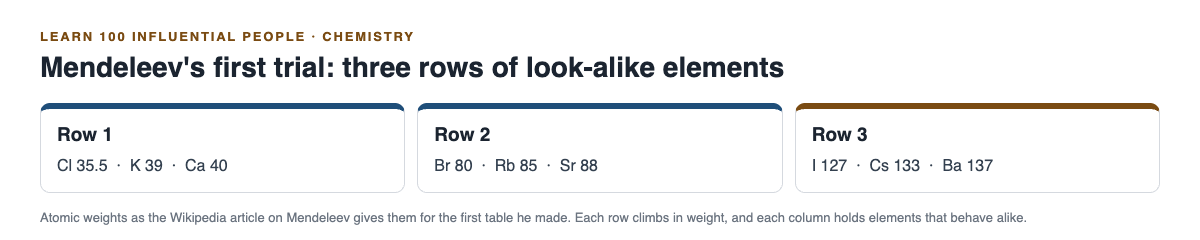
The three rows of Mendeleev's first trial, with the weights Wikipedia gives.
Try it yourself with the nine numbers. Read down the first column: chlorine at 35.5, bromine at 80 and iodine at 127 are three elements that behave alike, and their weights climb. The middle column, potassium at 39, rubidium at 85 and caesium at 133, does the same, and so does the third. Each row then climbs in weight from left to right. Weight and behavior line up in both directions. That is the idea in a small space.
On 6 March 1869 he presented his table to the Russian Chemical Society in a talk titled "The Dependence between the Properties of the Atomic Weights of the Elements". Among his points were that elements ordered by atomic weight show an apparent periodicity of properties, and that "We must expect the discovery of many yet unknown elements". Only a few months later, Meyer published a virtually identical table in a German journal.
Why the table worked: it left gaps and made predictions
Two habits set Mendeleev's table apart from the others.
- He kept the gaps. When the next known element did not fit the pattern, he did not force it. He left a blank and said an element belonged there. He named the missing ones with the Sanskrit prefixes eka, dvi and tri, meaning one, two and three.
- He doubted the numbers. When a weight put an element in the wrong place, he suggested the measurement was off. He doubled the weight and valence that chemists then gave for uranium, to 240 and 6, because the old values did not fit his table. The weight he reached is close to the modern value of 238.
Both habits made the table risky, because it could be shown wrong. A filing system never fails a test. A table that says "an element with these properties exists" can.
Gallium, scandium and germanium: predictions that came true
Three of his predictions were confirmed in his lifetime.
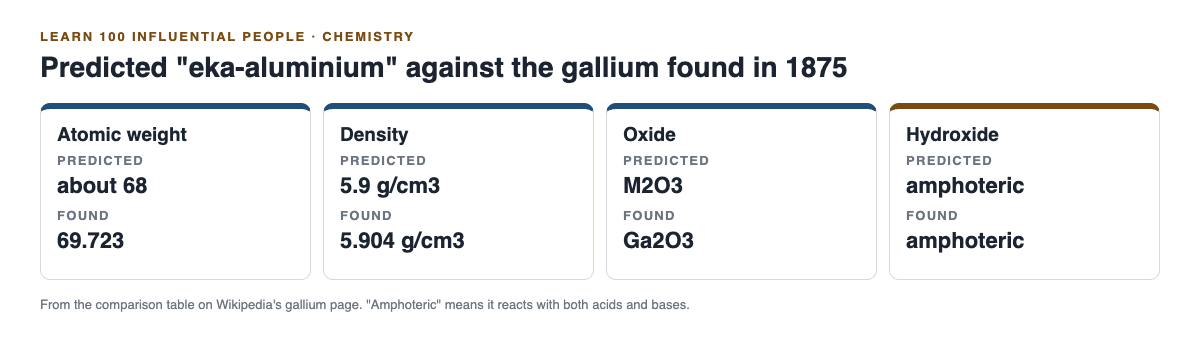
Predicted properties of eka-aluminium next to the gallium found in 1875.
- Gallium (eka-aluminium). In 1871 Mendeleev predicted an atomic weight of about 68 and a density of 5.9 g/cm3. Paul-Émile Lecoq de Boisbaudran found gallium in 1875 by its spectrum, and the true values are 69.723 and 5.904. At first Lecoq measured a density of 4.7, the one property that did not match. Mendeleev wrote to him and suggested he measure again, and the new value was 5.9.
- Scandium (ekaboron). In 1869 Mendeleev predicted an atomic mass between 40 and 48. Lars Fredrik Nilson found scandium in 1879 in the minerals euxenite and gadolinite. He was apparently unaware of the prediction, and Per Teodor Cleve noticed the match and told Mendeleev.
- Germanium (ekasilicon). Mendeleev estimated an atomic weight of 70, later 72, and a density of 5.5. Clemens Winkler found germanium on 6 February 1886 in a mineral called argyrodite from a mine near Freiberg. He measured an atomic weight of 72.32 and a density of 5.35.
Wikipedia's germanium article calls Winkler's data an important confirmation of the idea of periodicity. The three confirmations came within about 17 years of the 1869 talk, and each was a number written down before anyone could check it.
Where the table went wrong
Two problems stand out.
- Tellurium and iodine. Tellurium has a higher atomic weight than iodine, but Mendeleev placed it first, because its chemistry belongs there. He said the accepted weight must be wrong, with tellurium between 123 and 126. Wikipedia says he was incorrect: tellurium's weight is 127.6, so the measurement was not the problem, and atomic weight was not the quantity that sets the order.
- The noble gases. Ramsay and Rayleigh isolated argon in 1894. It did not react with anything and did not fit the periodic law, which Wikipedia says challenged the notion itself. Mendeleev's first response was that argon was a form of nitrogen, not an element of its own. By 1904 his table had a place for the noble gases, in group 0.
How Moseley fixed the order
The fix came from physics. In 1913 Henry Moseley measured the X-rays that different elements give off and found a relationship between their wavelength and the element's atomic number. With it he could place argon before potassium, cobalt before nickel and tellurium before iodine, exactly where the chemistry said they belonged. Wikipedia sums it up as showing that atomic numbers were not arbitrary tags but had a physical basis.
So Mendeleev found the pattern, and Moseley found what the order was really counting. If you want another case of a pattern found by careful counting, see Mendel's pea plant experiments.
The prize he did not get
In 1906 the Nobel Committee for Chemistry recommended Mendeleev for the prize, according to Wikipedia. The Nobel Prize site shows the 1906 prize went to Henri Moissan, for isolating fluorine and for his electric furnace. Wikipedia says a committee member put Moissan forward at the Academy's full meeting, that Svante Arrhenius argued the periodic system was too old to honor in 1906, and that the Academy chose Moissan by one vote. It adds that contemporaries thought Arrhenius was acting on a grudge. Mendeleev died in 1907. The element mendelevium, number 101, is named for him.
The post on primary and secondary sources shows why a claim like the grudge deserves care: it comes from "contemporaries", not from a document you can read.
Frequently asked questions
When did Mendeleev publish the periodic table?
He presented it to the Russian Chemical Society on 6 March 1869 and published a table of all the known elements, with predicted new ones, in a Russian journal. He kept revising it for years.
Did Mendeleev invent the periodic table alone?
No. Newlands and Lothar Meyer had published tables in the 1860s, and Meyer printed a near-identical one a few months after Mendeleev. Mendeleev's stood out for the gaps and the predictions.
Which elements did Mendeleev predict?
The best known are gallium (eka-aluminium), scandium (ekaboron) and germanium (ekasilicon), found in 1875, 1879 and 1886.
What did Moseley change?
In 1913 he showed that X-ray wavelengths follow atomic number, so elements are ordered by atomic number and not by weight. That fixed pairs such as tellurium and iodine.
Get started
Learn 100 Influential People is a web app of short lessons on the people who shaped history, and its home page lists a lesson on Lavoisier and Mendeleev in a Chemistry and Medicine course. The lessons take about 9 minutes, and every lesson lists its sources. You sign in with your email and an emailed sign-in code.
Start Learn 100 Influential People: short hands-on lessons on the people who shaped history, with every side of the debate and the sources to read next.
Comments
No comments yet.
Sign in or make an account to comment.