Middleham Castle history: the Nevilles and Richard III
Middleham Castle history is the story of a Yorkshire fortress that grew from a timber ringwork into a palace for one of England's most powerful families. English Heritage calls it one of the childhood homes of Richard III. Before him it was the base of the Nevilles, and of Richard Neville, Earl of Warwick, called "the Kingmaker". This post follows the castle from about 1086 to its decay, using English Heritage's history page.
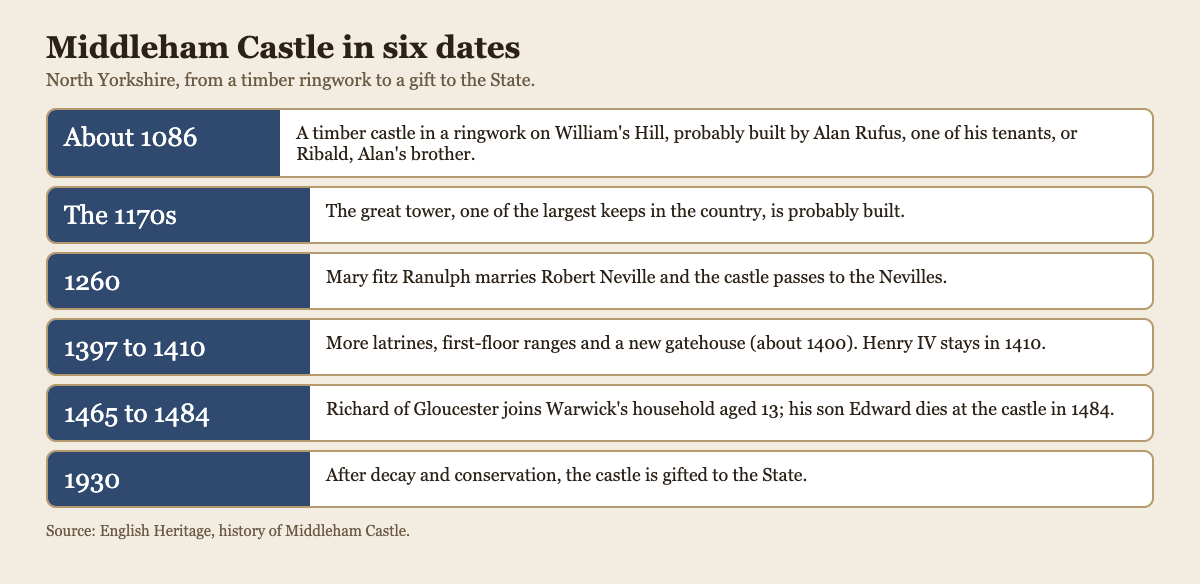
Middleham in six dates, from English Heritage's history page.
Middleham Castle history begins on William's Hill
There is only slender evidence for anyone living at Middleham before the Norman Conquest of 1066. Domesday Book of 1086 says a man called Gilpatrick held land at "Medelai" in the time of Edward the Confessor. After the Conquest, William I gave the lands to Alan Rufus, "the Red", his second cousin and one of his chief supporters.
The first castle was probably built in about 1086, either by Alan, one of his tenants, or by his brother Ribald. It stood on William's Hill, south of the present castle. It was timber buildings inside a ringwork, which is a circular earthwork, with timber defences and a deep ditch. The ditch is still there and part of it holds water. A bailey, or enclosure, lay beyond it on the south side. English Heritage adds that no written record of a castle at Middleham exists until 1216.
The great tower of the 1170s
The stone castle was begun in the late twelfth century. Its great tower, or keep, was probably built in the 1170s. The clue is in the chapel in the north-east corner of the keep, where the carved stone capitals have "waterleaf" decoration, a style used elsewhere in Yorkshire in the second half of that century. In the first half of the thirteenth century a tower was added on the east side, with a chapel on its top floor.
This keep is one of the largest in the country. If you want to see what a great tower was for, read what a castle keep was for. For a different shape, Conisbrough's round tower is the usual comparison.
How the Nevilles came to Middleham and made it a home
In 1258 Mary fitz Ranulph, known as the "Lady of Middleham", inherited the castle. In 1260 she married Robert Neville, and the castle passed to the Neville family. They rose to become one of the most powerful families in England and held Middleham until the late fifteenth century.
Their son Ranulph, the 3rd Baron Neville, probably built the curtain wall that surrounds the keep, in the early fourteenth century. After that little else seems to have happened. John, the 5th Baron, put his effort into Raby Castle and a new castle at Sheriff Hutton instead.
Ralph, the 1st Earl of Westmorland, inherited Middleham in 1388 and gave the town a weekly market and an annual fair. Work on the castle probably began in 1397, and it was about comfort. English Heritage points to the number of extra latrines. The curtain wall was raised to make first-floor ranges on at least three sides, the towers were heightened, and the north-east tower became the main gatehouse, in about 1400.
In 1410 Henry IV stayed at Middleham while on a journey through the north. English Heritage reads that as a sign the building work was largely done. It is not known for certain who carried it out; the mason John Lewyn may have had some part, because some windows and turrets look like his work at Bolton Castle.
Warwick the Kingmaker and the Wars of the Roses
The Nevilles were at their most prominent in the middle of the fifteenth century under Richard, Earl of Warwick. In the Wars of the Roses (1455 to 1485) he helped Edward, Earl of March, take the throne from the Lancastrian Henry VI in 1461. That earned him the name "the Kingmaker".
Edward IV stayed with Warwick at Middleham for a few days in 1461. In 1464 several defeated Lancastrians were executed at the castle. By 1469 Warwick had risen in rebellion against Edward, who was captured and briefly held at Middleham in August of that year. Edward fled to France and came back in 1471 to put down the rebellion. At the Battle of Barnet that year Warwick was killed.
Richard of Gloucester grows up at Middleham
When Edward IV became king in 1461, his younger brother Richard was made Duke of Gloucester. In 1465, at 13, Richard entered Warwick's household at Middleham and stayed until towards the end of 1468. After Warwick's death he took over the Neville lands in the north, including Middleham. He married Anne Neville, Warwick's younger daughter, and became president of the Council of the North.
Their son Edward was born at Middleham in about 1474. Richard became Protector of the Realm when Edward IV died in 1483, and was crowned Richard III later that year, taking the throne from his 12-year-old nephew Edward V. He kept spending time at Middleham, and stayed there for several days in 1484 after his own son died at the castle. English Heritage says it is not known whether Richard did any building there. The Nevilles had already turned it into a palatial home, so he may have seen no need.
Richard lost to Henry Tudor at Bosworth in 1485, and Middleham became Crown property.
Tudor neglect, the Civil War and rescue
Some money went on the castle in 1531, when the gatehouse got a new key and lock. By 1538 a Crown survey found the battlements, roofs and chimneys in poor condition, the gatehouse with no portcullis, ivy over the chapel and the south curtain wall, and the brewhouse decayed. Even so, the antiquary John Leland, passing through about 1540, called it "the fairest castel of Richemontshire next Bolton".
James I sold the castle to Sir Henry Lindley in 1604. In 1647, during the Civil War, Parliament ordered it destroyed so the Royalists could not take it. English Heritage says there is no record that the order was carried out. In 1655 Colonel Robert Lilburne held the castle with 30 men against a Royalist threat, and Royalist prisoners were kept there. To see how Parliament usually dealt with castles, read slighting a castle.
By 1774 the castle was in considerable decay, with much of its stone taken for building in the town. The lower few feet of stone of the keep's latrine towers had been taken, leaving them hanging in the air. In 1889 the Wood family sold it to Samuel Cunliffe Lister, later Baron Masham, and in 1897 the 2nd Lord Masham began to conserve it. Datestones of 1906 marked with the letter "M" can still be seen in the latrine towers. In 1926 the family placed it in the guardianship of the Office of Works, and it was gifted to the State in 1930.
A worked example: three changes to one castle
You can read Middleham's story as three jobs the owners gave it.
- About 1086: hold the ground. A ringwork with a ditch and a bailey, built in timber.
- The 1170s and about 1300: show strength. A very large stone keep, then a curtain wall around it.
- About 1397 to 1410: live well. More latrines, first-floor ranges, higher towers and a new gatehouse.
Compare Rochester, where the same kind of keep faced three sieges. Middleham's page tells no siege of its own, so its story is a story of owners rather than attacks.
Frequently asked questions
Where is Middleham Castle?
It stands over the town of Middleham in North Yorkshire. English Heritage looks after it.
What is the link between Middleham Castle and Richard III?
Richard entered Warwick's household at Middleham in 1465, aged 13, and stayed until late 1468. He later held the castle, his son Edward was born there in about 1474, and Edward died there in 1484.
When was the keep built?
English Heritage says it was probably built in the 1170s, dated by the carving in its chapel. It is one of the largest keeps in the country.
Why was Richard Neville called the Kingmaker?
He was instrumental in Edward taking the throne from Henry VI in 1461. He later rebelled against Edward and was killed at the Battle of Barnet in 1471.
Get started
Middleham's gatehouse was made from a corner tower in about 1400. In Two Towers, a medieval tower defense game, the gate is what you protect: the game's own text says "Repair mends it, Reinforce raises its full strength". You pick the two towers that guard it from four kinds, spend the gold you win on upgrades, and buy two more for the hills. There is no final stage.
Play Two Towers: it is free and plays in your browser on a computer or a phone.
Comments
No comments yet.
Sign in or make an account to comment.