Mind uploading: what it is and how it ties to AI risk
Mind uploading is the idea of copying a person's mind into a computer. A brain would be scanned in full detail, and a computer would then run that brain's information processing so that it responds the way the original brain would. This post explains what mind uploading means, the main ways it might be done, the open questions about identity and consciousness, the ethical worries, and how it ties into debates about AI risk. Its only source is Wikipedia's Mind uploading article.
What is mind uploading?
The article calls mind uploading a hypothetical process of whole brain emulation. A brain scan would be used to completely emulate a person's mental state in a digital computer. The goal is a simulation that would respond in essentially the same way as the original brain and have a sentient, conscious mind.
It is not real yet. The article says that as of June 2026 this kind of technology is almost entirely theoretical.
Why do people want it? Among some futurists and part of the transhumanist movement, it is treated as a way to extend life, sometimes called "digital immortality".
How mind uploading would work
The article names two broad methods.
Copy-and-upload
You scan and map the important features of a biological brain, then store and copy that information into a computer. The biological brain may not survive the copying, or may be destroyed on purpose.
Gradual replacement
Here neurons are replaced step by step until the original brain no longer exists and a program emulating it controls the body. The article notes this can be seen as gradual destructive uploading.
Getting the data
The proposed techniques include serial sectioning, where frozen brain tissue is scanned layer by layer, and brain imaging with tools such as fMRI and MEG. Each has limits. Current imaging lacks the resolution needed, and structure alone may not capture what neurons do, because part of their function depends on molecular events.
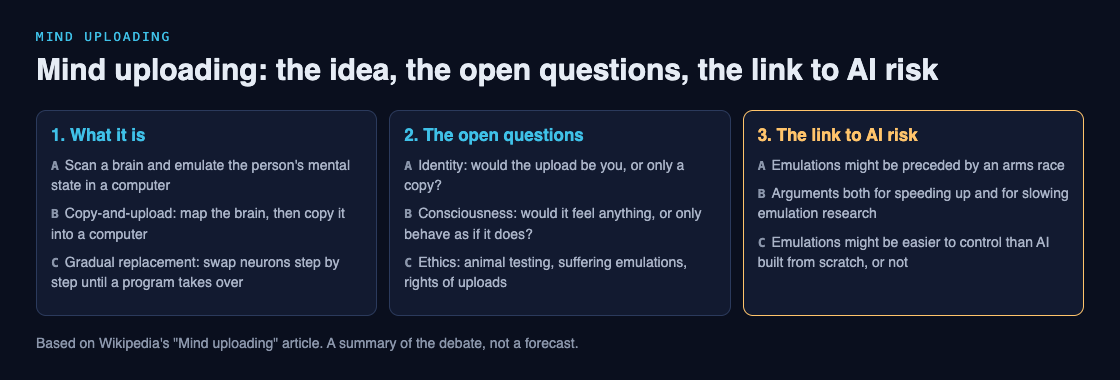
Mind uploading in three parts, as Wikipedia's article sets them out.
Would an upload be you? The philosophical questions
The article sets out two hard questions. It reaches no verdict on either, and neither does this post.
Identity: copy or continuation?
The question is old. In 1775, Thomas Reid asked whether a being rebuilt from his brain's materials would be him, and whether two or three such beings would all be him.
The philosopher and transhumanist Susan Schneider claims that, at best, uploading would create a copy of the original mind. She agrees consciousness has a computational basis, but not that a person survives uploading.
Others disagree. The Buddhist transhumanist James Hughes points out that if the self is an illusion, worries about survival are not reasons to avoid uploading. Keith Wiley argues that every mind an upload produces has an equal claim to the original identity. Michael Cerullo's "psychological branching identity" holds that a person would survive, with each copy an authentic continuation of the original.
Consciousness: would it feel anything?
The main problem the article names is the hard problem of consciousness: explaining how a physical thing can have subjective experience. Many proponents rely on the view that consciousness emerges from patterns of organization that other devices could carry.
An upload might also be a philosophical zombie: something that behaves as if it is conscious with no experience inside. Some scientists believe consciousness comes from substrate-neutral computation. Others, including Roger Penrose, believe it may depend on quantum computation in an organic substrate. Given this doubt, Sandberg proposes a cautious rule: assume an emulated system could have the same mental properties as the original, and treat it that way.
Ethical concerns about emulations
- Animal welfare. Building emulations would need animal experiments, first on invertebrates and then on small mammals, and some could cause pain.
- Suffering emulations. Depending on your view of consciousness, emulated animals or people might suffer, including by accident.
- Rights. Would uploads have the rights of humans? Would a copy inherit its maker's property? Could it have marriage and child-care rights?
The article adds that if uploads are not conscious at all, there may be a significant opportunity cost. In Superintelligence, Nick Bostrom expresses concern about this risk. Our post on Bostrom's book Superintelligence covers its main ideas.
Emulation timelines and AI risk
This is where mind uploading meets AI safety. The article says emulations might be preceded by a technological arms race driven by first-strike advantages. Our post on the AI race explains why races worry researchers.
Timing is disputed. Kenneth D. Miller, a professor of neuroscience at Columbia University, does not reject the idea in principle. But he believes a full copy of a mind will be out of reach for several hundred years, because the brain works through electrical and biochemical signals between neurons, not only through its connections. The article adds that people may have emulations only briefly, on the way to human-level AI not based on emulation. So should emulation research go faster or slower?
Arguments for speeding it up
If neuroscience is the bottleneck, limited computing power would make the first emulations slow and easier to adapt to. And a group that led in emulation would have more subjective time to win a race to build the first superhuman AI, so it would be less rushed and freer to consider AI risks.
Arguments for slowing it down
More emulation research might help AI researchers build brain-inspired algorithms, which could speed up risks from uncontrolled AI. Participants at a 2011 AI workshop put an 85% probability on brain-inspired AI arriving before brain emulation. By a very narrow margin, they leaned toward the view that speeding up emulation would raise expected AI risk.
Easier to control, or not?
Emulations might be easier to control than AI built from scratch. Human behavior is better understood, emulations could inherit human motives, and they could not quickly grow beyond the size of a human brain. Bostrom notes downsides: an emulation improving itself might be much harder to foresee than safe AI built from scratch, it might inherit darker motives, and a later move to AI built from scratch would mean two intelligence explosions and more total risk. The computer scientist Stuart J. Russell, in Human Compatible, rejects creating a superintelligence from brain emulation, calling it "so obviously a bad idea".
Futurists also say a large society of uploads might lead to a technological singularity: technology that develops beyond human control.
A worked example: sort the emulation-first argument
You can test the debate yourself. Take the claim "we should build emulations before other advanced AI" and run it through four steps.
- State the hope. Emulations think like people, so we know how to check them.
- Add the speed fact. An emulation could run faster than a brain, so one hour for you might be far longer for it. Ask: does better understanding still help if it thinks that fast?
- Add the race. A group ahead in emulation gets more subjective time. Ask: does that time go to safety work, or to winning?
- Add the second step. Bostrom notes that AI built from scratch would still come later. Count the risky transitions: one, or two?
Answers that lean toward "control helps and time goes to safety" rebuild the case for speeding up. Answers the other way rebuild the case for slowing down. The article lists both and settles neither.
Where Contain ASI fits
Contain ASI is a story strategy game for 1 to 4 players that runs in the browser and needs WebGL 2. Chapter 1, Before ASI, starts in January 2024 with four fictional AI labs in one race. As a researcher, research manager, CEO or government, you try for three years to keep every lab from crossing into recursive self-improvement before 2027.
The page says it is inspired by the AI 2027 scenario and that all its labs, people and events are fictional. It does not mention mind uploading. It is a game, not a forecast, but it puts you inside the kind of race the emulation debate worries about.
Frequently asked questions
What is mind uploading in simple terms?
It is the hypothetical copying of a person's mind into a computer by scanning the brain and running a simulation of it. The article says the technology is almost entirely theoretical.
Is mind uploading the same as whole brain emulation?
The article describes mind uploading as a hypothetical process of whole brain emulation.
Would an uploaded mind be conscious?
No one knows. Some scientists believe consciousness comes from substrate-neutral computation, others that it may need an organic substrate, and the article notes the subjectivity of consciousness rules out a definitive answer.
How does mind uploading relate to AI risk?
Emulations could be a path to superintelligence and might come with an arms race. Researchers disagree on whether emulation research should be sped up or slowed to reduce AI risk.
Get started
Curious how a race toward self-improving AI feels from the inside? Open Contain ASI in your browser and start a campaign as a researcher, research manager, CEO or government.
Comments
No comments yet.
Sign in or make an account to comment.