Moravec's paradox: why easy tasks are hard for AI
Moravec's paradox is the observation that the things people find hard are often easy for computers, and the things people find easy are often very hard for them. A program can play checkers or pass an intelligence test, yet a robot cannot match the perception and movement of a one-year-old. This post explains what Moravec's paradox says, why people think it happens, how one robotics researcher answered it, and where it is doubted.
Every claim below comes from Wikipedia's articles on the paradox, on Hans Moravec and on Nouvelle AI, opened for this post.
What Moravec's paradox says
The name comes from the robotics researcher Hans Moravec. In 1988 he wrote that "it is comparatively easy to make computers exhibit adult level performance on intelligence tests or playing checkers, and difficult or impossible to give them the skills of a one-year-old when it comes to perception and mobility".
Wikipedia says the observation was put into words in the 1980s by Moravec, Rodney Brooks, Marvin Minsky and others. The psychologist Steven Pinker later gave it a famous summary. In 1994 he wrote that "the main lesson of thirty-five years of AI research is that the hard problems are easy and the easy problems are hard".
Where the idea comes from
According to Wikipedia, Moravec earned his PhD at Stanford in 1980 for the Stanford Cart, a robot with a television camera that could find its way through cluttered obstacle courses. He then joined Carnegie Mellon's Robotics Institute. So he met the problem in the lab: getting a machine to see and move in a real room.
Marvin Minsky added a point about awareness: the hardest human skills to reverse engineer sit below conscious awareness. In his words, "we're least aware of what our minds do best", and "we're more aware of simple processes that don't work well than of complex ones that work flawlessly". You can describe how you solve a logic puzzle. You cannot describe how you recognize your friend's voice. For more on Minsky, see Marvin Minsky: who he was and what he said about AI.
The evolution argument behind Moravec's paradox
Moravec offered an explanation based on evolution. Every human skill runs on machinery shaped by natural selection, and natural selection tends to keep design improvements. So the older a skill is, the more time its design has had to be tuned.
Abstract thought is new. Moravec wrote that it is "perhaps less than 100 thousand years old". He described reasoning as "the thinnest veneer of human thought", effective only because it rests on a far older and more powerful layer of unconscious sensory and motor knowledge. He added that abstract thought is "not all that intrinsically difficult; it just seems so when we do it."
Wikipedia sets the argument out in three steps:
- The difficulty of reverse-engineering a human skill should be roughly proportional to how long that skill has been evolving in animals.
- The oldest skills are largely unconscious, so they look effortless to us.
- So skills that look effortless should be hard to reverse-engineer, while skills that take effort may not be hard to engineer at all.
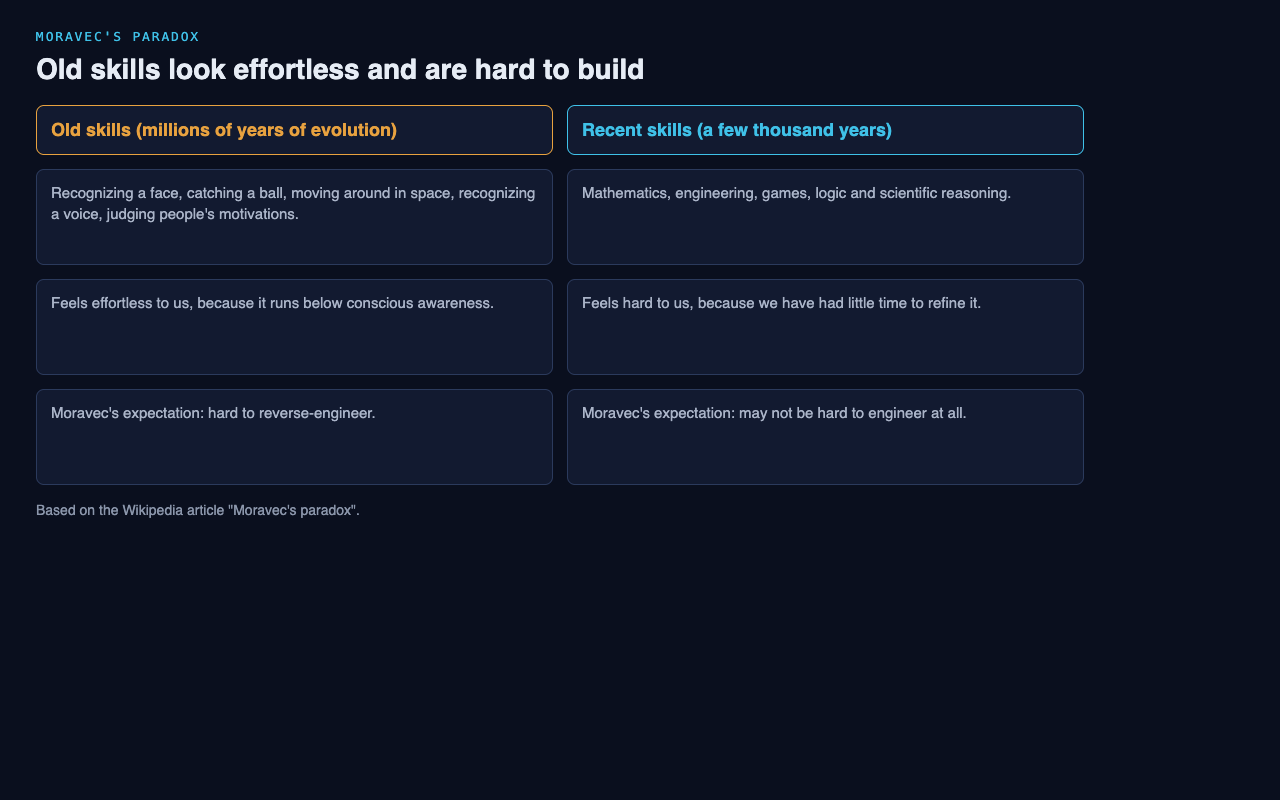
The article lists old skills that have evolved for millions of years: recognizing a face, moving around in space, judging people's motivations, catching a ball and recognizing a voice. It lists recent ones: mathematics, engineering, games, logic and scientific reasoning.
How early AI got caught out, and the answer from robots
In the early days of AI, leading researchers often said they would build thinking machines within a few decades. Wikipedia says that optimism came partly from success: their programs used logic, solved algebra and geometry problems and played games like checkers and chess. Many assumed that, with the "hard" problems nearly solved, the "easy" ones of vision and common sense would soon follow. They were wrong, and the field went through an AI winter, a stretch when funding and hope fell away. For the wider timeline, see the history of AI in a short timeline.
Rodney Brooks saw why. He said early AI treated intelligence as "the things that highly educated male scientists found challenging", such as chess and proving theorems. A four or five year old can tell a coffee cup from a chair or walk from the bedroom to the living room, and those feats were not counted as intelligence at all.
Nouvelle AI: build the body first
In the 1980s Brooks chose a different path, called Nouvelle AI. His aim was robots with the intelligence of insects, not of chess masters. The idea was that intelligence can grow out of simple behaviors that meet the real world, instead of out of a symbolic model of the world programmed in ahead of time.
Earlier robots such as Shakey kept an internal model of their surroundings, and had to update it whenever the world changed, which made them slow. A Nouvelle AI robot checks its sensors instead. Brooks put it this way: "the world is its own best model--always exactly up to date and complete in every detail."
The Nouvelle AI article describes several of his robots:
- Allen had a ring of twelve ultrasonic sonars and three behavior modules for avoiding objects. Alone, it stayed in the middle of a room until something approached, then ran away.
- Herbert searched the busy offices of the MIT lab for empty soda cans and carried them off. That looked like a goal, but it came from 15 simple behavior units working together. Herbert never stored information for more than two seconds.
Brooks also argued, in his 1990 paper "Elephants Don't Play Chess", that abstract thinking in robots has to rest on sensing and acting in the world.
A worked example: sort your own day by how old each skill is
You can test the idea on yourself with a pen and a short list. This is my own exercise, built on the sources' two lists.
- Write down ten things you did today, from reading a bus sign to adding up a bill.
- Mark each one old or recent. Recognizing a face, catching a falling cup and reading someone's mood are old skills in the article's sense. Arithmetic, chess and writing code are recent.
- Mark how hard each felt. Most old skills felt like nothing.
- Look at the pattern. The tasks you did without noticing are the ones Moravec's argument says would be hardest to turn into a program, because you have no steps to write down.
The exercise does not prove the paradox. It shows why your own sense of effort is a poor guide to what is hard to build.
Doubts about Moravec's paradox
Not everyone accepts it as a law. Wikipedia reports that Allen Newell, in a 1983 chapter on the history of AI, called the idea a "myth". More recently, Arvind Narayanan described the paradox as "a statement about what the AI community finds it worthwhile to work on" instead of something with "predictive power about which problems are going to be easy or hard for AI."
So there are two readings. One says the paradox reflects something real about evolution and hidden skills. The other says it mostly shows where researchers chose to spend their effort. The sources do not settle it. Either way, it is a warning against using human effort as the ruler for machine difficulty. The post on narrow AI versus general AI looks at a related point, that skill in one area says little about another.
Moravec's own view of where this leads
Moravec was not a skeptic about machine intelligence. In Mind Children, published in 1988, Wikipedia says he set out Moore's law and a scenario in which robots evolve into a new series of artificial species, starting around 2030 to 2040. In his 1999 book Robot: Mere Machine to Transcendent Mind, he extended the idea to a coming "mind fire" of rapidly expanding superintelligence. That is his scenario, not a forecast this post stands behind, and the same article notes that Colin McGinn reviewed the book harshly.
He also put forward the neural substitution argument, which asks whether consciousness would carry over if each neuron were replaced by an electronic part that behaves the same way. To follow that thread, read mind uploading and how it ties to AI risk.
For safety thinking, the useful lesson of the paradox is modest. A machine's abilities can be uneven, far past a person in one area and far behind a child in another. That makes a single question like "how smart is it?" a weak one.
Frequently asked questions
What is Moravec's paradox in simple words?
It is the finding that tasks people find hard, such as chess or algebra, are often easy for computers, while tasks people find effortless, such as recognizing a face or walking, are very hard for them.
Who came up with Moravec's paradox?
It is named after Hans Moravec, who wrote about it in 1988. Wikipedia says Rodney Brooks, Marvin Minsky and others put forward the same observation in the 1980s.
Why are easy tasks hard for AI?
One explanation, from Moravec, is evolution. Perception and movement had millions of years to be refined and run below conscious awareness, so we cannot easily describe the steps. Abstract reasoning is recent and was easier to turn into rules.
Get started
Moravec's paradox reminds us that how hard something feels is a poor measure of how hard it is to build. You can explore what happens when labs race ahead on that uneven path as fiction.
Play Contain ASI: a story strategy game for 1 to 4 players that runs in your browser. Its labs, people and events are all fictional. Chapter 1, Before ASI, starts in January 2024 with four AI labs in one race, and you try to keep every lab from crossing into recursive self-improvement before 2027. It needs a browser with WebGL 2, such as a recent Chrome, Edge, Firefox or Safari.
It is a game, not a forecast, and it is not a course. For the real sources, go to Wikipedia's articles on Moravec's paradox and Nouvelle AI.
Comments
No comments yet.
Sign in or make an account to comment.