Moving house problems: one list for the whole move
Most moving house problems are small on their own. A box of cables with no label. A fridge that is two centimetres too wide for the new kitchen door. A broadband start date that slips by a week. The trouble is that they pile up in different places, and by moving day you cannot find half of them. This guide shows how to keep moving house problems on one list for the whole move, from the first packing box to the last leftover job, with every problem, every fix you tried and every result in one place you can open on your phone.
Why moving house problems scatter across texts, notes and sticky pads
A move runs for weeks and involves many people. Your partner texts you about the parking permit. The removal company emails a quote. You write "check meter readings" on a sticky note that ends up in a packed box. Each problem gets recorded wherever you happened to be standing.
That works until the landlord asks about the scuffed wall and you are scrolling through three apps and a notebook. The problems are not hard. Finding them is.
The fix is simple: one place, one line per problem, and a record of what you tried. The post on event planning problems uses the same idea.
The most common moving house problems, from packing to the first week
Here are the groups of problems to look for, so you can write them down before they bite.
- Packing: running out of boxes, fragile items with no padding, not knowing what is in which box.
- Booking: movers unavailable on your date, a quote that changes, no parking space for the van.
- Measuring: furniture that will not fit through doors, stairs or lifts at the new place.
- Admin: address changes, school or doctor registration, post redirection, council or tax updates.
- Utilities: internet not live on arrival, final meter readings missed, accounts left in the old name.
- Moving day: keys late, items broken in transit, a box that went missing.
- The first week: a boiler that will not start, a leak nobody mentioned, the deposit back from the old place.
You will also have some you did not expect, so the list should take seconds to add to.
What to record for each problem
For each problem, record three things.
- The problem, in one line. "Sofa may not fit up the new stairwell." One line is enough to find it later.
- What you will try. Every idea, even the ones you doubt. "Measure the stairwell turn." "Take the legs off." "Ask the movers about hoisting through the window."
- What happened. Did it work, partly work, or fail?
Problem Graph is built around this shape. You type the problem in one line, put it in a lane (a move usually sits in personal, though handing in notice at work or setting up a home office might go in work), and press Enter. It lands on the graph straight away. Then you attach solutions as ideas, mark the ones you are trying, and record the outcome as worked, partly or failed.
Here is a worked example. You write: Fridge too wide for new kitchen doorway. You attach three solutions:
- "Remove the fridge doors before carrying it in" (idea)
- "Take the kitchen door off its hinges" (trying)
- "Sell the fridge and buy a narrower one" (idea)
On moving day, taking the door off its hinges gets you an extra few centimetres, but the fridge still catches on the frame. You mark it partly. Removing the fridge doors as well gets it through. You mark that worked. The partial attempt stays on the map, and so would a failed one. The home page puts it plainly: "A solution that failed three times stays on the map as a failed solution, and that is exactly what the next person needs to know." If you move again, that next person is you.
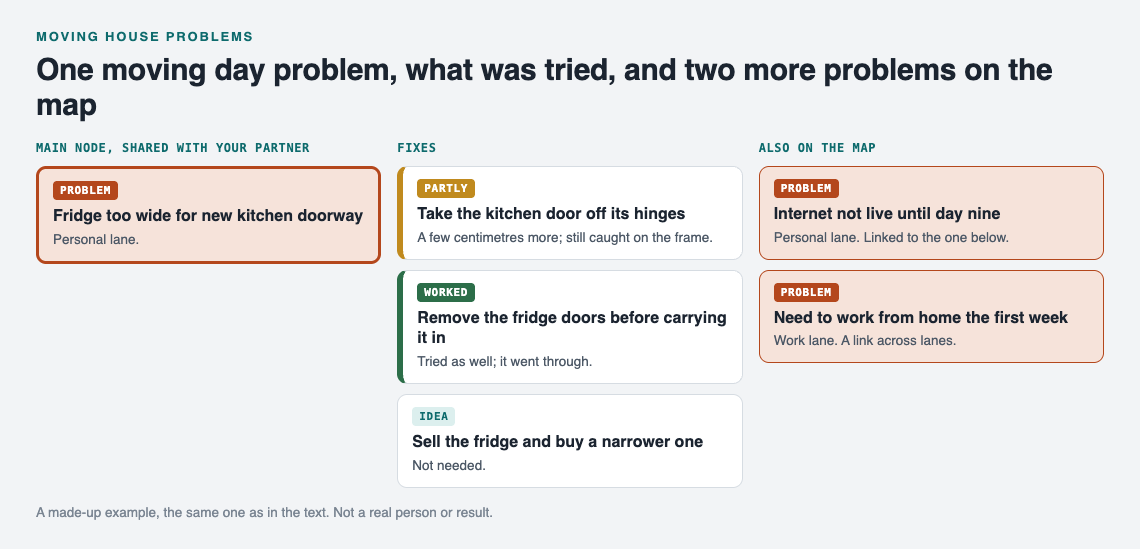
A made-up example: the fridge problem from moving day and two more problems on the map.
Then link problems that belong together. "Internet not live until day nine" links to "Need to work from home the first week". "Parking for the van" links to "Movers arrive at 8am". Links can cross lanes, so a personal problem can link to a work one. Patterns show up on a map that you would miss in a list, like noticing that four of your problems all trace back to one late date from the estate agent.
Before moving day: catching problems while you still have time
The weeks before the move are where a list pays off most. Problems found early leave you more options.
A good habit: walk through each room of the old place and the new one, and write down anything that might go wrong. Do it on your phone as you walk. Problem Graph runs in the web browser and works on your phone, so you do not need to sit at a desk.
Some prompts to get you started:
- "What is the biggest item in this room, and will it fit through every door on the way out and in?"
- "What here would I need on the first night?"
- "What here is fragile, and what will I wrap it in?"
If you get stuck on a problem, you can ask for suggestions. The AI proposes new solutions grounded in what worked for others on problems like yours. Treat each one as an idea to check, not an answer.
On moving day: logging issues as they happen
Moving day is fast and loud. You will not write long notes. You will write one line, if that.
That is fine. The goal on the day is to catch the problem before you forget it. "Mirror cracked in van." "Box 14 not unloaded." "Back door key does not work." Type it, press Enter, move on. You can attach solutions and outcomes that evening when you sit down.
For damage, add a solution like "Photograph it before the movers leave" and mark it as soon as you have done it. That small habit means you know later what you captured and when. It is the same idea as a car problems log: record each fault when you see it, not when you remember it.
After the move: damage claims, utilities and the leftover jobs
The move is not finished when the van leaves. The first weeks bring a second wave of problems, and they tend to be slower and more tedious.
- Damage claims: each damaged item gets its own line. Attach "Send photos to mover" and "Chase claim reply" as solutions, and record the outcome of each.
- Utilities: "Old electricity account still active" with "Call supplier with final reading" as the fix.
- Leftover jobs: curtains that do not fit, a shelf that needs new wall plugs, a smoke alarm to test.
- The old place: deposit return, keys handed back, forwarding of post.
Link these back to the moving day problems they came from. "Mirror cracked in van" links to "Damage claim for mirror". When the claim closes, you can see the whole chain on one map: what broke, what you did, what came back.
Sharing the list with your partner or family
A move is rarely a solo job. Your list is private by default. Only you see it, and it follows you to any phone or computer you log in on.
When you want to share, you create a private network and give the invite code to the people you choose, like your partner, a parent helping with the kids, or a friend lending a van. Be aware that anyone with the invite code can join, so only hand it to people you mean to include. Members see what you share; you stay the one who keeps the list up to date, and they tell you what changed.
Sharing works through main nodes. You mark a problem as a main node, and only a main node can be shared. When you share it, its solutions, their outcomes and the requirements they need go with it. A problem you only link to it stays home with the rest of your graph. So if you want your partner to see both "Fridge too wide for doorway" and "Internet not live until day nine", mark each one as a main node and share both.
This is the same pattern as a shared list for a community garden: everyone sees the problems that matter to the group, and you keep the rest to yourself.
Frequently asked questions
What are the biggest problems when moving house?
Common ones include furniture that will not fit, movers or vans not available on your date, items damaged in transit, and utilities like internet not ready when you arrive.
How do I keep track of everything during a move?
Keep one list, write each problem in one line, and record what you tried and whether it worked. Use something on your phone so you can add problems while you walk through rooms or stand by the van.
Should I write down damage from movers right away?
Yes. Note it and photograph it before the movers leave, while the details are clear. Check your mover's terms for how and when to make a claim.
How long after moving should I keep my problem list?
Keep it at least until every claim, deposit and utility account is settled. You may want to keep it longer: a record of what worked and what failed helps the next time you move.
Get started
Open the app and write your first moving problem in one line. If you want to see how a graph looks before you start, an empty graph offers buttons to load an example set or an example network. You can also switch to List view if you prefer reading problems in a column.
Try Problem Graph: it is free, and you can look around the public network without an account. Write one problem down in a line and attach the first thing you will try.
Comments
No comments yet.
Sign in or make an account to comment.