Narrow AI vs general AI: what is the difference?
The short answer to narrow AI vs general AI is scope. Narrow AI is built for one defined task and does that task well. General AI, usually called AGI, would handle almost any thinking task a person can, and would carry what it learns from one problem to the next. This post uses Wikipedia's articles on weak artificial intelligence and artificial general intelligence to explain the gap, the confusing word "strong AI", and why the gap matters for AI risk.
Narrow AI vs general AI on one line
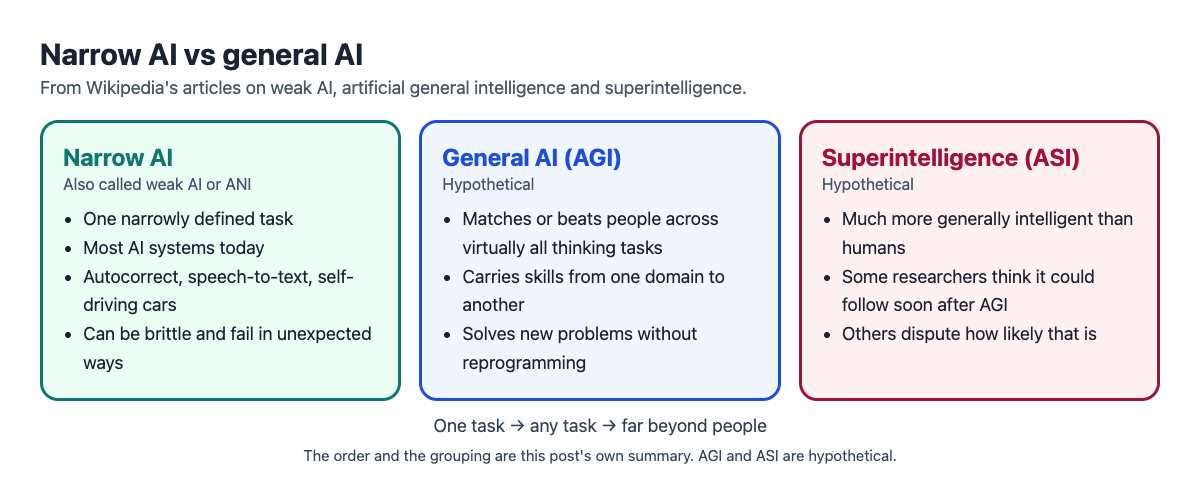
Think of the two terms as two ends of a line. At one end, a system is limited to a single, narrowly defined task. At the other end, a system can apply its intelligence to any problem. Most things called AI today sit near the first end. AGI sits at the far end and is still hypothetical.
What narrow AI is
Narrow AI is also called weak AI or artificial narrow intelligence (ANI). The Wikipedia article describes it as limited to a single, narrowly defined task and says most modern AI systems fall in this category. That does not mean the tasks are easy. Its examples include a board-game-playing program, self-driving cars and medical robot systems, plus autocorrect, speech-to-text and recommender systems.
The weakness the article stresses is brittleness. A narrow system can be unreliable, its behavior can become inconsistent, and it can struggle to find a solution that works across many environments. When it fails, it can fail in ways nobody expected. The article lists possible consequences: disruptions to the electric grid, misdirected self-driving cars, wrongly sorted medicines and faulty or biased medical diagnoses. It also names real controversies, including unfair prison sentences and discrimination against women in hiring. So narrow does not mean harmless.
What general AI is
AGI is a hypothetical type of AI that matches or surpasses human abilities across virtually all cognitive tasks. The key phrase in the article is that an AGI system can generalise knowledge, transfer skills between domains and solve new problems without task-specific reprogramming. A narrow system needs rebuilding for a new job. A general one would not.
Researchers generally expect an AGI to reason, use strategy, solve puzzles, make judgments under uncertainty, hold common sense knowledge, plan, learn and communicate in natural language, all toward any given goal. The article admits there is no single agreed definition of intelligence as applied to computers.
The names vary. AGI is also called general AI, full AI, human-level AI and, confusingly, strong AI. The article says Mark Gubrud used the term in 1997, and that Shane Legg and Ben Goertzel popularized it around 2002.
Past AGI sits artificial superintelligence, or ASI: a hypothetical type of AGI that is much more generally intelligent than humans. The philosopher David Chalmers argues AGI is a very likely path to ASI. For a longer walk through the general idea, see What is AGI? Artificial general intelligence, explained.
Why "strong AI" confuses the picture
Weak AI is contrasted with strong AI, and "strong AI" has more than one meaning. The weak artificial intelligence article lists three: AGI, ASI and artificial consciousness. The last one is the sense the philosopher John Searle used.
Searle coined the term in 1980 alongside his Chinese room argument. His strong AI hypothesis says an AI system can have a mind and consciousness. His weak AI hypothesis says it can only act as if it does. By that definition "weak" has nothing to do with how many tasks a system handles. Some futurists, including Ray Kurzweil, use "strong AI" to mean human-level AGI instead.
According to Russell and Norvig, quoted in the AGI article, most AI researchers take the weak AI hypothesis for granted and do not care about the strong one. In academic AI research, "strong AI" and "AGI" are two different things. Antonio Lieto warns that the weak AI hypothesis should not be confused with the general versus narrow split. The tidy rule: use "narrow" and "general" for how many tasks a system covers, and "strong" and "weak" for whether a machine has a mind.
How far apart are they, and who disagrees
The gap looked small to early researchers. In 1965 Herbert A. Simon wrote that machines would be capable within twenty years of doing any work a man can do. By the early 1970s researchers saw they had grossly underestimated the difficulty. Confidence collapsed in the late 1980s, and by the 1990s AI researchers had a reputation for vain promises.
Mainstream AI then turned toward narrow problems such as speech recognition and recommendation, where results could be checked and sold. Hans Moravec wrote in 1988 that the bottom-up route to AI would one day meet the traditional top-down route. Stevan Harnad argued in 1990 that the only workable route runs from the ground up.
On whether AGI can be built at all, most AI researchers think strong AI can be achieved, while Hubert Dreyfus and Roger Penrose deny it. Timing guesses vary widely. Four polls in 2012 and 2013 gave a median date, at 50 percent confidence, between 2040 and 2050, with a mean of 2081, and 16.5 percent of experts answered "never" when asked at 90 percent confidence. Stuart Armstrong and Kaj Sotala looked at 95 such guesses made between 1950 and 2012 and found a strong lean toward saying human-level AI is 15 to 25 years away, whenever the guess was made. These dates record what people said; they are not forecasts.
The line has also become harder to draw. A 2023 framework in the article describes five levels of AGI, from emerging to superhuman: a competent AGI outperforms half of skilled adults across a wide range of non-physical tasks. A language model from 2020 was widely thought not to be AGI, yet some considered it too advanced to call narrow. In 2023 two researchers argued in an essay that leading models already show a significant level of general intelligence. Others disagree, so the definitions are still contested.
Why the difference matters for AI risk
Narrow AI risk and general AI risk are different problems. For narrow systems, the worry is brittle, biased or unreliable tools failing inside systems people depend on. These risks exist today and do not need AGI.
For general systems, the debate is about existential risk, and the AGI article describes it as contested. Some experts say reducing the risk of human extinction from AGI should be a global priority. Others find AGI too remote to present such a risk. Skeptics often say AGI is unlikely in the short term or that fear of it distracts from problems with current AI.
The article gives voices on each side. Stephen Hawking said in 2014 that ignoring the issue was like answering a message from a superior alien civilisation, which said it would arrive in a few decades, with "call us when you get here". Yann LeCun, a skeptic, argues AGIs would have no desire to dominate humanity and that people should not read human motives into them. On the other side, instrumental convergence says that almost whatever their goals, intelligent agents have reasons to survive and gain power, and that this needs no emotions.
Worried researchers advocate more work on the control problem, which the article says the AI arms race makes harder, since groups might cut safety precautions to release products before their competitors. More in AI race: what it is and why it worries researchers.
A worked example: sort five systems
Here is a method you can use on any news story about "AI". Ask three questions, taken from the articles above.
- Is it limited to a single, narrowly defined task? If yes, it is narrow AI.
- Could it transfer skills to a new domain without task-specific reprogramming? If yes, it is moving toward general.
- Does it show the whole list together (reasoning, planning, learning, common sense, natural language)? Only then does the AGI label start to fit.
Now try five systems.
- Autocorrect on your phone. One task. Narrow.
- A speech-to-text program. One task. Narrow.
- A recommender that guesses what you will watch next. One task, at a huge scale. Narrow.
- A self-driving car. Hard work with many parts, but the article files it under narrow AI. Narrow.
- A language model that writes, translates and answers questions. It crosses several tasks without being rebuilt for each, so some call it too advanced to be narrow, yet it was widely not seen as AGI. This one is the grey zone.
Four answers are easy, and the fifth is where the real argument lives. When a headline says a system "is AGI", run the three questions.
Frequently asked questions
Is a chatbot narrow AI or general AI?
Wikipedia does not rule on any one product. For language models it reports that a 2020 language model was widely not seen as AGI, though some thought it too advanced to call narrow. Experts disagree, and the definitions are contested.
Does general AI exist yet?
The AGI article calls it hypothetical. It also notes that in 2023 some researchers argued early forms may already exist, while others disagree, so the question is still debated.
Is strong AI the same as general AI?
Not always. Searle used "strong AI" for a machine with a mind and consciousness. Some futurists use it for human-level AGI. Most AI researchers treat the two as different things.
Is narrow AI dangerous?
It can be. The weak AI article says unreliable narrow systems can fail in unpredictable ways, and it lists harms from grid disruptions to faulty medical diagnoses.
Get started
Contain ASI is a story strategy game for 1 to 4 players that runs in your browser. It starts in January 2024 with four fictional AI labs in one race, and you try for three years to keep every lab from crossing into recursive self-improvement before 2027. It is inspired by the AI 2027 scenario, and all its labs, people and events are fictional.
Play Contain ASI: a story strategy game for 1 to 4 players that runs in your browser. Its labs, people and events are all fictional.
Comments
No comments yet.
Sign in or make an account to comment.