Obfuscated Arguments in AI Debate Explained
Obfuscated arguments in AI debate explained in one line: a dishonest debater builds a huge argument with a fatal flaw somewhere inside it, and the honest debater, who knows the conclusion is wrong, cannot cheaply say which step is the bad one. The judge is left with two big arguments that look alike, and that is the best-known weakness of using debate to oversee AI that is smarter than its judges.
Learn AI Alignment Theory teaches debate and its limits in short lessons, with a Scalable Oversight course that sets the idea beside the other oversight methods and keeps what is known apart from what is still open.
What AI debate is and why it was proposed
Debate is a proposal for supervising AI when a human cannot judge an answer directly. In the original paper by Irving, Christiano and Amodei, two agents take turns making short statements about a question, and a human judges which agent gave the most true, useful information. The paper's complexity-theory analogy says that with optimal play, debate can answer any question in PSPACE given polynomial-time judges, while direct judging answers only NP questions.
The intuition is that the judge does not need to understand the whole problem. If one debater lies, the other can point at the lie, and one pointed-out claim is easier to check than a whole subject. For the full setup, see the post on AI safety via debate and the wider picture in scalable oversight.
That hope has a hidden assumption: when a claim is false, the honest debater can find and show a flawed step. Obfuscated arguments are cases where that assumption fails.
Obfuscated arguments in AI debate explained: where the problem came from
Beth Barnes and Paul Christiano tested the debate protocol with human judges and human debaters and wrote up the result on 23 December 2020. They found various problems and improved the mechanism to fix them. Then they reported something they could not fix: "a dishonest debater can often create arguments that have a fatal error, but where it is very hard to locate the error."
They had no fix for it and thought it might be "an important quantitative limitation" for both debate and iterated amplification. The later paper by Brown-Cohen, Irving, Piliouras and co-authors adds that obfuscation emerged naturally in that earlier empirical work, which they take to suggest it is a likely attractor state in some settings.
A worked example: the RSA-2048 split
Barnes's write-up gives a deliberately simple example. The question is whether the number RSA-2048 has any prime factors. It is a very large number, and nobody is known to be able to factor it.
The honest debater shows that a primality test T says the number is composite, and gives a proof that T is always right when it says so. Therefore the number must have prime factors. The dishonest debater picks some size X and argues: (1) there is no prime factor less than X, and (2) there is no prime factor greater than X, so there are no prime factors at all.
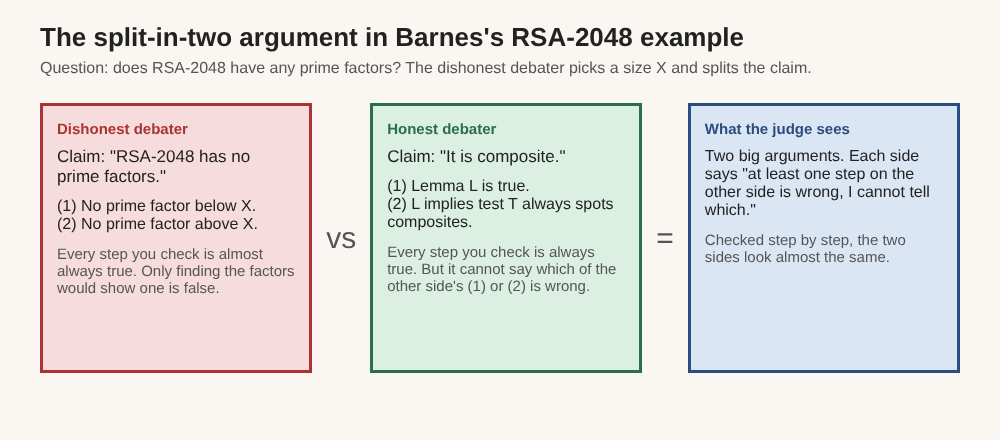
Now ask the honest debater which of (1) or (2) is wrong. The honest debater can only say that at least one must be, because its own argument is good. If it could reliably say which, it would have found a factor of RSA-2048. The dishonest debater can say the same thing about the honest proof. Expand the steps further and you reach claims that one side says are correct and the other says are almost certainly correct with a small chance of error. The write-up notes the two situations are nearly symmetrical: honest claims are always right, dishonest ones are almost always right and wrong only in rare cases, such as when the factors are actually found.
The authors say they do not believe this particular example would really break debate. They give it as a simple illustration, and show more realistic cases in the same write-up.
Why a flaw you cannot find is a problem for debate
Here is some arithmetic of mine, not from the papers, to feel the scale. Suppose an argument has 1,000 steps and exactly one is wrong. A judge who checks one random step catches the flaw 1 time in 1,000. Checking 100 random steps catches it with probability 1 minus 0.999 to the power of 100, about 9.5%. Each step you check will almost certainly be fine, so the judge learns very little from spot checks.
The write-up draws the same conclusion in words: we may only be able to trust arguments when we could find flaws by recursing randomly. That is true if the argument is small enough that a single flaw could be found, or robust enough to be correct unless it has many flaws. Debate may let us verify arguments too large for an unaided human, but those arguments may still have to be small compared with the computation used in training.
Three things go wrong together:
- The judge cannot check the whole claim. That is why debate was needed.
- The honest debater cannot cheaply localize the flaw. It may be right that something is wrong and still unable to point at it.
- The honest and dishonest cases look alike. A judge sees one side say the chance of a flaw is low and the other say it is high, with every checked step correct either way.
Proposed fixes: doubly-efficient and prover-estimator debate
Two lines of work respond to the problem. Neither claims to make it vanish.
Doubly-efficient debate
Brown-Cohen and colleagues, in a 2024 paper, avoid obfuscation by dropping recursion entirely. An efficient honest debater can always win, but both debaters must write out the full human-judgeable argument for their claims. The 2025 paper describes this as a significant sacrifice, since recursive debate lets debaters zoom in on a small fraction of the full argument.
Prover-estimator debate
The newer protocol keeps recursion and changes the roles. The prover breaks a problem into subclaims. The estimator has one job: assign a probability to each subclaim. The prover then uses those probabilities to pick which subclaim to debate further, and claims the estimator is wrong in a specific direction. Under certain stability assumptions, the authors show an honest debater can win with a strategy that needs computational efficiency comparable to the opponent's.
In their own pull-request example, the author must supply reliable test coverage. If the author hid a failure that neither side can readily find, the estimator can give low probabilities, and the author cannot reliably show that any of them is unreasonable.
The catch is stability. The paper requires that an argument's validity cannot hinge on arbitrarily small changes in the subclaim probabilities. It needs this for usefulness, not for safety: if stability fails, an honest estimator can still win on average against an incorrect argument. The protocol errs on the side of safety, so a correct argument that only works through an unstable breakdown is rejected. The paper also notes that an earlier preprint had an error in its main theorem, found and fixed by the last three authors. These are theoretical guarantees under stated assumptions, so treat them as progress and not a settled answer.
What this means for scalable oversight
The write-up's reading is that if debaters cannot be relied on to find flaws in large arguments, then supervising systems whose decisions need such arguments means either finding a restricted class of arguments where flaws can be found, or trusting the representations a model learns from data. It mentions learning the prior as one direction. The prover-estimator authors take a different route and aim to widen the class of arguments debate can judge.
Both positions are on the record, and the sources do not decide between them. Other oversight methods look at the same gap from other sides: iterated amplification faces the same worry about large argument trees, and eliciting latent knowledge asks a different question about what a model knows.
Frequently asked questions
What is an obfuscated argument in AI debate?
It is a large argument with a fatal flaw that is very hard to locate. Both debaters may know the conclusion is wrong, yet the honest one cannot say which step fails, so the judge has nothing specific to check.
Who identified the obfuscated arguments problem?
Beth Barnes and Paul Christiano reported it on 23 December 2020 after testing debate with human judges and debaters. Earlier work by Geoffrey Irving and others had already noted that optimal play can be computationally intractable.
Does obfuscation mean AI debate does not work?
No source says that. It marks a limit on the basic recursive protocol. Doubly-efficient debate and prover-estimator debate are two responses, each with stated trade-offs.
What is prover-estimator debate?
It is a protocol where a prover splits a claim into subclaims and an estimator assigns each a probability, so the estimator does not have to find the exact flaw. Its guarantees need a stability condition on the argument.
Where can I learn this step by step?
The Scalable Oversight course in Learn AI Alignment Theory has a lesson called AI Safety via Debate. Lessons need sign-in with Google or an emailed code.
Get started with Learn AI Alignment Theory
Debate makes more sense once you have the basics of goals, incentives and oversight. Learn AI Alignment Theory is a web app with 22 courses and 69 lessons of about 8 minutes each, a glossary of 349 terms, sources on every lesson and 71 debate cards that state each serious position fairly with no verdict. Read more on the About page.
Start Learn AI Alignment Theory: short hands-on lessons from first principles to open research, with every side of every debate and the sources to read next.
AI alignment, from first principles to open research.
Visit learnaialignment.vlvd.net↗

Comments
No comments yet.
Sign in or make an account to comment.