Old Wardour Castle siege: Lady Blanche held it six days
In May 1643 a woman of about 60 held a Wiltshire castle for six days against a Parliamentarian force. This post tells the Old Wardour Castle siege day by day, using English Heritage's own pages on the castle and on Lady Blanche Arundell. It is a siege where the guns did little, the mines did more, and a one-hour deadline settled it.
Old Wardour Castle siege in short
English Heritage dates the siege to 2 to 8 May 1643. Lady Blanche Arundell's husband, Thomas, 2nd Lord Arundell, had gone to join Charles I at Oxford, and he left her in charge of the castle. With her were her daughter-in-law, her grandchildren, several maidservants and about 25 men. Against them came the Wiltshire militia under Sir Edward Hungerford, a Parliamentarian. Blanche refused to give up the castle, held out, and surrendered only when the besiegers threatened to blow part of it up.
Her stand made her famous among Royalists. The castle was not finished with sieges either: a second one followed in 1643 to 1644, and that one ruined it.
The castle Lady Blanche held
Old Wardour is an odd castle. John, Lord Lovell, built it in the 1390s as a hexagon around a small courtyard, with a twin-towered entrance on one side. In the 1570s Sir Matthew Arundell modernised it. English Heritage notes that his changes, including round-headed windows that let in more light, made the castle harder to defend. Even so, it says, it was still an impressive stronghold.
That mix matters for the story. The walls were thick and old, but they had been opened up for comfort. Blanche's defence leaned on stubbornness more than on stone.
Who was inside, and who was outside
English Heritage lists the people on each side. Inside were Lady Blanche, about 60, and her daughter-in-law Cicely Compton, about 33. There were three young grandchildren, the family's Jesuit chaplain, John Falconer, and about 25 male servants and local men. Several maidservants were there too; a Royalist account calls them "valiant beyond their sex".
Outside were Sir Edward Hungerford, an MP who led the Wiltshire militia, and Colonel William Strode, who led a Somerset infantry regiment. Captain Edmund Ludlow, then about 26, and Captain Bean were also with the besiegers. A Royalist source claimed 1,300 Parliamentarian soldiers. English Heritage says this is an exaggeration.
The six days, one by one
English Heritage sets the siege out day by day.
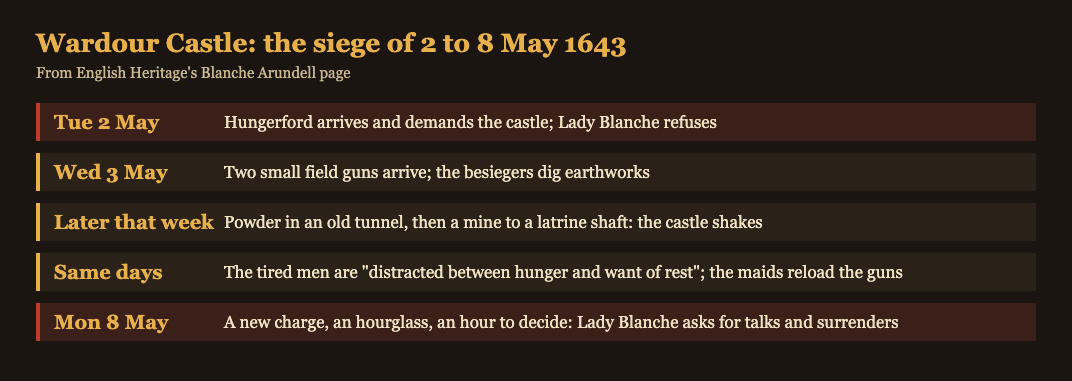
The siege in five steps. The first and last days are the red ones.
Tuesday 2 May. Hungerford arrives and demands the castle. Blanche answers that she had a command from her lord to keep it, and that she would obey it. Hungerford sends for reinforcements.
Wednesday 3 May. Two small field guns arrive, probably placed on the hill north-east of the castle. Shot damage can still be seen on that side. The besiegers dig earthworks to cover their foot soldiers and guns. They offer to spare the lives of Blanche, Cicely, the children and the maids, but not the fighting men. Blanche and Cicely refuse.
Later that week. The light guns do little to the walls, though one shot smashes through a window and damages a fireplace. The besiegers put gunpowder at the end of an old tunnel that leads to the castle, with little effect. Then they mine towards another part of the castle, probably reaching a latrine shaft on the south side, and set off two or three barrels of gunpowder. The blast goes up the shaft and, in the words of the account, did "much shake and endanger the whole fabrick" of the castle.
Meanwhile the men inside tire, "distracted between hunger and want of rest". Blanche orders the maids to take charge of reloading the guns with powder and bullets.
Monday 8 May. The besiegers place another charge. The Royalist account puts it at the castle's "garden-door", while Ludlow says it was by another latrine shaft. They set an hourglass running and threaten to fire it after one hour. Blanche asks for talks. Three articles of surrender are agreed: everyone's life is spared, the women may leave with six male servants to support them, and the castle's goods are to be safe from plunder.
Two accounts of one siege
We know the siege mostly through two writers who disagree. Edmund Ludlow, the Parliamentarian officer, wrote his account in the 1660s. He arrived only at the end of the siege, so he must have heard the earlier days from Hungerford and his soldiers. The Royalist side comes from Bruno Ryves, whose newspaper Mercurius Rusticus covered the siege in its May 1643 issue.
Their numbers differ a lot. Ryves reported at least 60 Parliamentarian soldiers killed and no deaths among the besieged. English Heritage thinks that is probably a tenfold exaggeration. Ludlow says only that one of Blanche's servants was grazed across the face by a bullet.
English Heritage also reads the siege as less of a battle than an order to surrender. Had Hungerford truly had 1,300 men, it argues, he would have stormed the castle on the first or second day. It suggests he wanted the castle intact, along with the Arundells' valuables. If you want to see how a siege could end without a storm, read Starving a castle: how a blockade forced surrender.
After the surrender, and the second siege
Hungerford honoured only the first of the three articles of surrender, the one that spared lives. Blanche, Cicely and the children were taken prisoner to Shaftesbury with only the clothes they wore. Blanche and Cicely were released in early June. In Salisbury Blanche learned that her husband had died on 19 May from wounds taken in battle. She died in late 1649.
Ryves said the Parliamentarians sold what they took: five cartloads of the "richest hangings and other furniture", as well as horses, cattle, deer and the fish in the ponds. Ludlow found money, plate and jewels worth 1,200 pounds hidden in the castle walls. He then patched up the castle, levelled the siege earthworks and stocked up on food.
In December 1643 Blanche's son Henry, now 3rd Lord Arundell, came with a Royalist army. For three months Ludlow's garrison held out. Arundell ordered a mine under the walls. English Heritage's Blanche page says the charge was set off, perhaps by accident from Parliamentarian fire, and one side of the castle was blown up. Ludlow surrendered on 18 March 1644. The castle's history page puts it more simply: Henry blew up one side of his own castle with a mine. Either way, the castle was ruined beyond repair. Henry did not rebuild it. After he recovered his estate in 1660 he built a smaller house beside it.
For the digging side of sieges, see Undermining a castle: how medieval siege mines worked. For what happened to many castles afterwards, see Civil War castle sieges: what happened to the castles.
A worked example: four pressures on one castle
You can read the Wardour siege as four pressures, each tried in turn. Use the same four questions on any siege you read about:
- Guns. Did they break the walls? At Wardour, not much: two small field guns and a smashed window.
- Digging. Did a mine reach something weak? Here the latrine shaft carried the blast up into the castle, and the building shook.
- Tiredness. Could the defenders keep going? About 25 men grew tired and hungry, so Blanche put the maids on reloading.
- A deadline. Was there a threat the defenders could not answer? An hourglass and one hour ended it.
The shaft is worth noticing. A latrine shaft is a hole built into the wall for another purpose, and it gave the besiegers a way in for their powder. For how those shafts were built, see Castle toilets: how a medieval garderobe worked.
Frequently asked questions
When was the siege of Old Wardour Castle?
English Heritage dates the first siege to 2 to 8 May 1643, when Lady Blanche Arundell held it. A second siege ran for three months and ended on 18 March 1644.
Who defended Old Wardour Castle in 1643?
Lady Blanche Arundell, with her daughter-in-law, her grandchildren, several maidservants and about 25 men. Her husband was away with Charles I's army.
How did the siege of Wardour Castle end?
The besiegers set an hourglass and threatened to fire a gunpowder charge after one hour. Blanche asked for talks and agreed three articles of surrender. Only the first, sparing lives, was kept.
Was the castle destroyed in the siege?
Not in the first siege, though a mine shook the building. In the second, in 1644, one side of the castle was blown up by a mine, and the castle was ruined beyond repair.
Get started
In Two Towers, a medieval tower defense game, you hold a gate rather than a hexagon, but the same pressures are there. The game says "Repair mends it, Reinforce raises its full strength", so a damaged gate can be mended and strengthened between attacks. Its sappers have a line that sounds like Wardour's mines: "Digs under your strongest hill tower to silence it". If you want tips on stopping them, read Two Towers tips: how to stop sappers and fire archers. The game does not model gunpowder charges or an hourglass.
Play Two Towers: it is free and plays in your browser on a computer or a phone.
Comments
No comments yet.
Sign in or make an account to comment.