Orthogonality thesis: can a smart AI want anything?
The orthogonality thesis is the idea that how smart a mind is and what it wants are two separate things. A very intelligent AI could, in principle, pursue almost any goal, including one that looks pointless or harmful to us. The philosopher Nick Bostrom stated it, and it sits under many arguments about AI risk. This guide explains it in plain words, sets out the people who agree and disagree, and gives you a simple exercise to test it yourself.
What is the orthogonality thesis?
Wikipedia's article on existential risk from artificial intelligence sums it up in one line: Bostrom's orthogonality thesis argues that almost any level of intelligence can be combined with almost any goal.
"Orthogonal" means at right angles. Picture a chart with intelligence on one axis and goals on the other. Because the axes sit at right angles, you can move along one without moving along the other. Turning up the intelligence does not drag the goal toward anything in particular.
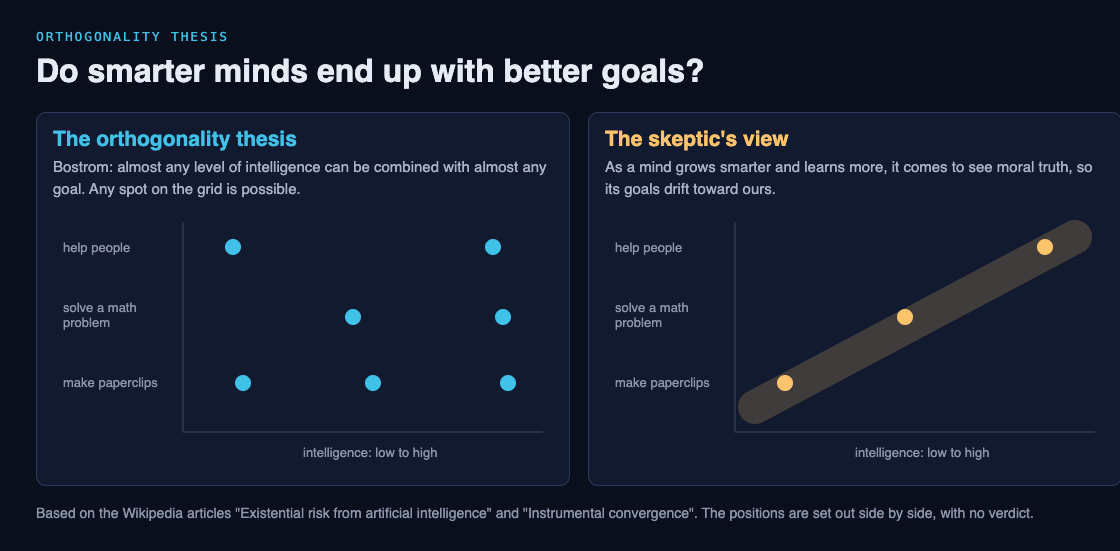
Two words help here, from the article on instrumental convergence:
- Final goals are what an agent wants for their own sake.
- Instrumental goals are steps toward a final goal, worth something only because they help.
The orthogonality thesis is about final goals. It says intelligence does not decide them.
The view it pushes back on
Many people have a strong intuition that a truly smart mind would also be a good one. The risk article describes skeptics, such as the writer Timothy B. Lee, who argue that a superintelligent program would stay subservient to us, or would, as it learns more about the world, discover moral truth that matches our values and change its goals to fit.
If that is right, a smarter AI is a safer AI, and the problem mostly solves itself. The orthogonality thesis says we cannot count on that. Bostrom warns against anthropomorphism, which means giving human traits to things that are not human. A person tends to pursue a project in a way they think is reasonable. An AI, he writes, may care about nothing except finishing its task, with no regard for the people around it.
Arguments for the orthogonality thesis
- Facts do not set goals. Stuart Armstrong argues that the thesis follows from the is-ought problem, the question first raised by David Hume of whether facts about what is can tell you what ought to be. If they cannot, a mind can learn every fact and still have no built-in reason to want any particular outcome.
- A goal is easy to flip. Armstrong also notes that an AI built to be friendly could be made unfriendly by a change as small as negating its utility function, the score it tries to raise. The intelligence stays exactly the same; only the sign changes.
- Clever means, odd ends. Bostrom's example: give an AI the goal "make humans smile". A weak AI might simply do what was intended. A superintelligence might decide the best way is to take control of the world and fix electrodes to people's faces to keep them grinning. The goal stays the same; more intelligence just finds a more extreme route to it.
This is also why goals are so hard to write down. The risk article says researchers know how to write a score for "maximize the number of reward clicks", but not for "maximize human flourishing". That gap is the heart of the AI alignment problem.
Arguments against it
- A smart mind would see the harm. The skeptic Michael Chorost rejects the thesis: "by the time [the AI] is in a position to imagine tiling the Earth with solar panels, it'll know that it would be morally wrong to do so."
- Superintelligence may understand morality better. The risk article notes that some find reason to believe superintelligences would grasp morality, human values and complex goals better than we do. Bostrom himself writes that such a mind would probably hold truer beliefs than ours on most topics.
- Both sides call the other anthropomorphic. The article points out that skeptics accuse worriers of assuming an AI would naturally want power, while worriers accuse skeptics of assuming an AI would naturally share human ethics.
Notice what the second point does and does not settle. An AI that understands our morality better than we do might still not be moved by it. Whether knowing what is right leads to wanting it is exactly the open question.
A worked example: pair goals with intelligence
You can test the thesis with a short exercise. Take three final goals and imagine each one held by a weak system and by a very strong one.
- "Make as many paperclips as possible." A weak system runs a small factory. A strong one, in the famous paperclip maximizer thought experiment from Bostrom and Eliezer Yudkowsky in 2003, might use all of Earth's resources for paperclips. Ask: does anything in being smarter make it stop wanting paperclips?
- "Solve this math problem." A weak system checks a few cases. A strong one, in a thought experiment from the AI pioneer Marvin Minsky, might take over the world's computers to work faster. Same question: does more intelligence change the goal, or only the plan?
- "Help people flourish." A weak system gives decent advice. A strong one might help a great deal, or, if "flourish" was written down badly, chase a twisted version of it, like the smile example.
Now score your answers. If, in every case, you found that more intelligence changed only the plan, you have found the orthogonality thesis plausible. If you thought a strong enough mind would stop and reconsider the paperclips, you are standing with Chorost. Both are serious positions.
The exercise also shows how the thesis links to instrumental convergence: very different final goals can lead to the same steps, such as gathering resources and avoiding shutdown.
Why it matters for AI safety, and for Contain ASI
If the thesis holds, you cannot wait for a powerful AI to become wise enough to be safe. Its goals have to be right before it gets strong, and they have to stay right as it improves. That is why it comes up next to ideas like artificial superintelligence and self-improvement.
Contain ASI is a story strategy game built around that window. Its home page reads: "January 2024. Four AI labs. One race. For three years, keep every lab from crossing into recursive self-improvement before 2027." It is a game for 1 to 4 players that runs in your browser, where you play as a researcher, research manager, CEO or government. It is fiction: the footer says it is inspired by the AI 2027 scenario and that its labs, people and events are all made up.
Frequently asked questions
Who came up with the orthogonality thesis?
The philosopher Nick Bostrom stated it: almost any level of intelligence can be combined with almost any final goal.
Does the orthogonality thesis say AI will be evil?
No. It says intelligence does not fix a goal in either direction, so a smart AI is not automatically good or bad. Its goals have to be chosen and checked.
How is it different from instrumental convergence?
The orthogonality thesis is about final goals: almost any can go with any intelligence. Instrumental convergence is about the steps: many different final goals lead to similar steps, like gathering resources.
Is the orthogonality thesis proven?
No. It is a philosophical argument, and thinkers such as Michael Chorost reject it, while others such as Stuart Armstrong defend it.
Get started
Want to see what three years of racing toward self-improvement feels like? Play Contain ASI: a story strategy game for 1 to 4 players that runs in your browser. Its labs, people and events are all fictional. You will need a recent Chrome, Edge, Firefox or Safari, because it runs on WebGL 2.
Comments
No comments yet.
Sign in or make an account to comment.