Pasteur's germ theory: what he showed and what came before
Pasteur's germ theory is often told as one man's discovery, but the sources tell a more shared story. Louis Pasteur (1822 to 1895) did not invent the idea that living things cause disease. What he did was run experiments that made the idea hard to wave away. This post sorts what came before him from what he added himself, and where historians still argue.
What Pasteur's germ theory claims
Germ theory is a few claims bundled together. Microbes are alive. They come from other microbes, not from dead matter. Some of them cause fermentation and rot, and some cause specific diseases. Each claim needed its own proof, and no single person supplied all of them.
The Science History Institute's biography says it plainly: Pasteur "was not the first to say that pathogens caused disease," but his experiments gave the theory strong support. The same biography notes that some circles call him the "father" of microbiology, and adds that he also helped win acceptance through "carefully crafted public relations campaigns".
Before Pasteur: miasma, early germ ideas and the people who got close
In the mid-1800s many people still held the miasma theory, which said disease came from bad air. Basic forms of germ theory were already on record. Wikipedia's article on germ theory dates a first version to Girolamo Fracastoro in 1546, expanded by Marcus von Plenciz in 1762, but says such views were held in disdain while miasma ruled.
Microbes had also been seen. Anton van Leeuwenhoek is said to have been the first to see and describe bacteria, in 1674. Seeing a microbe is not the same as showing it does anything, though.
Several people came near the answer before Pasteur's main work.
- Agostino Bassi published findings in 1835 and 1836 that fungal spores passed a silkworm disease from one caterpillar to the next. He advised removing sick caterpillars and disinfecting surfaces.
- Ignaz Semmelweis, an obstetrician in Vienna, made doctors wash their hands in chlorinated lime water in 1847. He recorded deaths falling from 18% to 2.2% over a year. Most of the medical establishment rejected him anyway.
- John Snow argued in 1849 that cholera spread by the fecal-oral route. In 1855 he guessed it was caused by cells smaller than human cells. He showed that homes served by one water company had fourteen times as many deaths as homes served by another.
Each had evidence that something material carried disease. None could name a microbe, grow it and show it caused the illness. Koch's 1884 work confirmed the cholera bacterium Snow had pointed toward.
Living yeast and the swan-neck flasks
Pasteur began as a chemist. In 1854 he became dean of the science faculty at Lille, and his interest moved to fermentation. One story says a wine maker asked him why wine was going sour. Pasteur said it grew out of his earlier work on how crystals twist light.
The leading view, from the chemist Justus von Liebig, was that fermentation was chemical decomposition. Pasteur showed that yeast, a living organism, caused alcoholic fermentation. He was building on and confirming Theodor Schwann's earlier work. He also showed a living organism turns sugar to lactic acid in milk. He and Liebig argued by letter through the 1850s and 1860s.
In 1864 he found that heating wine to at least 50 to 60 degrees Celsius killed the microbes that spoiled it. He patented this as pasteurization, and it was used on wine and beer, later on milk.
If microbes spoil broth, where do they come from? Many still believed life could arise from dead matter. Félix Pouchet argued this in a book of 1859, and the French Academy of Sciences offered a prize of 2,500 francs for an experimental answer either way.
Pasteur's famous test used flasks with long, curved necks.
- Boil a nutrient broth in a flask to sterilize it.
- Leave the neck open to the air, but bent so that falling dust lands in the curve.
- Wait. The broth stays clear for a long time.
- Tilt the flask so the broth meets the dust, and it clouds quickly.
The point was that the air itself did not spoil the broth. Particles in the air did. In other tests he opened flasks at different heights: fewer flasks grew organisms at higher altitude, where there was less dust.
This did not end the argument at once. In the 1860s Pasteur repeated Spallanzani's older experiments, and Pouchet got a different result using a different broth. Wikipedia says some minority opposition continued after the swan-neck work.
From microbes to disease: silkworms and vaccines
Showing microbes spoil broth does not show they cause disease. Pasteur's first big step on disease came with the silkworm illness pébrine, which threatened the silk industry. He did not yet understand its cause, but he gave breeders a sorting method. They crushed a sample of chrysalises, looked for corpuscles and bred only from batches where very few showed. A similar method had been proposed a few years earlier by Osimo. It curbed pébrine and saved much of the industry in the Cévennes, though another silkworm disease, flacherie, kept resisting.
Vaccines came next. Jenner had started the idea in 1796. By the mid-1800s, scientists like Pasteur wanted vaccines made from weakened forms of a disease's own agent. His group worked with Emile Roux and Charles Chamberland on chicken cholera, and weakened the bacterium by exposing it to air. The biography says this approach was later found to be ineffective.
The public test of the anthrax vaccine came in 1881 at Pouilly-le-Fort. According to the biography, the 25 animals that received it survived infection and those that did not died. Then, in 1885, he vaccinated a nine-year-old boy bitten by a rabid dog, and the boy did not develop rabies. The Pasteur Institute opened in November 1888.
Where historians disagree about Pasteur
His own notebooks complicate the tidy story, and historians weigh them differently.
- The anthrax vaccine. Pasteur told the Academy of Sciences he had weakened the bacterium with air. His notebooks show he used a chemical, potassium bichromate. Jean Joseph Henri Toussaint had made an effective vaccine with a similar antiseptic method. The biography says Pasteur's claim overstated how unique his approach was, in a bid for priority.
- The rabies trials. He said the vaccine worked on about 50 dogs. Later accounts questioned the number and the success.
- The first human case. Wikipedia notes he had no medical licence, that Roux, who did, refused to take part, and that the physician Jacques-Joseph Grancher gave the injections under Pasteur's supervision and defended him before the National Academy of Medicine.
Some historians read these as ambition and rivalry that bent the record. Others point to the lasting results: the fermentation work, pasteurization and vaccines. You can hold both views, and the sources do not force a verdict.
What Koch and Lister added
Robert Koch is recognized as the discoverer of the anthrax bacterium, even though Pasteur is often credited with its vaccine. In 1884 Koch published four criteria for tying a specific microbe to a specific disease: the microbe is found in the sick and not the healthy, it is grown in pure culture, it causes disease in a healthy host, and it is found again in that host. He knew they did not always fit. Cholera carriers who show no symptoms break the first rule, and viruses cannot be grown in pure culture.
Joseph Lister read Pasteur's papers on fermentation and saw that open fractures became infected by microbes from outside. He used carbolic acid as an antiseptic. Germ theory moved from the lab to the operating room through him.
The same pattern, one name on top of many hands, shows in the chemistry stories of Lavoisier and Mendeleev, and in the medicine story of Fleming and penicillin.
A worked example: split a big claim into parts
The claim "Pasteur discovered germ theory" is too big to test. Try this on any famous-name claim, using the method in the post on building a history argument from evidence.
- Split it. Germ theory has four parts: microbes are alive, they come from other microbes, some cause fermentation, and some cause specific diseases.
- Name who showed each part, and how. Yeast alive: Schwann, then Pasteur. Microbes from microbes: Spallanzani, then Pasteur's flasks. A specific microbe for a specific disease: Bassi for silkworms, Koch's criteria for others.
- Check the source's own caution. The biography says he was not the first, and that his notebooks differ from his public reports.
- Write the narrower sentence. "Pasteur gave germ theory its strongest early experiments and carried it into vaccines" holds up. "Pasteur discovered germs cause disease" does not.
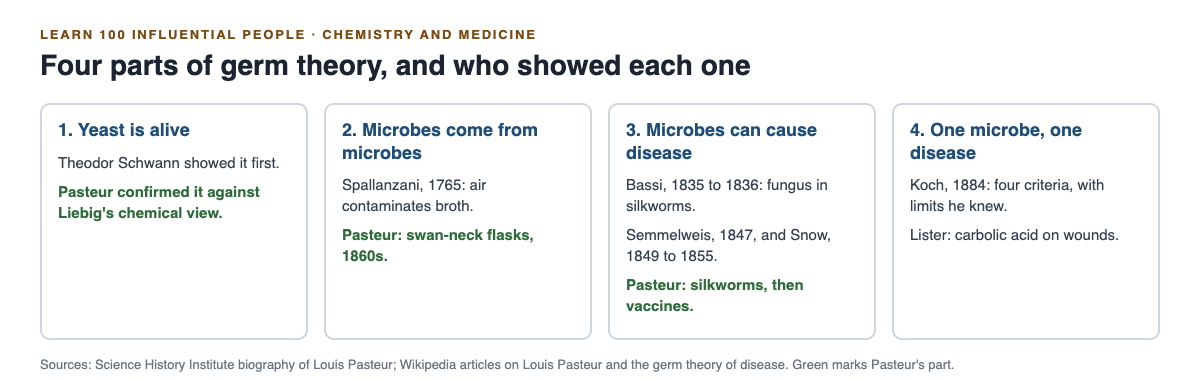
Four parts of germ theory, and who showed each one.
The home page of Learn 100 Influential People, where the lessons start.
Frequently asked questions
Did Pasteur invent germ theory?
No. Fracastoro proposed a basic form in 1546, and Bassi, Semmelweis and Snow added evidence before Pasteur's main work. Pasteur's experiments gave the theory its strongest support.
What did Pasteur's swan-neck flasks show?
Sterilized broth stayed clear when air could enter but dust could not, and clouded when the dust reached it. That pointed to airborne particles, not life arising from the broth.
Was Pasteur honest about his experiments?
The Science History Institute says his notebooks reveal differences between his public reports and his private research. For example, he told the Academy he had weakened the anthrax bacterium with air, but he had used a chemical.
How did Koch's work differ from Pasteur's?
Koch published criteria in 1884 for linking a particular microbe to a particular disease and is recognized as the discoverer of the anthrax bacterium. Pasteur worked on fermentation, spontaneous generation and vaccines.
Get started
Learn 100 Influential People has short hands-on lessons, about 9 minutes each, on the people who most shaped history, with questions that check what you learned. Its Chemistry and Medicine course has a lesson on Jenner and Pasteur, and every lesson lists its sources. You sign in with your email and an emailed code. Open Learn 100 Influential People and read about the project first if you want to see what is inside.
Comments
No comments yet.
Sign in or make an account to comment.