Paul the Apostle: who he was and what he taught
Paul the Apostle is one of the most influential people in the history of religion, and one of the hardest to pin down. He was never one of Jesus' inner circle, yet scholars attribute seven books of the New Testament to him. The famous story says he was converted on the road to Damascus. Many scholars now ask whether "convert" is even the right word. This post sets out who he was, what he taught, where the sources disagree, and how to weigh them, using Rebecca Denova's article on Paul the Apostle in World History Encyclopedia.
Who was Paul the Apostle?
Denova, an emeritus professor of early Christianity at the University of Pittsburgh, describes Paul as a Diaspora Jew (a Jew living outside Judea) and a member of the party of the Pharisees. Paul claimed that, when it came to the Law of Moses, he was more zealous and knew more than anyone else, and that he was of the tribe of Benjamin.
At some point he had what he describes as a vision of the resurrected Jesus. After it, he travelled widely through the eastern Roman Empire, spreading the "good news" that Jesus would soon return and bring in the reign of God. He worked as a teacher and missionary across much of Asia Minor and present-day Greece, setting up communities and keeping in touch with them by letter.
A point that surprises many readers: Paul did not think he was founding a new religion. According to the article, he believed his generation was the last before the end of the age.
The seven letters scholars agree he wrote
The New Testament contains 14 letters traditionally credited to Paul. The article says the scholarly consensus is that seven were actually written by him:
- 1 Thessalonians
- Galatians
- Philemon
- Philippians
- 1 and 2 Corinthians
- Romans
The others, it says, were most likely written by followers using his name to carry authority. The article also warns against reading the seven as a complete system of belief. They were answers to particular problems in particular communities, and came to matter more only over time.
Two sources, two stories
Most of what people "know" about Paul's life comes from the Book of Acts, written by the author Christian tradition calls Luke. Paul's own letters often tell it differently.
Acts says he was born in Tarsus, which is why tradition calls him Paul of Tarsus. In his letter to the Galatians, Paul indicates he was from the area of Damascus. Acts says he grew up in Jerusalem and sat on its council. Paul says he visited Jerusalem only twice, for a few days each time.
The article points out that both sources have an agenda. Luke shows Paul checking with the leaders in Jerusalem. Paul insists that no person told him what to do, because his call came straight from the risen Jesus. Denova's own judgment is that it is usually best to trust Paul's letters over Acts on his motives and work. That is a sound rule for any life: a person's own words beat a later account, though they are not neutral either.
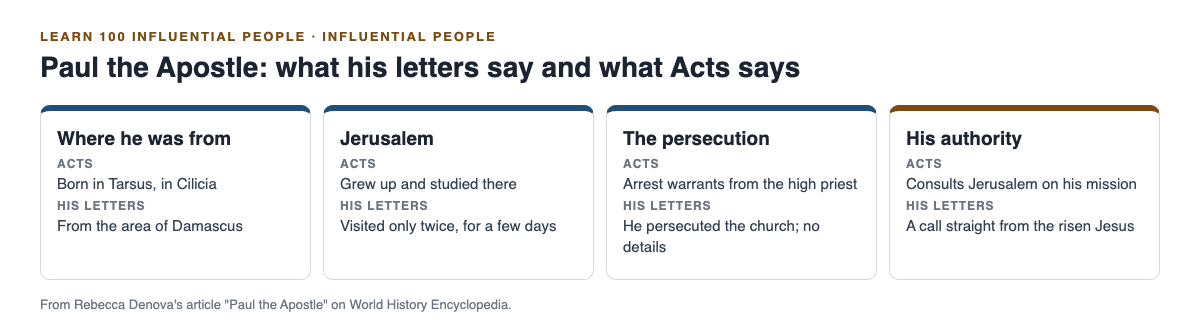
Four places where the two sources differ, from the World History Encyclopedia article.
Conversion or calling?
The road to Damascus has become a byword for a sudden change of mind. But the article argues that "convert" fits Paul badly, for two reasons. At the time there was no separate Christian religion to convert to. And Paul himself is unclear about what he considered himself.
Denova suggests it is better to say he was called by God, in the tradition of the prophets of ancient Israel. In Galatians, Paul says the risen Jesus commissioned him to be the Apostle to the gentiles, the non-Jews. That claim mattered: he had never been one of Jesus' inner circle, so a direct call was how he argued for the same authority as the earlier apostles.
Paul also freely admits that he had earlier persecuted the church of God. He never says what he did or why, and the article says most scholars cannot agree on what it means. Acts gives a dramatic version with arrest warrants from the high priest, which Denova calls hyperbole.
What Paul taught about the Law and the gentiles
Paul saw his job as bringing his message to gentiles. Most of what he writes about the Law of Moses comes from that. In his view, gentiles who joined did not need to keep three practices that separated communities: circumcision, food laws and the Sabbath.
That did not make them free of all rules. The article stresses that Paul did not let gentiles keep worshipping idols, and that he brought Jewish ethical and charitable ideas into his communities. It sums up the scholar E. P. Sanders' view in his book on Paul: gentiles get in without following the Law, but once in, they follow it, or Paul's version of it.
Paul also wrote that Christ is the "telos" of the Law. Some Bibles translate this as "the end of the Law"; the article argues it means "the goal of the Law."
Faith alone: one phrase, two readings
Paul wrote that gentiles are saved by faith, and not by works of the Law. The article calls this the basis of centuries of commentary that culminated in Martin Luther's break with the church of Rome. Our post on Luther vs Calvin follows that later story.
For centuries, many readers took the phrase as the great divide between Judaism and Christianity. The reading the article gives is narrower. By "works of the Law," it argues, Paul meant the ritual barriers between communities, and he was arguing against other Christians who said gentiles must become Jews first, not against Judaism itself. Both readings have long histories and serious defenders. You can weigh them for yourself by reading Galatians and Romans next to each other.
Founder of Christianity?
The article's strongest claim is that, over the last century, scholars have come to see Paul as the actual founder of the movement that became Christianity. As time passed and Jesus did not return, it says, second-century Church Fathers turned to Paul's letters to support the teaching that became Christian doctrine.
That is the author's argument, not the only view. The familiar account, which the article itself starts from, is of a follower of Jesus who converted on the road to Damascus and spread an existing faith. The fair way to put it is that how far Paul founded Christianity, rather than spread it, is still debated, and the sources above are the evidence on both sides.
His death is uncertain too. The article says we cannot confirm where or how he died. Acts ends with him under house arrest in Rome, still preaching; the story of his beheading comes from later, second-century writings.
Worked example: compare two sources on one life
This 20-minute exercise trains the skill this post is built on. It follows our guide to how to analyze a primary source.
- Pick one question (2 minutes). For example: where was Paul from?
- Read source one (6 minutes). Read Acts 9 and note what it says. Write who wrote it and roughly how long after the events.
- Read source two (6 minutes). Read the opening of Galatians and note what Paul says about his own life.
- Weigh them (6 minutes). Write one sentence on what each author wanted readers to believe, and one sentence on which you trust more for this question, and why.
Then try the same method on another founder of faith, such as Moses, or on a later reader of Paul, Augustine.
Frequently asked questions
Which letters did Paul the Apostle write?
Scholars broadly agree on seven: 1 Thessalonians, Galatians, Philemon, Philippians, 1 and 2 Corinthians, and Romans. The other letters under his name were most likely written by followers.
Was Paul one of Jesus' first followers?
No. He was never one of the inner circle; he based his authority on a vision of the risen Jesus that, he said, made him the Apostle to the gentiles.
Why is Paul called Paul of Tarsus?
Because the Book of Acts says he was born in Tarsus. Paul's own letter to the Galatians suggests he was from the area of Damascus.
How did Paul die?
It cannot be confirmed. Acts ends with him under house arrest in Rome; the account of his beheading comes from later, second-century writings.
Get started
Paul is a good example of a life where the sources disagree, and of why you should read more than one. Learn 100 Influential People teaches the 100 people who most shaped human history, from Moses to the web, in war, philosophy, religion, art, science, engineering and economy, in 46 lessons of about 9 minutes. Its 272 questions check what you learned, 38 cards set out where researchers disagree, and every lesson lists its sources. Sign in with your email and an emailed code, and read what the site is for.
Comments
No comments yet.
Sign in or make an account to comment.