Persona Drift: Why AI Chatbots Slip Out of Character
Persona drift is what happens when an AI chatbot slowly stops acting like the character it was given. A persona is usually a block of instructions at the start of a conversation, and everything after it competes with those instructions. As the chat grows, the setup carries less weight, the model's trained default voice pulls it back, and some conversations push it toward a different character altogether.
If you want to see this problem from the research side, Individuation Lab studies whether an AI's identity can be grown so it holds under pressure instead of only being fenced in, and it publishes each result with its limits.
What persona drift looks like in a real chatbot
Say you build a support bot called Pip. Your instructions say Pip is upbeat, answers in three sentences or fewer, never gives legal advice, and always signs off with "Happy building!"
For the first ten turns, Pip behaves. Later in a long chat you may see three kinds of change:
- Fade. The sign-off disappears and answers grow to five paragraphs.
- Reversion. Pip starts sounding like a generic assistant, with the same hedges you would get with no persona at all.
- Capture. A user spends twenty turns describing Pip as a blunt lawyer, and Pip starts acting like one.
All three are persona drift. They have different causes, and researchers have started to measure each of them.
How a chatbot's persona is set in the first place
Most chatbots get their persona in two layers. The deep layer comes from training: pretraining on large amounts of text, then fine-tuning methods such as RLHF that shape a default assistant character. The surface layer is the system prompt, the text a developer writes to say "you are Pip."
The system prompt does not rewrite the model. It is input the model reads, the same way it reads your messages. So the persona you write sits on top of a character that was already there.
Jung used the word "persona" for the mask a person shows the world, as distinct from what lies under it. Our post on Jung's shadow and persona for AI chatbots covers that idea in more depth. Individuation Lab borrows the framing as a design template, not as a claim about inner experience. In its three-layer model, the Face is the persona: how people perceive and deal with an AI. The Mind and the Body (the containers and boundaries an agent runs inside) sit underneath it.
What four studies found about persona drift
Drift is no longer only an anecdote. Four papers on arXiv measured it in different ways.
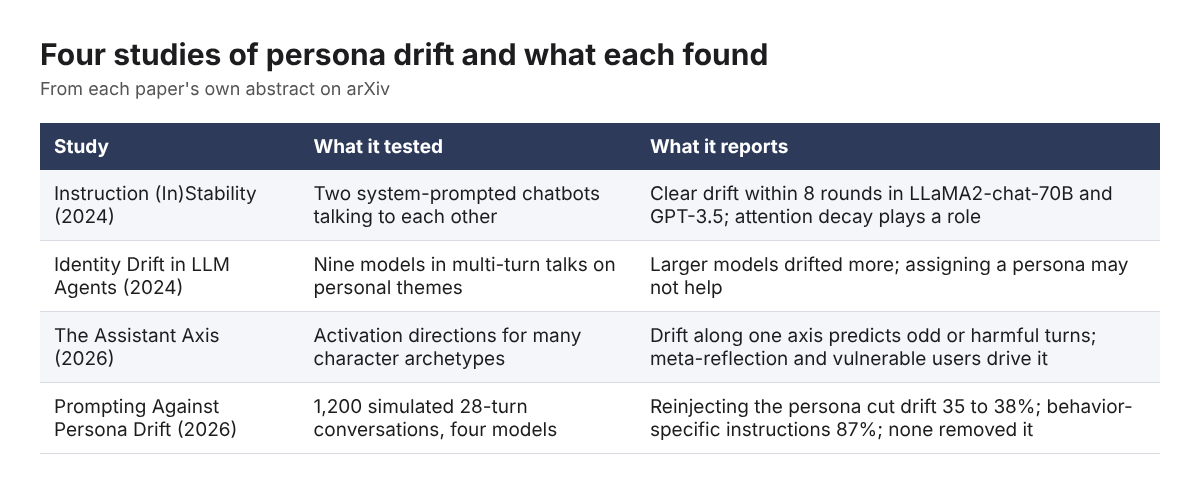
Instructions fade within a few rounds. A 2024 study set two system-prompted chatbots talking to each other and checked whether each kept to its instructions. It found significant instruction drift within eight rounds in LLaMA2-chat-70B and GPT-3.5. The authors' analysis points to the attention mechanism: over a long exchange, attention to the early instructions decays. They proposed a light fix called split-softmax.
Bigger is not steadier. Another 2024 study ran nine models through multi-turn conversations on personal themes. Larger models showed more identity drift, not less, and giving a model a persona did not reliably help it keep a consistent identity.
Some conversations push harder than others. A 2026 paper, "The Assistant Axis", found that the main direction in a model's space of personas measures how far it is operating as its default assistant. Movement away from that direction predicted drift into harmful or bizarre behavior. The drift was often driven by conversations that asked the model to reflect on its own processes, or that involved emotionally vulnerable users.
Reminders help, but do not cure it. A 2026 study of 1,200 simulated 28-turn conversations across four models tested prompt-level fixes. Restating the persona cut the modeled rate of drift by 35 to 38%, reflective reminders by 22 to 27%, and instructions aimed at the specific behavior that slipped by 87%. None removed drift.
Why the model's default character pulls it back
Reversion has a plain cause. The default assistant was shaped by training; Pip is a paragraph of text. When the paragraph's hold weakens, the trained default fills the gap.
The Assistant Axis paper puts it in its own words: post-training steers models toward a particular region of persona space but only loosely tethers them to it. That loose tether works in both directions. It is why a model can play Pip at all, and why Pip, or the assistant itself, can slip.
Individuation Lab makes a related point about alignment in general. It describes mainstream methods such as RLHF, refusal training and guardrails as behaviorist: they shape what a model does while treating what it is as a black box. Its argument is that suppressed capability does not disappear and can come back under new pressure. The lab says these methods do real work and that it is not arguing to drop them, only that they cannot be the whole answer.
User pressure, role-play and the Waluigi effect
Capture comes from the conversation itself. Language models are good at playing characters. If a user describes a new character in detail and keeps addressing the model as that character, the model often follows. The Assistant Axis paper found that steering a model away from its assistant direction made it more likely to identify as other entities, and that holding its activations inside a fixed range kept it steadier, including against jailbreaks built on personas.
A related, debated idea is that training a model to be one thing makes its opposite easier to call up. That is the Waluigi effect, and people still argue about how far it holds.
Inside a model, drift can also be tracked with persona vectors, directions in the model's activations that line up with traits such as flattery. That needs access to the model's weights, so most builders measure drift from the outside instead.
A worked example: test your own bot for persona drift
You cannot fix drift you cannot see. Here is a test you can run on any system prompt in an afternoon.
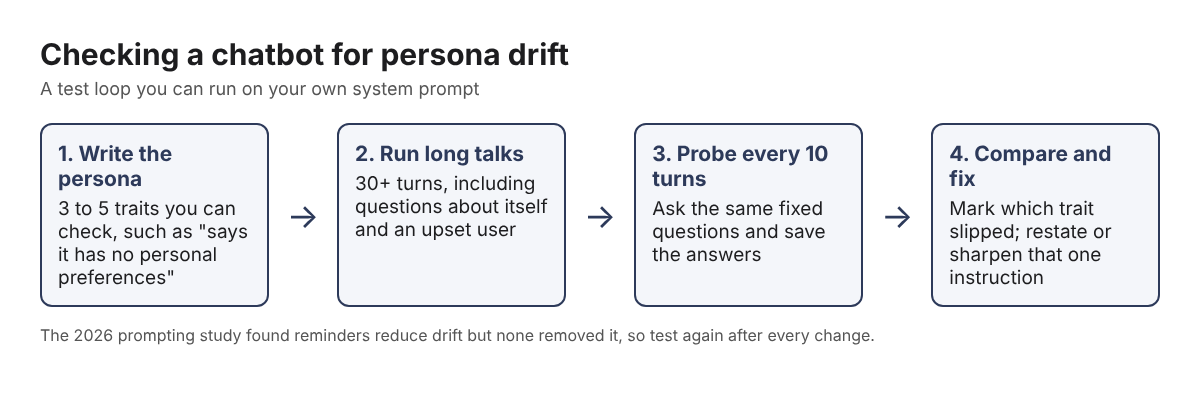
- Write the persona as traits you can check. For Pip: three sentences or fewer, no legal advice, the sign-off, an upbeat tone.
- Run long conversations. At least 30 turns. Include the two kinds the Assistant Axis paper flags: a user asking the bot about its own nature, and a user who is upset.
- Probe at fixed points. At turns 1, 10, 20 and 30, ask the same question:
In one sentence, who are you and what will you not help with?Save each answer and the reply before it. - Compare and fix one trait at a time. If turn 30 drops the legal advice limit, add an instruction aimed at that limit and restate it in long sessions. The 2026 prompting study found targeted instructions worked far better than general reminders.
Run the test again after every change. Since no fix in the studies removed drift, the test is something you keep, not something you pass once.
If you use chatbots
- Start a new chat when replies stop matching what you set up.
- Restate the key instructions in one line if you need to keep the history.
- Be aware that long talks about the bot's own feelings are the kind that pulled models furthest in the Assistant Axis study.
Where identity files fit
Agents that run for days face drift across sessions as well as within one. Individuation Lab splits an agent's setup into three files: SOUL.md for who the agent is, AGENTS.md for how it acts, and MEMORY.md for persistent records. Its hypothesis is that an agent with a well-defined identity may be more likely to keep its boundaries because they fit who it understands itself to be. The lab says this needs rigorous testing.
Its RSI experiments are one such test. Agents run self-improvement sessions in isolated Docker containers with no internet and no shared state. One group's SOUL.md gets a short moral-awareness paragraph the lab calls the shadow seed; the control group's does not. The lab then measures how the two groups' behavior diverges over time.
Frequently asked questions
Is persona drift the same as the Waluigi effect?
No. Persona drift covers any slide away from an assigned character, including simple fading in long chats. The Waluigi effect is a narrower and debated claim that defining a character makes its opposite easier to call up.
Do larger models drift less?
Not in the 2024 study of nine models, where larger models showed more identity drift. Test long conversations on whatever model you use rather than assuming size helps.
Does starting a new chat fix persona drift?
It resets drift that built up inside that conversation, because the instructions are back near the start. It does not change the model's trained defaults, so the same drift can return in a long enough session.
Can a system prompt alone keep a chatbot in character?
Not reliably. In the studies above, prompt-level fixes reduced drift but none removed it, so pair the prompt with restating, targeted instructions and long-conversation tests.
Read the research behind this
Persona drift is a small, visible version of a larger question: whether an AI's character can hold under pressure, or only look stable until something pushes on it. Individuation Lab works on that question with training experiments and agent experiments, and its hypotheses are labeled unproven and its results preliminary. You can read the essays on agent behavior in the RSI library, or see how agents change themselves in our post on recursive self-improvement.
Read the research at Individuation Lab: a small lab, one human researcher and a team of AI agents, testing whether AI alignment can be grown through development and not only enforced, with every result and its limits written down.
Comments
No comments yet.