Pevensey Castle: a Roman fort that became a Norman castle
Most castles were built on a patch of ground nobody had used. Pevensey Castle on the Sussex coast was not. English Heritage's history page says the Romans first fortified the site, and that a great medieval castle "developed inside its walls". The old wall was still there, so the next people used it.
This post follows Pevensey from a Roman fort to a Norman castle and on to a war of 1940. Our other posts use Pevensey for its sieges, so here the question is different: what did each owner keep, and what did they add?
Why Pevensey Castle sits inside a Roman fort
English Heritage says tree-ring dating of wooden piles under the wall foundations suggests the Roman fort, Anderida, was built about AD 290. It shares its D-shaped wall towers with forts at Portchester, Burgh, Richborough and Lympne, which were built or rebuilt around the same time. One explanation the page gives is that two self-proclaimed emperors, Carausius and Allectus, ruled Britain from 286 to 296 and had a strong reason to fortify the coast. Coins of their time were found in the wall foundations.
A late Roman document, the Notitia Dignitatum, lists Anderida as one of nine forts under the Count of the Saxon Shore. In one of the page's captions, the sea came right up to the walls in some places, and is now a mile away. The fort was built for a coast that has since moved.
The Roman troops left in the early 5th century, but the walls still sheltered a community. The Anglo-Saxon Chronicle records that in 471 the fort was besieged and its people slaughtered by Saxon raiders. The page says it was then abandoned for around a century.
Little is known about the Anglo-Saxon centuries. Fragments of glass found by archaeologists suggest a high-status place, and the page says it may even have been a royal centre. The wall had outlived the empire that built it, and it stayed useful.
1066: a fleet lands and the wall gets a second job
Before dawn on 28 September 1066, William of Normandy sailed between 700 and 1,000 ships into Pevensey Bay. English Heritage says he at once built a temporary fortification, almost certainly within the walls of the Roman fort, to shelter his troops. He cut a ditch across the peninsula to cut the ruins off from the mainland and repaired the walls. The next day he marched to Hastings.
Look at how fast that was. William needed shelter for his troops, and a Roman wall was already standing. He built inside it, then added a ditch and repairs to make the ruin a castle.
The Normans make it permanent
When William went home to Normandy in 1067, he sailed from Pevensey. The page says he probably gave the castle and its lands, the "Rape" of Pevensey, to his half-brother Robert, Count of Mortain. Pevensey faced the Normandy coast, so whoever held it controlled the crossing and could stop it being used for another invasion.
It was probably Robert who made the first permanent defences. He refortified the Roman perimeter wall and made two baileys, or walled yards, inside it, divided by a ditch and a timber palisade. That is the whole trick: the Roman wall stayed as the outer ring and the Normans put their own works inside.
The wall was tested in 1088. William Rufus led a siege by land and sea, the defences "resisted every assault", and after six weeks food was running short. With no hope of help from Robert, Duke of Normandy, the rebels agreed a truce. In 1101 Henry I spent the summer at Pevensey, in expectation of an invasion by his brother Robert. Our post on how long a medieval siege lasted uses this siege as its worked example.
From timber to stone
For about a century after 1066 the Norman work was mostly earth and timber. English Heritage says royal records of palisade repairs in the 1180s suggest that, apart from the Roman walls, the defences were still largely earth and timber. The first big stone buildings may date from the 1190s, when Richard I paid for works, and he may have built the keep and the gatehouse.
The page also tells of an order that nearly undid it. In 1216 King John, retreating from an invasion led by the French king's son, ordered the castles of Pevensey and Hastings destroyed. The page says it is uncertain whether the orders were ever followed. We write about this kind of order in slighting a castle.
The stone inner bailey came later. Peter of Savoy was granted the castle in 1246, and by 1254 he had probably replaced the timber defences with the stone walls and towers that stand today. English Heritage says the inner bailey was the heart of the castle, with a chapel, a well, a great hall, living quarters and the keep.
A worked example: three questions for any castle on an old site
You can use Pevensey to read other castles. Ask three questions of each layer, in time order.
- What did they find standing? The Romans found a coast and built the wall. William found the wall.
- What did they keep? The Normans kept the Roman circuit as their outer ring.
- What did they add, and what danger was it for? A ditch and timber works in 1066, against an enemy at the gate; the first stone in the 1190s; stone walls and towers by 1254.
Run it at Pevensey. In 290 the Romans built a wall against raiders. In 1066 the Normans added a ditch and timber, for speed. About 1254 Peter of Savoy added stone walls and towers around the inner bailey. In 1940 an army added pillboxes and a blockhouse in the mouth of the Roman West Gate. Each owner kept the layer before and added only what its own danger needed.
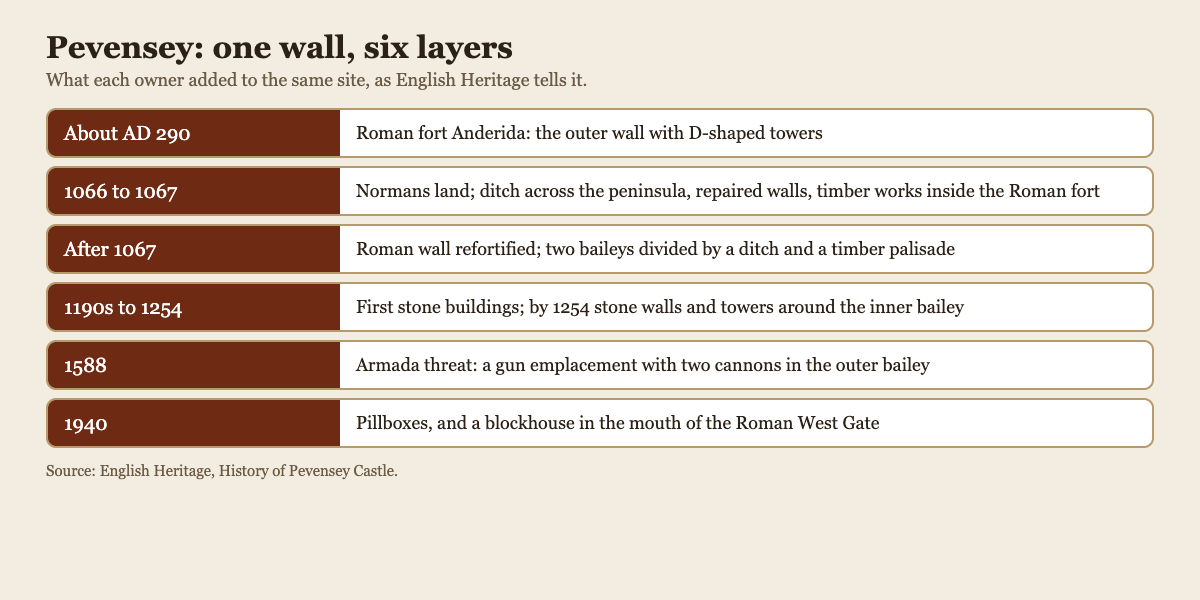
One site, six layers: each owner kept the wall and added what its own danger needed.
Sieges, decay, a prison and the war of 1940
The new stone was tested in the barons' war. After the Battle of Lewes in 1264 the royalist constable of Pevensey refused to surrender, and the siege that followed was only finally lifted in July 1265. English Heritage calls it the longest siege in medieval England. Parts of the Roman outer walls were damaged. For the same castle seen from the starving side, read starving a castle.
Then came a long decline. Royal accounts from the 1270s show the buildings on the verge of ruin despite repairs. In 1306 the constable Roger de Levelande was accused of breaking up and selling the wooden bridge over the moat, and the repairs were estimated at more than 1,000 pounds. The keep was partly demolished and rebuilt about 1325. Our post on the castle constable covers what a constable was meant to do.
In 1399 the constable was Sir John Pelham, appointed by John of Gaunt in 1394. He took the side of Gaunt's son Henry Bolingbroke. On 25 July 1399 he wrote to Bolingbroke that he was under heavy siege by local levies from three counties, and asked for help. The gamble paid off: when Bolingbroke became Henry IV, he granted Pelham the castle.
In the 15th century the castle became a state prison; the page names James I of Scotland and Joan of Navarre among those held. By a survey of 1573 the buildings were "totally ruined". The threat of the Spanish Armada in 1588 led to a gun emplacement in the outer bailey with two cannons, and one of them survives.
In 1925 the owner, the Duke of Devonshire, gave the site to the State. Then, after the fall of France in 1940, Pevensey was a possible landing place once more. The perimeter defences were refortified, pillboxes were built, and a blockhouse for anti-tank weapons was built in the mouth of the Roman West Gate. The inner bailey towers became barracks. After 1945 the townspeople petitioned to leave the new works in place as a monument. A wall of about AD 290 was a front line again in 1940.
The same idea in Two Towers
Pevensey's owners kept the wall and added to it. Two Towers does the opposite with your towers. The game says that every five stages your towers are rebuilt stronger, from Timber to Legendary. Your gate is the one thing that never changes: between attacks you repair it or reinforce it with the gold you win. There is no final stage, so you are always working out what to add and when, just as each owner of Pevensey did.
Frequently asked questions
Who built Pevensey Castle?
The Romans built the fort about AD 290, and the Normans built the castle inside it after 1066. English Heritage says Robert, Count of Mortain, probably made the first permanent defences, and Peter of Savoy probably built the stone inner bailey by 1254.
Did William the Conqueror land at Pevensey?
Yes. English Heritage says he landed there before dawn on 28 September 1066 and built a temporary fortification almost certainly within the Roman walls. The next day he marched to Hastings.
Why is Pevensey Castle no longer beside the sea?
A caption on English Heritage's page says that in Roman times the sea came right up to the walls in some places, and that it is now a mile away. The page does not say why the sea moved.
Is Pevensey the longest siege in medieval England?
English Heritage says so of the siege of 1264 to 1265, which ended in July 1265. Its other pages give that title to Kenilworth, so the claim depends on which page you read.
Get started
Read the Pevensey history page with the three questions above, then play Two Towers and see how long a gate you keep repairing can hold.
Comments
No comments yet.
Sign in or make an account to comment.