Piano Music for a Language Lesson Video: What Works
Piano music for a language lesson video has one job: keep the room warm without competing with the words. Wavecrate does not offer a solo piano track, so this guide is honest about what it does hold, shows how to keep any music under a teacher's voice, and ends with the license your lesson video needs.
Piano music for a language lesson video: what Wavecrate has
On 17 October 2026 we opened every one of the 100 music tracks on the music page and read its description. Seven mention piano, and none says solo piano.
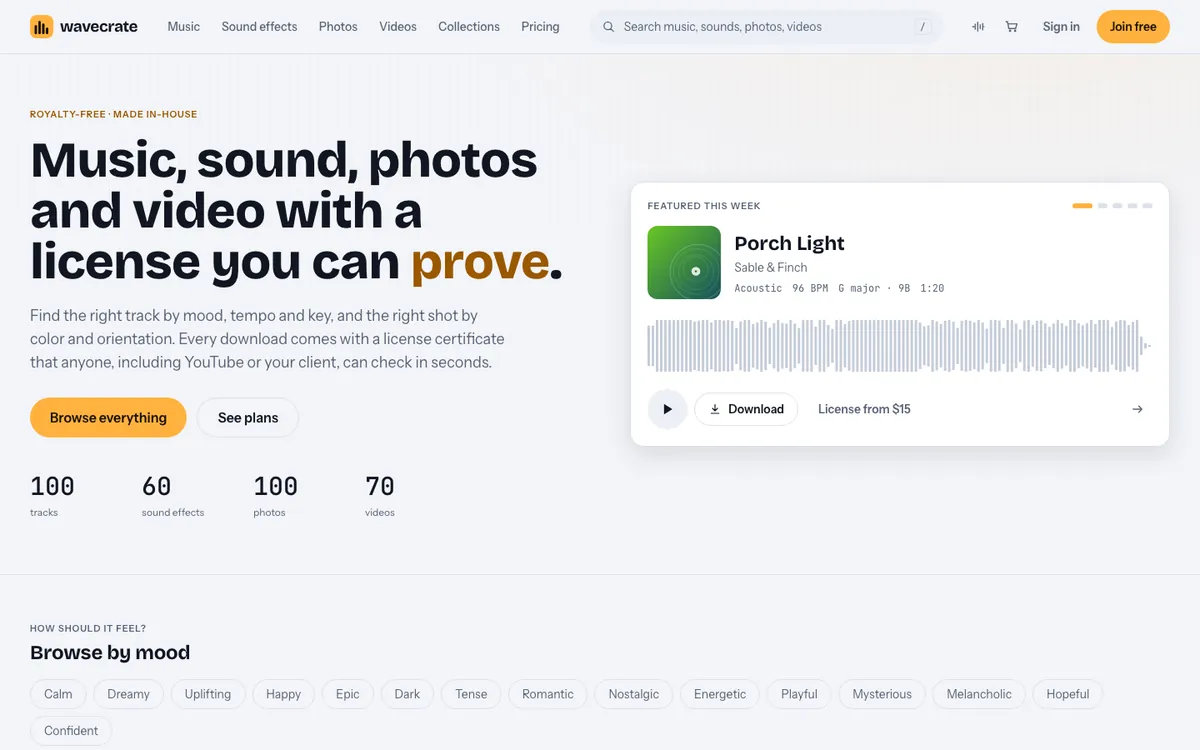
- Four Lo-fi tracks are described as "Dusty swung drums under soft electric piano chords and a little vinyl crackle": Tea and Tape, Night Bus Home, Rainy Window Notes and Paper Lanterns.
- Three Hip-hop tracks (Concrete Garden, Corner Store Sunday and Lagos Rooftop) are described as "Boom-bap drums, deep sub bass and a looping piano phrase."
The Hip-hop tracks bring heavy drums and sub bass, which is a lot to put under someone learning to hear new sounds. The Lo-fi tracks are the closer fit. Electric piano is not a grand piano, so play each track before you decide.
What to listen for under a teacher's voice
A few simple rules of thumb decide whether a track helps or gets in the way.
- No singing. Words in the music compete with the words you teach. Use the Vocals filter on the music page and choose Instrumental.
- Slow and level. The Tempo filter offers Slow (under 90 BPM), Mid (90 to 120) and Fast (over 120). The Energy filter runs from Calm and Relaxed up to Intense. Start with Slow and Calm or Relaxed.
- Gaps for your voice. Soft chords with space between them leave room. A track that keeps adding layers will not.
- A mood that fits the task. The mood list includes calm, dreamy, hopeful and nostalgic. Calm suits a grammar explanation; hopeful suits a recap.
Four Lo-fi tracks that mention piano
All four are in the Lo-fi genre. Here is what each page showed on 17 October 2026.
- Tea and Tape: marked Free, 82 BPM, Relaxed, tagged calm and happy, Instrumental. Its tags are study and cooking.
- Night Bus Home: marked Free, 78 BPM, Relaxed, tagged calm and nostalgic, Instrumental.
- Rainy Window Notes: a Premium track, 72 BPM, Calm, tagged calm and dreamy, Instrumental. It is the slowest and calmest of the four.
- Paper Lanterns: a Premium track, 84 BPM, but its Details line reads "With vocals", so skip it for a lesson.
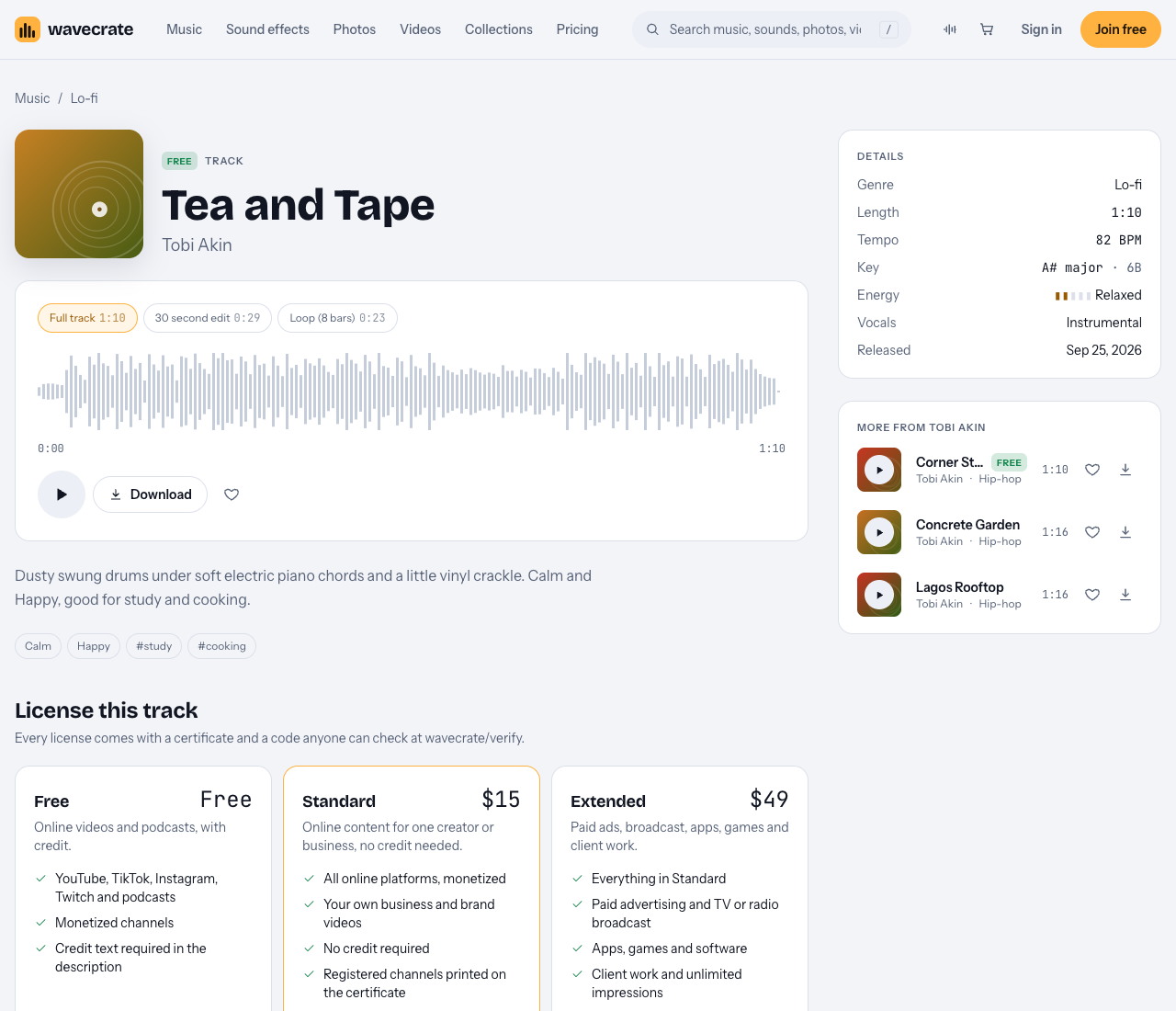
The Tea and Tape page: description, three versions and the three license cards.
Every track page lists three versions: the full track, a 30 second edit and an 8 bar loop. Tea and Tape runs 1:10, 0:29 and 0:23. Rainy Window Notes runs 1:10, 0:30 and 0:27. The short edit suits an intro or outro, and the loop suits a bed you repeat under a longer part.
Find more with the filters
Piano is not a filter, but the others get you close. On the music page set Vocals to Instrumental, Tempo to Slow, Energy to Calm or Relaxed, and a mood such as calm or hopeful. Then open the Ambient and Acoustic genres too. We did not find piano in their descriptions, but a calm, slow, instrumental track under a lesson does not need to be piano to do its job.
The Study and focus collection is a good place to browse by feel. You can also filter to Free items.
A worked example: a ten minute lesson on ordering food
Say you teach Spanish and are filming a ten minute lesson on ordering food. Here is one way to place music, using one track so the series sounds the same each week.
- 0:00 to 0:30, intro. The 30 second edit of Night Bus Home plays while you say hello and name the goal. It fades out as you start the lesson.
- 0:30 to 4:00, vocabulary. No music. You say a word, pause, and the learner repeats it. Silence makes each word clear.
- 4:00 to 8:00, grammar. The loop of Night Bus Home sits very low under your voice while you explain how to ask for something politely.
- 8:00 to 9:30, listening practice. No music again, because the audio is the exercise.
- 9:30 to 10:00, recap. The same track returns, a little louder, as you repeat the five phrases to remember.
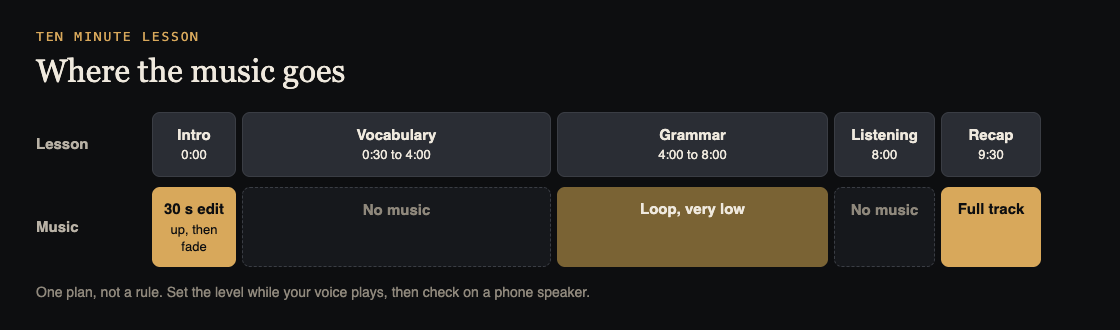
Set the music level while your voice is playing, never with the music alone. Then listen once on laptop speakers or a phone. If you have to strain to follow a sentence, lower the music further.
Which license a lesson video needs
You do not own the music. The pricing page says: "You get a license to use it. We keep the copyright." What you may do depends on the card on the track page. Paid licenses are not on sale yet: Wavecrate says purchases open soon, so the prices below are the listed prices for when sales open. Items marked Free can already be downloaded with a free account.
- Free. Only on items marked Free, like Tea and Tape and Night Bus Home. The card reads "Online videos and podcasts, with credit", covers monetized channels, and needs credit text in your description. A free account gets 3 free downloads a month.
- Standard, listed at $15 a track. Online content for one creator or business, no credit needed, with your registered channels printed on the certificate. Your own business and brand videos are included.
- Extended, listed at $49 a track. Paid advertising, TV or radio broadcast, apps, games and software, and client work. If a school or company pays you to make the lesson, that is client work.
- Pro. Listed at $99 a year or $12 month to month and not on sale yet, with a Standard license on the whole catalog. Pro does not include Extended.
The pages do not say how a paid course sold on your own site is treated, and Wavecrate has no terms page that does. Read the cards on the track you chose and decide from what they list. Every download comes with a certificate and a code that anyone can check on the verify page, which shows the licensee, the item, the license type and the registered channels. See the pricing page for the full table.
Frequently asked questions
Does Wavecrate have solo piano music?
Not that we could find. Seven of the 100 music tracks mention piano, four as soft electric piano chords under Lo-fi drums and three as a looping piano phrase in Hip-hop. Listen before you choose.
Should a language lesson have music under the whole video?
It is your choice. A common plan is to keep music to the intro, the outro and calm explanations, and use silence for vocabulary and listening practice so each sound is clear.
Can I use a Free track in a monetized lesson on YouTube?
The Free card covers online videos and podcasts, including monetized channels, with credit text in your description. Only items marked Free have it, and a free account gets 3 free downloads a month.
Do I need Extended if a company pays me to make the lesson?
Extended lists client work, so read that card first. Standard lists your own business and brand videos.
Get started
Browse Wavecrate: you can join free and download items marked Free now, paid licenses are not on sale yet (purchases open soon), and every download comes with a license certificate and a code anyone can check on its verify page.
Pick a slow, calm, instrumental track and test it under ten seconds of your own voice before you download it. To try Wavecrate, join free and use your 3 free downloads a month on items marked Free.
Comments
No comments yet.
Sign in or make an account to comment.