Plato vs Aristotle: the key differences explained
Plato vs Aristotle is the most famous teacher and student pair in philosophy. Aristotle spent about twenty years at Plato's Academy in Athens, then built a way of thinking that differs from his teacher's on almost every big question. This guide puts the two side by side on four of those questions, using the Stanford Encyclopedia of Philosophy as the source, and gives you a method you can reuse for any pair of thinkers.
Plato vs Aristotle: who they were
The Stanford entry on Aristotle gives the outline of how the two lives meet. Aristotle was born in 384 BCE in Stagira, in northern Greece. At about seventeen he was sent to Athens to study in Plato's Academy, "then a pre-eminent place of learning in the Greek world". He stayed associated with it until Plato died in 347.
After Plato's death Aristotle left Athens. In 343 he went to the Macedonian court to tutor the king's thirteen-year-old son, Alexander, the future Alexander the Great. The entry is careful here: "little concrete is known about their interaction", and the tuition probably lasted only two or three years. Back in Athens, Aristotle set up his own school, the Lyceum, where members researched botany, biology, logic, mathematics, ethics, political theory and much more. He died in Chalcis in 322.
Plato wrote dialogues, many with his own teacher Socrates as the main speaker. If you want that earlier step in the chain, read Socrates vs Plato first.
What is most real: forms or things?
This is the split everyone starts with. The Stanford entry on Plato sums up the doctrines most people link to him: the world our senses show us is "in some way defective and filled with error", but there is "a more real and perfect realm", populated by forms that are "eternal, changeless". The most basic distinction in his thought is between the many things that look beautiful or good and the one thing that is what beauty or goodness is.
Aristotle keeps the word "form" but brings it down to earth. In his account, a thing is form in matter. The entry on his metaphysics uses a bronze ball as the example: "The bronze and the roundness are not two separate things." You do not need a second world to explain why this ball is round.
To explain anything fully, Aristotle asked for its four causes. Take a statue:
- Material: what it is made of, the bronze.
- Formal: the shape that makes it this statue.
- Efficient: what made it, the sculptor at work.
- Final: what it is for.
According to the Stanford entry, Aristotle held that once you have named all four, you have met "a reasonable demand for explanatory adequacy". For more on how this shaped his science, see Aristotle's contribution to science.
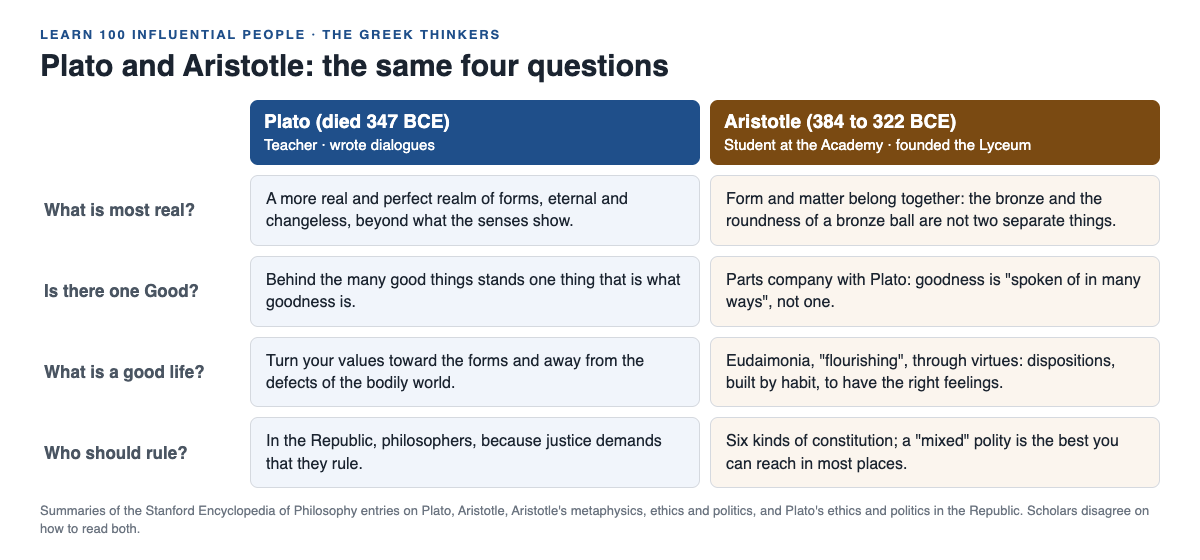
Plato and Aristotle on the same four questions, summarised from the Stanford Encyclopedia of Philosophy.
How do you know: recollection or observation?
If the most real things are not in the world of the senses, how do you come to know them? In a few works, Plato says the soul keeps the ability to "recollect" what it once grasped of the forms before birth, most famously in the dialogue Meno. Learning, on that view, is closer to remembering.
Aristotle starts closer to the ground. The Stanford entry says that after he left the Academy he "in all likelihood" began to expand his research into marine biology, and the Lyceum collecting manuscripts on a long list of subjects. He also built a theory of deduction "now called syllogistic", a way to test which arguments follow and which do not.
Be careful not to turn this into a cartoon. Plato did not ignore the world, and Aristotle did not distrust reason. The difference is where each one starts: Plato from what reason grasps beyond appearances, Aristotle from the things in front of him.
Is there one Good? What a good life looks like
For Plato, the good things around you point to one Good. The Stanford entry says he urges us to "transform our values" by taking to heart the greater reality of the forms. In the Republic, the soul has three parts, reason, spirit and appetite, and the form of the good stands behind the famous images of the Sun, the Line and the Cave, according to the entry on the Republic's ethics and politics.
Aristotle disagrees at the root. The Stanford entry says he "parts company with Plato" over whether goodness is one thing. His favourite phrase for words like "good" is "being spoken of in many ways".
His ethics, as the entry on Aristotle's ethics sets it out, begins with eudaimonia, "happiness" or "flourishing". Virtue is a disposition, built by habit, to have the right feelings. The courageous person lies between the coward, who flees every danger, and the rash person, who thinks every danger worth facing. That middle is not an arithmetic midpoint, and ethical virtue is fully developed only together with practical wisdom.
Who should rule: philosophers or a mixed constitution?
The Republic is where Plato puts philosophers in charge. The Stanford entry reads it this way: "the philosophers rule because justice demands that they rule."
Aristotle's Politics starts from the claim that human beings are "by nature political animals". According to the entry on his political theory, he sorts constitutions into six kinds, a scheme "doubtless adapted from Plato's Statesman":
- One ruler: kingship, or its deviant form, tyranny.
- Few rulers: aristocracy, or oligarchy.
- Many rulers: polity, or democracy.
For most real cities, he thought the best you can reach is a polity, a "mixed" constitution led by a middle group of citizens between the rich and the poor. He is also sharply critical of the Republic: he says it overvalues unity, that its plan for children and property held in common is impractical, and that it neglects the happiness of individual citizens.
A worked example: compare them on four questions
Here is a method you can use for an essay, a class discussion or your own notes. It is the same four questions as the diagram above.
- Pick four questions both thinkers answer. Here: what is most real, is there one Good, what is a good life, who should rule.
- Write each answer in one line, from a source. For example: Plato, a realm of eternal forms; Aristotle, form in matter.
- Quote one sentence for each side. "The bronze and the roundness are not two separate things" is a good one for Aristotle.
- Mark where they agree. Both care about form and about virtue; the quarrel is over where form lives and how you reach the good.
- Leave the verdict to the reader. Give each side its strongest case.
If you are writing this up, how to compare two historical figures in an essay turns these notes into a structure.
Where scholars disagree
The two kept arguing long after both were dead. The Stanford entry on Aristotle notes that Avicenna and Averroes wrote commentaries that "interpreted and developed Aristotle's views in striking ways", and that Thomas Aquinas sought to reconcile Aristotle with Christian thought. Even that is debated: some Aristotelians think Aquinas bent Aristotle, some Christians think he gave too much to a pagan, and many others see a brilliant synthesis.
Scholars also disagree about how far apart Plato and Aristotle really were, since Aristotle kept many of his teacher's words while changing what they meant. Set out both readings and let the evidence lead.
Frequently asked questions
Was Aristotle a student of Plato?
Yes. He went to Plato's Academy in Athens at about seventeen and stayed associated with it until Plato died in 347 BCE.
What is the main difference between Plato and Aristotle?
Plato held that the most real things are eternal, changeless forms beyond the world of the senses. Aristotle held that form lives in matter, in the individual things around you.
Did Aristotle agree with Plato's Republic?
No. He criticised it for overvaluing unity and for a plan of shared children and property that he thought impractical, and he preferred a mixed constitution for most cities.
Who was more influential, Plato or Aristotle?
There is no agreed answer. Each shaped later philosophy in different ways, and scholars still argue over how to read both.
Get started
Plato and Aristotle are both in The Greek Thinkers, a Basic course on Learn 100 Influential People with Socrates, Euclid, Archimedes and Hippocrates. Basic means "The best-known names, no background needed." Lessons take about 9 minutes, questions ask you to choose, put in order, match, sort and estimate a number, and 38 cards set out where researchers disagree. Every lesson lists its sources, as the about page says, so you can read the original work. Sign in with your email and an emailed code, and questions from finished lessons come back for review, up to 5 a day.
Comments
No comments yet.
Sign in or make an account to comment.