Poka-yoke at home: mistake-proof a daily task
Poka-yoke at home means you change a daily task so a mistake either cannot happen or shows up the moment it does. The term comes from factories, but the idea fits a hallway or a kitchen just as well. This guide shows you how to use poka-yoke at home: pick one repeat mistake, find where it starts, add a small guard, and check for a week whether the guard holds.
What poka-yoke means and why it fits a home
The Lean Enterprise Institute defines poka-yoke as a Japanese term for error-proofing with simple, inexpensive devices. "Poka" means inadvertent error and "yoke" means prevention. Its purpose is to find a defect at its source, so the problem can be solved and the defect stops coming back.
The key move is to change the setup, not to ask more of the person. A part shaped so it only fits one way is poka-yoke. So is a washing machine that will not start until its door is closed, one of the everyday examples on the same page. Spell-check is another.
The page names two kinds of guard:
- Shutdown: the next step will not start until this one is done right. It calls these the most powerful.
- Warning: the mistake can still happen, but something tells you right away, like a buzzer or a light.
It also lists what makes a good guard: simple, long-lived, low maintenance, reliable, inexpensive, and designed for the place it is used. That last point matters at home. Your hallway is not a factory, so the guard should fit how your hallway actually works.
Pick one daily task that keeps going wrong
Pick one task. Only one. The best candidate has three traits:
- It happens often, ideally every day.
- The same mistake keeps coming back.
- Each mistake costs you something you can name: time, money, a late arrival, a wasted meal.
Common examples: leaving without your keys, missing bin day, letting the phone die overnight, leaving food out of the fridge. Write the problem down in one line, as plainly as you would say it out loud. "I leave without my keys about twice a week" is better than "I need to be more organised." The first one you can fix. The second one you can only feel bad about.
Find the exact mistake and where it starts
"Forgot the keys" is the result. The mistake starts earlier. Walk back through the task step by step and ask where it first goes off track.
Ask yourself:
- Where were the keys when I left without them?
- Why were they there and not somewhere I would see them?
- What was I doing in the last two minutes before I walked out?
You will often find the mistake is about where something was put, not about memory. The keys were in yesterday's jacket. Or on the kitchen counter under the mail. The guard belongs at that point, not at the front door. If the answer to "why" keeps going deeper, the 5 whys example walks through the same questioning one step at a time.
Choose a guard: shutdown or warning
Once you know where the mistake starts, pick a guard. Start with the cheapest one that changes the setup rather than your habits.
Shutdown guards
- Block the next step. Leave tomorrow's bag against the front door with the keys inside, so you cannot open the door without picking the bag up.
- Tie the task to something you never skip. Put the lunch box in front of the milk, so you move it every time you make coffee.
- Make the right place the only place. One hook by the door is where keys live, and the counter is kept clear of anything they can hide under.
Warning guards
- Make absence visible. An empty hook is easy to spot on the way out. A charging tray with one spot per phone shows at a glance which phone is not charging.
- Put the check where you already look. A note on the inside of the front door is seen more than a note on the fridge.
Write each guard you consider as a separate idea. You will probably try more than one.
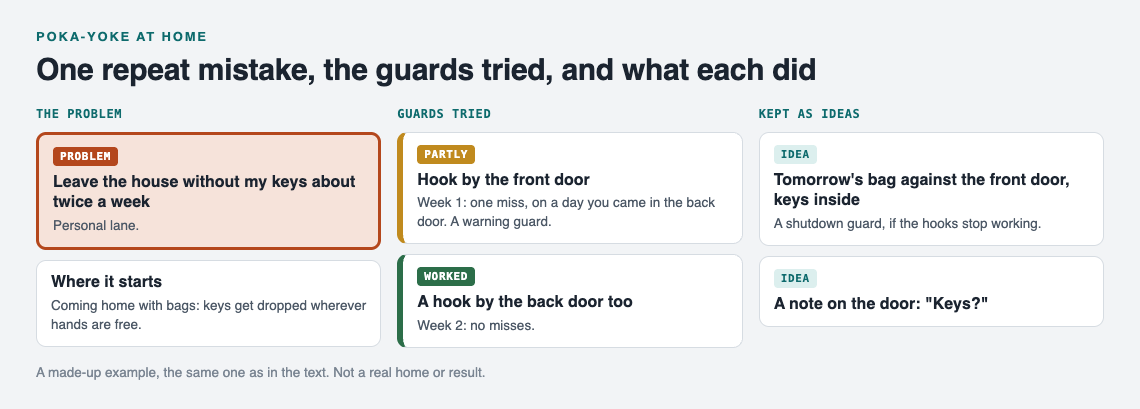
The worked example as a map: one problem, the guards tried, and their outcomes.
Worked example: poka-yoke at home for your keys
Here is the full loop, written the way you would log it in Problem Graph.
The problem, in one line: "Leave the house without my keys about twice a week." You put it in the personal lane. It lands on your graph as soon as you press Enter.
Where it starts: after a few days of paying attention, you notice the keys go missing on days you come home with bags. You drop them wherever your hands are free.
Guards, added as ideas:
- A hook by the front door, at hand height (a warning: an empty hook shows the keys are missing).
- Tomorrow's bag against the front door with the keys inside (a shutdown).
- A note on the door: "Keys?"
What you try first: you mark the hook as the one you are trying. It is the cheapest guard, and it sits exactly where the mistake starts: the moment you walk in.
The outcome after a week: you left without your keys once, on a day you came in through the back door. You record the hook as partly. That one word tells you something real. The guard works, but only at one entrance.
The next round: you add a new idea, "A hook by the back door too," and try it. The next week there are no misses, so you mark it worked. The bag and the note stay on the graph as ideas you never needed. If the hooks ever stop working, they are waiting there.
The point of logging it this way is that the graph keeps the history for you. A month later you will not remember why there are two hooks. The map will.
Test the guard for a week and log what happened
A guard is a guess until you test it. Give it one ordinary week, and judge it at the end of the week rather than on the first day.
At the end of the week, pick one of three outcomes:
- Worked: the mistake did not happen.
- Partly: it happened less, or only in one situation.
- Failed: no real change.
Record failures too. A guard that failed tells you where the mistake does not start, which narrows the search. Problem Graph's home page puts it this way: "The graph is honest. A solution that failed three times stays on the map as a failed solution, and that is exactly what the next person needs to know." The next person is often you, months from now. If you already keep a home maintenance log, this is the same habit applied to routines instead of repairs.
When a guard is not enough: pair it with andon
Some mistakes cannot be designed away. You cannot put a hook on "I overbook my weekends." For those, you need a signal that makes the problem visible early, before it grows. The Lean Enterprise Institute calls that kind of signal andon, a visual tool that shows status at a glance. The post on andon at home shows how to set one up.
The two work together. Poka-yoke stops the mistakes you can predict. Andon flags the ones you cannot.
In Problem Graph you can link problems that belong together, even across lanes. Say you log "Forget keys," "Forget lunch," and "Late for the 8:05 train." Linked on the map, they may point at one shared cause: mornings with no spare minutes. That is a pattern you could miss in a list of separate to-dos, and it lets you work on the cause instead of three results.
Your graph is private by default, so nobody else sees it. If a fix is worth passing on, you can mark a problem as a main node and share it into a private network, like your household, or put it out for everyone, where others can borrow the solution that worked. A shared main node carries its solutions and their outcomes with it, so people see what held and what did not.
Frequently asked questions
What is a simple example of poka-yoke at home?
A single key hook by the door is a common one. Keys have one home, and an empty hook shows you at a glance that they are missing.
What is the difference between poka-yoke and andon?
Poka-yoke changes the setup so a mistake cannot happen or is caught at once. Andon is a signal that makes a problem visible early so you can deal with it before it grows.
Which daily tasks are worth mistake-proofing first?
Start with a task you do every day, where the same mistake keeps coming back and each slip costs you something you can name. Keys, bin day and phone charging are good first picks.
How do I know if my guard is working?
Test it for one ordinary week and record the outcome as worked, partly or failed. If the mistake still happens, note when, because that usually shows you the situation the guard does not cover.
Get started
Pick the one task that went wrong this week. Write it as a single line. Add two or three guards as ideas, mark the one you will try, and come back in seven days to record what happened. If you want to see how a graph looks before you start your own, the app offers a "Load example set" button on an empty graph.
Try Problem Graph: it is free, and you can look around the public network without an account. Write one problem down in a line and attach the first thing you will try.
Comments
No comments yet.
Sign in or make an account to comment.