Portland Castle: Henry VIII's gun fort on the Dorset coast
Portland Castle stands on the Dorset coast, and it was built for one job: to fire guns at ships. English Heritage says Henry VIII had it built in 1539 to 1540, as one of two forts with heavy guns guarding the anchorage of Portland Roads. It then served as a coastal defence until 1816, held out in the English Civil War, became a family home, and ended up as a naval training base. This guide follows it through those years, using the history page English Heritage publishes for it.
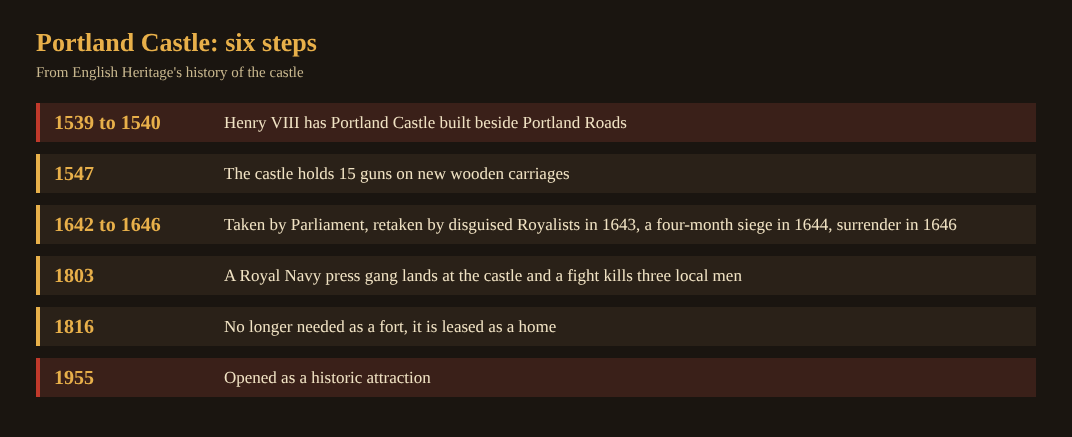
Portland Castle in six dates, from English Heritage's history page.
Why Henry VIII built Portland Castle
The castle was part of a national plan. During Henry VIII's reign new forts went up at important ports and anchorages along the east and south coasts. The threat that prompted them came from Europe, where Charles V of the Holy Roman Empire and Francis I of France were being urged by Pope Paul III to invade England. Their alliance was unlikely, since the two were usually hostile to each other. English Heritage says it was partly a response to Henry's divorce from Katherine of Aragon in 1533 and the Act of Supremacy of 1534, which made him head of the church in England. Pope Paul brokered the alliance in 1538 to 1539.
English Heritage adds that how real the invasion threat was is debatable. The government acted fast anyway. In February 1539 the Privy Council enacted what it called "the device of the king", a plan to improve the nation's defences, and "expert men" were sent round England and Wales to recommend what to do. Sir John Russell, the most powerful king's man in the west, reported on Portland.
Portland Roads is a large stretch of deep water, sheltered from the worst weather by the Isle of Portland and by the natural barrier of Hamm Beach and Chesil Beach, which joins the island to the mainland. English Heritage says it was a valuable refuge for English ships, and for that reason an attractive target for an enemy who might land troops and supplies there for a campaign inland.
Henry's builders provided two forts. Portland Castle sits on the southern shore, close to the eastern end of Chesil Beach. Sandsfoot Castle stood on a low cliff to the north-west, towards Weymouth. Together, their guns could cross their fire at ships in the anchorage. If you want to know how a different kind of siege gun worked, read What was a bombard? The first great siege guns.
A castle shaped around its guns
Portland is not round. Other castles built in the same campaign had a circular plan for all-round defence, but English Heritage says Portland's main gun battery, which was originally two storeys high, is a segment of a circle facing the sea. Behind it sits a chevron-shaped keep of three storeys, which gave room to live and to store things. The roof of the keep was an open platform for a third tier of guns.
The wall round the castle yard and the moat outside it came later, in the mid 1620s. English Heritage says the castle may have had earthwork defences facing the land before that. You entered the yard over a drawbridge and through an L-shaped lodge in the south-west corner, probably a porter's lodging and guard house. By 1716 this building held the captain's brewhouse, a small stable and quarters for a sutler, who sold food to the garrison. After many changes it is now known as the Captain's House. For what a drawbridge did on a castle with a real landward threat, see Castle drawbridge: what it was and how it worked.
A small garrison, and guns that did not always work
The garrison of a fort like this was small in peacetime. Its job was to look after the castle, keep watch and stand for the king's government. In wartime, professional soldiers and local part-time soldiers joined it to work the guns. The first captain, Thomas Mervin, had only four gunners and two other men. In 1596 captain Carew Ralegh commanded 18 men: a porter, an under-porter, a master gunner, five gunners and ten soldiers. By 1636 the garrison was a captain and 11 soldiers and gunners.
In 1547 the castle held 15 guns on new wooden carriages, four of them large weapons that could fire a long way. Then came neglect. In 1574 the captain, John Leweston, reported that none of the guns was fit for service, and nothing was repaired until the 1580s, early in the war with Spain. A fort of this kind was only as strong as its last repair.
The Civil War siege of 1644
Repairs soon followed, and the castle was well kept for the First English Civil War, from 1642 to 1646, when the Isle of Portland was a Royalist stronghold. The garrison made a bigger defended area with new earthworks beyond the castle yard. A Parliamentary force took the castle in 1642, but Royalists disguised as friendly troops took it back in 1643. In 1644 the garrison held firm through a siege of four months. For how sieges like this ended, with or without a breach, read Starving a castle: how a blockade forced surrender.
By 1646 the war had turned in Parliament's favour and Royalist forces in the west were beaten. With no hope of aid or supplies, the Portland soldiers surrendered, and they were allowed to leave unharmed. For the wider picture, see Civil War castle sieges: what happened to the castles.
Pirates, press gangs and neglect
After the war the Commonwealth kept a garrison of about 60 soldiers. After the Restoration the castle had 16 big guns, and by then two stone platforms, the east and west batteries, stood on either side of it and could support another five guns firing into the anchorage.
The Dorset coast was a place for pirates and smugglers, and English Heritage says Portland Roads was a pirate lair. In the 1550s the captain, George Strangways, let his brother Henry store stolen goods in the castle. In 1607 Viscount Bindon, the Lord Lieutenant of Dorset, wrote to the Privy Council that Portland Castle was "the only place of refuge, and a very nursery, accounted these many years for giving succour to all pirates".
The 18th century brought more neglect. In 1702 a magistrate, Charles Langrish, wrote that there was "not a grain of powder in the Castle" and that two porters were the only garrison. In 1715 an Ordnance engineer found that none of the guns was serviceable, and repairs followed. The castle's main job was to defend merchant ships in the anchorage against privateers and pirates. In 1803 the only real invasion came from the Royal Navy: a press gang landed at the castle and went on to Chiswell village to force men into the Navy. A fight broke out, three local men were shot dead and a woman died later from her wounds.
From fort to family home to naval base
In 1816, a year after the Napoleonic Wars ended, the castle was no longer needed for defence. The Board of Ordnance leased it to a local clergyman, the Reverend John Manning, as a home. His son, Captain Charles Manning, kept it until 1869.
After 1869 the castle went back to government hands. In 1914 it became an arms and ammunition store, and in September 1916 the Royal Navy took it over as a base for floatplanes hunting U-boats in the English Channel. The Royal Air Force ran it from April 1918 until August 1919. From 1920 until 1980 it was used mostly as an anti-submarine warfare training base. It opened as a historic attraction in 1955.
What Portland Castle can teach a Two Towers player
Portland shows how a defence is tied to what it must stop. The castle faced a sea route, so its guns faced the sea, and two forts crossed their fire on the same water. In Two Towers, a medieval tower defense game, you pick the two towers that guard the city gate, and the title screen tells you what each does: "Stones on a crowd" for the Trebuchet and "Bolts through armor" for the Ballista. Gold you win goes on upgrades, and you can buy two more towers for the hills, 150 gold for the first and 300 for the second.
Portland also shows what happens when a defence is not kept up. Its guns were unfit in 1574 and 1715, and each time repairs had to come before the castle could do its job. In the game, every stage is harder than the last and there is no final stage, so the same lesson holds: a plan that was enough at stage 5 needs upgrades by stage 15.
Frequently asked questions
Who built Portland Castle and when?
English Heritage says it was built in 1539 to 1540 on the orders of Henry VIII, as one of two forts with heavy guns guarding Portland Roads. The other was Sandsfoot Castle.
Why was Portland Castle built?
It was built at a time of national emergency, when Charles V and Francis I were being urged to invade England. Portland Roads was a deep-water anchorage that ships used as a refuge, so it was also a good place for an enemy to land.
Was Portland Castle attacked in the Civil War?
Yes. A Parliamentary force took it in 1642 and Royalists disguised as friendly troops took it back in 1643. The garrison held through a four-month siege in 1644 and surrendered in 1646, when the soldiers were allowed to leave unharmed.
Is Portland Castle a medieval castle?
It is a Tudor fort, from the 16th century. English Heritage calls it a device castle, one of the forts Henry VIII built with guns in mind, and its plan faces the sea rather than a ring of walls.
Get started
Portland's guns faced the sea, and your towers in Two Towers face a road that gets busier every stage.
Play Two Towers: it is free and plays in your browser on a computer or a phone.
Comments
No comments yet.
Sign in or make an account to comment.