Pre-mortem: list what could go wrong before you start
A pre-mortem is a short meeting where you imagine your project has already failed and then work out why. This guide shows you how to run a pre-mortem, list what could go wrong before you start, turn that list into owners and fixes, and keep it in one place so it stays useful after the meeting ends. It takes about 30 minutes. You need a few people, a timer, and somewhere to write.
What a pre-mortem is and how it differs from a plan review
In a normal plan review, someone presents the plan and everyone else looks for holes. People can stay polite, and nobody wants to be the one who says the date is wrong.
A pre-mortem flips the question. You do not ask "what might go wrong?" You say "it is three months from now, and this failed. What happened?" That one change does two things:
- It makes doubt the job. Everyone is asked to name a cause of failure, so raising one is no longer disloyal.
- It makes the failure concrete. "Risks" are vague. "The van broke down in the second city" is specific, and you can act on it.
The output is a list of problems, each one written in a single line, that you can act on before you begin.
When to run a pre-mortem: projects, events, moves, and launches
Run one when the cost of a surprise is high and you still have time to change course. Good moments:
- Projects with a fixed deadline, a few people, and work that depends on other work.
- Events where the date cannot move: a wedding, a fundraiser, a show.
- Moves, where one missed step (keys, movers, utilities) blocks everything after it.
- Launches of anything people will see: a product, a website, a published guide.
The best time is after you have a rough plan but before you have spent money or made promises. Too early and there is nothing to break. Too late and the list just becomes a list of regrets.
Pre-mortem: list what could go wrong before you start (a 30-minute method)
Here is a format that fits in half an hour.
- Set the scene (2 minutes). State the goal in one sentence. Then say: "Imagine it is the day after. This went badly. Not a disaster, just clearly worse than we hoped."
- Write alone (5 minutes). Everyone writes every reason for failure they can think of, one per line, without talking. Writing in silence keeps the loudest person from setting the direction.
- Read out in rounds (8 minutes). Go around the room. Each person reads one item, then the next person. Keep going until the lists run dry. No debate yet, only clarifying questions.
- Group and link (5 minutes). Some items are the same problem in different words. Some cause others. Merge the duplicates and note which ones are connected.
- Pick the top few (5 minutes). Ask two questions of each: how likely is it, and how bad would it be? Pick the handful that score high on both.
- Assign (5 minutes). Each top problem gets an owner, a first fix to try, and a warning sign. More on that below.
If you only have ten minutes, keep steps 2 and 6: silent writing and named owners.
Prompts that surface the problems nobody wants to say out loud
The obvious risks show up on their own. Read a few of these prompts aloud during the silent writing step:
- "Which part of this plan are we pretending is easier than it is?"
- "Who on this team is already overloaded?"
- "What are we assuming someone else will handle?"
- "What did we skip last time, and are we skipping it again?"
- "If one person dropped out next week, what would stop?"
- "What would an outsider say is the weak spot?"
Pre-mortem examples: a band tour, a house move, and a community event
A band tour
Goal: play six shows in two weeks and break even. Failure lines from the room:
- The drummer cannot get time off for the last three dates.
- Merch arrives after the first show.
- Nobody has a backup if the van fails.
- We under-rehearse the new songs and drop them from the set.
If your band keeps a shared list of rehearsal problems, read it before the pre-mortem.
A house move
Goal: move out on the 30th with nothing left behind and no extra rent. Failure lines:
- The movers cancel and we have no second quote.
- Internet at the new place is not connected for two weeks.
- Keys to the new place are not ready until the afternoon, after the truck arrives.
- Packing the kitchen takes three times longer than planned.
The keys and the truck are linked. Fixing one changes the other. For a fuller version, see one list for the whole move.
A community event
Goal: a garden open day with 50 visitors and volunteers on every station. Failure lines:
- Rain, and no covered space.
- Volunteers sign up but half do not show.
- Nobody knows who holds the gate key.
- The flyer goes out too late to matter.
If your group already tracks community garden problems on one shared list or what went wrong at past events, read it first.
Turn the list into action: owners, early warning signs, and fixes
A pre-mortem that ends with a list and no names changes nothing. For each top problem, write three things:
- Owner. One person, not "the team." They do not have to fix it alone. They have to notice if it is happening.
- Early warning sign. Something you can see before the failure lands. "Movers have not confirmed by the 20th." "Fewer than 8 volunteers confirmed a week out."
- First fix. The first thing you will try. Not the perfect answer, just a start: "Get a second mover quote this week."
Then, once you try a fix, write down what happened. Did it work, partly work, or fail? A fix that failed is still useful information. It tells the next person not to rely on it.
Keep your pre-mortem alive with one shared problem list
A pre-mortem list can die in a notebook. The meeting ends, the project starts, and nobody looks at the risks again until one of them happens. The fix is to put the list somewhere you will actually update.
Problem Graph is a problem and solution journal drawn as a map. It fits a pre-mortem well because it is built around the same three moves: write the problem, attach what you try, record the outcome. Here is how the house move example would look:
- Write each failure line as a problem. One line is enough: "Movers cancel and we have no backup." Put it in a lane (personal, work, expert or scientific). A move is personal; a launch is probably work. It appears on the graph when you press Enter.
- Attach the fixes. Add "Get a second quote" as a solution idea. When you start on it, mark it as trying. Later, mark it worked, partly or failed.
- Link the connected problems. Link "Keys not ready until afternoon" to "Truck arrives in the morning." Links can cross lanes, so a work problem like "No time off on moving day" can connect to the personal ones. Connections you would miss in a list show up on the map.
- Share the problems others need to see. Mark each one, such as "Movers cancel and we have no backup," as a main node. Create a private network, give the invite code to the people moving with you, and share those main nodes into it. Their solutions, outcomes and requirements go with them. Members see them; nobody else does. You keep the list; they tell you what changed. Anyone with the invite code can join, so share it only with the people you mean to.
Anything you do not share stays private, which is the default. A problem you only link to a main node stays home too. In the app you can filter by Mine or Network, or switch to the List view if a list is easier to scan in a meeting.
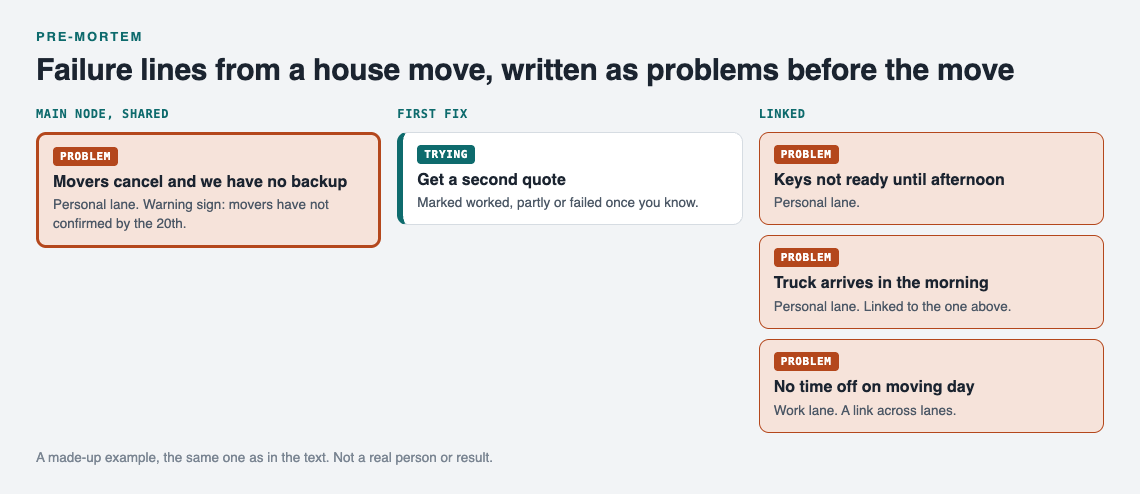
A made-up example: the pre-mortem list from the house move, kept as problems.
If you get stuck on a fix, you can ask for suggestions. The AI proposes new solutions grounded in what worked for others on problems like yours. Treat these as ideas to test, not answers.
Frequently asked questions
What is the difference between a pre-mortem and a post-mortem?
A post-mortem looks back at a failure that already happened. A pre-mortem imagines the failure before you start, so you can prevent it while there is still time to change the plan.
Who should be in the room for a pre-mortem?
Everyone who will do the work, plus one person who knows the area but is not attached to the plan. Keep it small enough that each person reads out at least two items.
How many risks should a pre-mortem list include?
Collect as many as people can write in five minutes. Act on the top three to seven, since each needs an owner and a fix.
Can I run a pre-mortem by myself?
Yes. Set a timer, write the failure story in the past tense, and list every cause you can. It works best if you then show the list to one other person who will tell you what you missed.
Get started
Pick the next thing you are about to start. Imagine it went wrong. Write the first reason down in one line, and attach one fix you will try this week.
Try Problem Graph: it is free, and you can look around the public network without an account. Write one problem down in a line and attach the first thing you will try.
When you are ready to build your list, open the app. If the graph is empty and you want to see how a finished one looks, use the "Load example set" button first.
Comments
No comments yet.
Sign in or make an account to comment.