Primary vs secondary sources in history: examples
The difference between primary vs secondary sources comes down to one thing: when and by whom the source was made, measured against the question you are asking. A primary source comes from the time you are studying. A secondary source looks back on that time and explains it. This guide shows both with three people from world history, gives you a test you can run on any source, and lists the mistakes that cost students marks.
Primary vs secondary sources: the short answer
A primary source is evidence made during the period you are studying, usually by someone who took part in it or saw it. A letter, a diary, a speech, a photograph, a law, a scientific paper or an object from the time all count.
A secondary source is made later by someone who studied the evidence. A biography, an encyclopedia entry, a journal article and your own essay are all secondary sources.
Neither kind is automatically right. The Stanford Encyclopedia of Philosophy's entry on the philosophy of history puts it plainly: "Historical data do not speak for themselves; archives are incomplete, ambiguous, contradictory, and confusing." A primary source can mislead you, and a secondary source can be out of date. You need both, and you need to know which one you are holding.
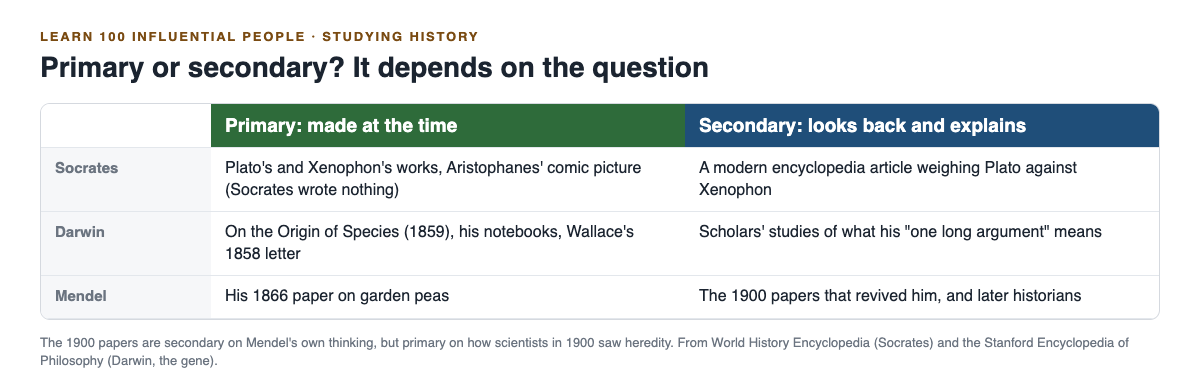
Three people, two kinds of source.
Example 1: Socrates, who wrote nothing
Socrates of Athens lived from about 470 to 399 BCE, and, as World History Encyclopedia's article on Socrates notes, "He, himself, wrote nothing". So where does our picture of him come from?
- Primary sources: the works of his student Plato, the works of another student, Xenophon, and a comic picture of him by the playwright Aristophanes. Plato and Xenophon knew him as his students.
- Secondary sources: the World History Encyclopedia article itself, and any modern book that weighs those writers against each other.
This is a useful case because the primary sources disagree. The article says most of what we know comes from Plato, and "less so" from Xenophon, and that there are differences between how the two describe him. A primary source is close to the event, but it still has an author with a point of view.
Example 2: Darwin's Origin of Species
Charles Darwin's On the Origin of Species was issued in London by John Murray on 24 November 1859, according to the Stanford Encyclopedia's entry on Darwin.
- Primary sources: the Origin itself, the notebooks Darwin began near the end of the Beagle voyage, and his letters, including the letter and manuscript he received from Alfred Russel Wallace on 18 June 1858, which pushed him to publish.
- Secondary sources: the Stanford entry and the many studies it cites, which argue over what the book's reasoning really is.
The entry shows why secondary sources matter. Darwin called his book "one long argument", yet the entry says the exact nature of that argument "is not immediately transparent", and scholars have offered different readings of it. It also notes that manuscripts and letters that have become available since the 1960s led recent historians to question the standard picture of the young Darwin. New primary sources can change the secondary story.
Example 3: Mendel's pea plants
Gregor Mendel published his experiments on garden peas in 1866. The Stanford Encyclopedia's entry on the gene tells what happened next. In 1900, several botanists reached similar results on their own, found Mendel's paper and stated its importance. The early followers who took up his work then turned his regularities into "laws" of heredity.
Here is the twist. The entry says Mendel "did not think of the regularities as laws of heredity", and historians have argued he was asking a different question, about the role of hybrids in evolution. So:
- Mendel's 1866 paper is the primary source for what Mendel thought.
- The botanists' papers of 1900 are secondary sources on Mendel, because they read him from the outside, 34 years later.
- Those same 1900 papers are primary sources if your question is how scientists in 1900 understood heredity.
Reading only the later accounts, you would think Mendel set out to find laws. Reading his paper with a historian's help, you see he may not have.
The test: the question decides the label
The Mendel case shows the rule most students miss. A source is not primary or secondary on its own. It is primary or secondary for a question. Ask these three things in order:
- What is my question? Write it down: "What did Darwin argue in 1859?" is a different question from "How have historians read Darwin?"
- When was the source made, and by whom? If it was made during the time your question is about, by someone inside it, it is primary for that question.
- Is it reporting, or explaining from later? If the author is looking back and weighing other sources, it is secondary for that question.
Try it as a worked example. Your question is "What was Socrates like?" Plato's Apology: written by a student who knew him, so primary. A modern encyclopedia article: made over two thousand years later from Plato and Xenophon, so secondary. Now change the question to "How do modern historians judge Plato's account?" The modern article becomes your main evidence, and Plato becomes the thing being judged.
Once you know which kind you have, read it properly. The National Archives' document analysis page gives four steps that work for every type of primary source: meet the document, observe its parts, try to make sense of it, and use it as historical evidence. Our guide on how to analyze a primary source in history walks through them.
Mistakes that cost marks
- Treating "primary" as "true". Plato and Xenophon both knew Socrates and still describe him differently. Ask who made the source and why.
- Treating "secondary" as "second best". Without the Stanford entry, you would not know that historians read Mendel's aims differently from the 1900 botanists.
- Labelling without a question. If an essay question asks you to "use primary sources", check what period the question is about first.
- Quoting a secondary source as if it were the person. "Darwin said" should be followed by Darwin's words, not a modern summary of them.
- Forgetting the gaps. The Stanford entry on history notes that the historian Marc Bloch described problems such as words changing meaning over time and deliberate efforts to hide the truth. Say what your sources cannot tell you.
When you put several sources together in an essay, the steps in how to build a history argument from evidence show how to turn them into a claim. If you want the bigger picture of how historians argue with each other, read what is historiography.
Practice with Learn 100 Influential People
All three people in this guide appear in Learn 100 Influential People, a web app of short hands-on lessons on the 100 people who most shaped human history. Socrates is in The Greek Thinkers course, and Darwin and Mendel are in The Scientific Revolution.
Two parts of the site fit this skill. Every lesson lists its sources, and the about page says this is "so you can read the original work". And 38 cards set out where researchers disagree, which is what secondary sources look like when they read the same evidence and reach different views.
A simple practice routine: finish one lesson of about 9 minutes, open one source it lists, and decide whether it is primary or secondary for a question you write yourself. Questions from lessons you finish come back later, spaced out, up to 5 a day.
Frequently asked questions
Is a biography a primary or secondary source?
A biography written after the person's life by someone studying the evidence is a secondary source. An autobiography or memoir written by the person is a primary source for their own view of their life.
Can one source be both primary and secondary?
Yes, for different questions. The 1900 papers that revived Mendel are secondary on Mendel's own thinking, and primary on how scientists in 1900 understood heredity.
Is an encyclopedia a primary source?
No, not for the people it describes. An encyclopedia entry on Darwin or Socrates is written later from other sources, so it is a secondary source and a good starting point for finding the primary ones.
Why do historians need secondary sources if they have the originals?
Because archives are incomplete and often contradict each other. Secondary sources compare many originals, and they show you where scholars still disagree.
Get started
Pick one person you are studying, find one primary and one secondary source about them, and run the three-question test on both. To keep going with short lessons that list their sources and set out each side of the debate, start Learn 100 Influential People; you sign in with your email and an emailed sign-in code.
Comments
No comments yet.
Sign in or make an account to comment.