Problem Solving Mindset: Ask What Is True First
A strong problem solving mindset: ask what is true first comes down to one habit. Before you pick a fix, you check what you actually know. Most stuck problems are not stuck because the fix is hard. They are stuck because the problem was never described correctly.
This post shows you how to do that. You will learn how to separate facts from guesses, follow a short routine, and see one problem go from vague to clear.
Problem solving mindset: ask what is true first, explained
It means your first question is not "What should I do?" It is "What is true here?"
You list what you can observe. You mark what you are assuming. You hold off on solutions until the picture is honest. This is slower for about ten minutes and faster for the rest of the problem.
It does not mean you must be certain before you act. It means you know which parts of your plan rest on evidence and which rest on a hunch. Then you can test the hunches cheaply.
Why we jump to solutions before checking the facts
Jumping to a fix feels like progress. A problem is uncomfortable, and an action relieves the discomfort fast. Asking questions feels like stalling.
There are a few other reasons.
- The first story sticks. Once you decide "my manager ignores me," every later event gets read through that story.
- Solutions are easier to name than causes. "Buy a planner" is concrete. "I do not know why my week falls apart" is not.
- Other people hand you answers. Advice arrives with confidence. It rarely arrives with the facts it depends on.
The same habit of checking before you accept applies to reading. If you want a related skill, see how to summarize an article in your own words. Restating something in your own words quickly shows you what you actually understood and what you only nodded along to.
Facts, assumptions and opinions: how to tell them apart
You need three buckets. Sort every statement about your problem into one of them.
Facts
A fact is something you or someone else could check. "The invoice was sent on the 3rd." "I slept five hours on Tuesday." If a stranger could verify it, it is a fact.
Assumptions
An assumption is something you believe but have not checked. "The client saw the invoice." "They are slow on purpose." These may be true. You just do not know yet.
Opinions and feelings
These are judgments. "This client is disrespectful." "I am bad at mornings." They matter, because they tell you what you care about. But they are not evidence.
A quick test: ask "How would I know?" If you can answer with a date, a number, a message or an observation, it is a fact. If the answer is "I just feel it," it is not.
A belief like "I am not a math person" feels like a fact and is often an assumption: you can ask what you have actually observed. For a related look at how beliefs about ability are studied, read does a growth mindset help you study better.
A 5-step routine to ask what is true first
- Write the problem in one line. Keep it plain. "Invoices get paid late." One line forces you to choose what the problem is.
- List what you know. Only things you can check. Dates, numbers, what was said, what you saw.
- List what you are assuming. Be harsh. Anything with "probably," "always," "never" or "they want" belongs here.
- Pick the assumption that carries the most weight. Ask which one, if wrong, would change your plan the most.
- Find the cheapest way to check it. A message, a look at a record, a one-day test. Then decide what to try.
Notice that step five still ends in action. You are not avoiding solutions. You are choosing them with better information.
Worked example: turning a vague problem into a clear one
Say your first version is: "My clients are terrible at paying on time." That is an opinion wrapped around a problem. Run the routine.
One line: Invoices are paid late.
What I know:
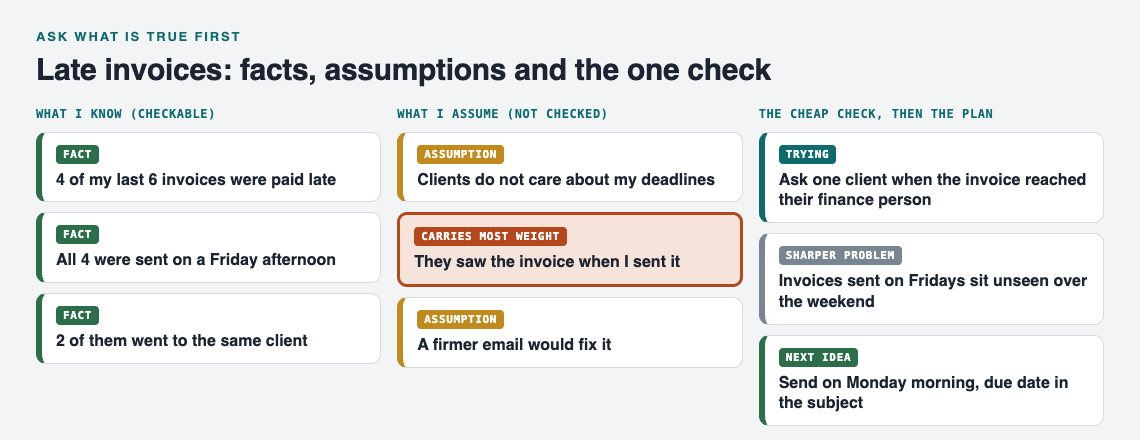
- Four of my last six invoices were paid after the due date.
- All four were sent on a Friday afternoon.
- Two of the late ones went to the same client.
What I assume:
- The clients do not care about my deadlines.
- They saw the invoice when I sent it.
- A firmer email would fix it.
The assumption with the most weight is "they saw the invoice." If it is wrong, a firmer email solves nothing. The cheap check: ask one client when the invoice reached their finance person, or look at whether the emails were opened.
Now the problem is sharper. It might be "Invoices sent on Fridays sit unseen over the weekend." That points to different solutions: send on Monday morning, add a due date in the subject line, or ask who actually handles payment. None of those would have come up from "my clients are terrible."
Your problem might sit in another area entirely, such as sleep or a team process. The steps stay the same.
Common traps that make false beliefs feel true
- Repetition. You have told yourself the story so often it feels like memory.
- One vivid example. A single bad meeting outweighs ten fine ones in your mind.
- Source blur. You forget whether you saw something or only heard it.
- Mind reading. You state what someone else thinks as if it were observed.
- Looking only for confirmation. You check the records that agree with you and skip the ones that do not.
The same care applies when you study the past. A film clip looks like direct evidence, but it was made by someone for a reason. The steps in watching a newsreel or film clip as a historical source are a good model for asking what a source really shows and what it only suggests.
How to map what is true with a problem graph
A list gets long and flat. A map keeps the relationships visible. That is what Problem Graph is for. It is a personal problem and solution journal drawn as a knowledge graph.
Here is how the routine fits it.

- Write the problem in one line. It lands on the graph as soon as you press Enter. You choose a lane: personal, work, expert or scientific.
- Attach what you try. Add solutions as ideas, mark the ones you are trying, and record the outcome: worked, partly, or failed.
- Link related problems. If "Late invoices" connects to "Sleep debt" because you send invoices when you are tired, link them. Patterns show up on the map that never show up in a list.
The failed outcomes matter most for this mindset. A solution that failed stays on the map as a failed solution. That is a true record of what you tried, and it stops you from repeating a fix because you forgot it did not work.
If you want to see what others learned, Problem Graph can show similar problems that people have shared and which of their solutions worked. You can borrow one into your own graph, and it keeps a link back to where it came from. Treat a borrowed solution the way you treat any claim: it is a lead to test, not a fact about your situation. The AI suggestions work the same way. They are proposals grounded in what worked for others, and you still check them against what is true for you.
Your graph is private by default. You can also share a main node with a private network you choose, such as a team or a study group, which is useful when several people need to agree on the facts. If you only want to look around first, the public network can be browsed without an account.
Problem Graph is a journal and a map. It is not a substitute for medical, legal or mental health advice.
Frequently asked questions
What does it mean to ask what is true first?
It means you list what you can verify about a problem before you choose a fix. You also mark which beliefs are assumptions, so you know what to test.
Does this slow me down?
It adds a few minutes at the start. It usually saves time later, because you stop acting on a wrong picture of the problem.
How do I know if something is a fact or an assumption?
Ask "How would I know?" If you can point to a date, a number, a message or something you observed, it is a fact. If not, treat it as an assumption.
What if I cannot check an assumption?
Keep it labeled as an assumption and pick a plan that still works if it turns out to be wrong. You can also run a small, cheap test instead of a full check.
Get started with Problem Graph
Try Problem Graph: it is free, and you can look around the public network without an account. Write one problem down in a line and attach the first thing you will try.
Then add one more line: the thing you are assuming. That small step is the whole mindset.
Comments
No comments yet.
Sign in or make an account to comment.