Propaganda posters in history: how to read one
Propaganda posters in history were made to do one job: make people think, feel or act in a certain way, fast. A government, a party or an army paid for them and put them where crowds would see them. That makes them some of the most useful sources you can study, as long as you read them for what they are. The four steps below come from the National Archives document analysis worksheets. This post explains each step, then walks you through a poster from 1920.
What propaganda posters in history can tell you
A poster is not a report. It does not try to be fair or complete. It picks one message and pushes it with big words, strong colours and simple pictures.
That is exactly why historians use them. A poster shows what its makers wanted people to believe, who they thought needed persuading, and which fears or hopes they thought would work. It is evidence of a message and an audience, not of what was true.
Read a poster with the same basic questions as any document: who made it, when, for whom and why? Our guide to how to analyze a primary source sets those out. Posters are close cousins of political cartoons, so our post on how to analyze a political cartoon is good practice too.
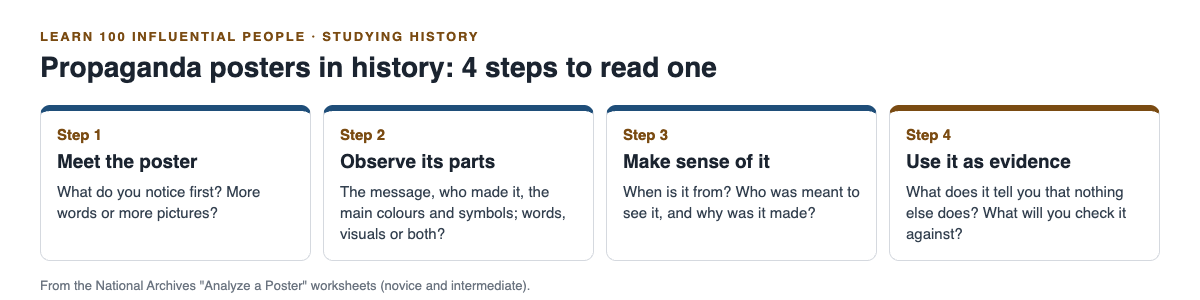
The four steps, in the order the worksheets use them.
Step 1: Meet the poster
Start with a quick look. The intermediate poster worksheet asks you to scan the poster and note what you notice first. The makers chose what would grab you, so your first glance is your first clue.
The novice worksheet adds a simple question: are there more words or more pictures? Then read the words. Write down any you do not know and look them up. A poster in a foreign language or old wording needs a translation before you can go on.
Step 2: Observe its parts
Now slow down and list what is there, before you decide what it means. The intermediate worksheet splits this into words and visuals.
- Words. Is there a message printed on it? Are there questions or instructions? Does it say who created it?
- Visuals. List the people, objects, places and activities. What are the main colours? Are there any symbols?
Then the worksheet asks a question that is special to posters: does it try to persuade mainly through words, through visuals, or both equally? Finish the step by writing one sentence that sums up the poster.
Keep describing and explaining apart. "A figure points straight at the reader" is a description. "The poster blames the reader for doing nothing" is already an interpretation, and it belongs in the next step.
Step 3: Try to make sense of it
This is where you think, not just look. The intermediate worksheet asks four questions.
- When is this poster from?
- What was happening at the time in history it was made?
- Who do you think is the intended audience?
- Why was it created?
For each answer, list the evidence from the poster that tells you so. The novice worksheet puts it simply: what is the main idea, and which two parts of the poster, words or pictures, support it?
The audience question is the one students skip most. A poster aimed at soldiers, factory workers or voters will say different things. Ask who would have walked past it, and what the makers wanted those people to do next.
Step 4: Use it as historical evidence
The last step turns the poster into evidence for an argument. The worksheet's key question is this: "What did you find out from this poster that you might not learn anywhere else?"
Usually the answer is about persuasion: which enemy a government chose to show, which words it used, which feelings it reached for. That is real evidence, but only of the message. To know what actually happened, or whether people believed it, you need other documents next to it. The National Archives page makes the same point: "Analysis is just the foundation."
Worked example: a Bolshevik poster from 1920
Open the Bolshevik propaganda poster on World History Encyclopedia and work through the four steps. Give it about 20 minutes, and write your answers down.
- Meet the poster. Note what you see first. Decide whether it relies more on words or on pictures. The page translates the title for you: "Comrade Lenin cleans the Earth from scum".
- Observe its parts. List the people and what they are doing. The page says the poster shows representatives of the European monarchy, the Orthodox Church and wealthy capitalists. Note the main colours and any symbols, and write two words that describe it.
- Make sense of it. The page names the maker, Viktor Deni, and the date, 1920. It says the poster was issued after the Bolshevik Revolution of November 1917 to convey the message that Lenin was clearing Russia of its enemies. Now answer the audience question yourself: who was meant to see this, and what did the Bolsheviks want them to feel about kings, priests and the rich?
- Use it as evidence. Write the message in one sentence. Then ask what the poster shows that a list of events does not: which groups the new government chose to name as enemies, and how it wanted its leader seen. Last, list what you would check it against, because the poster tells you what the Bolsheviks wanted people to believe, not what those groups had done.
For a second try, open the British Lancaster bomber poster from the Second World War. The page says it was produced by the British Office of War Information but names no artist. Work through step 3 again: what can you still say about its audience and purpose, and what can you not say? Then compare the two posters. Which persuades mainly with words, and which with pictures? Our guide on how to analyze a historical photograph uses the same steps on a different kind of image.
Frequently asked questions
What are the four steps to read a propaganda poster?
The National Archives worksheets use four: meet the poster, observe its parts, try to make sense of it, and use it as historical evidence.
Are propaganda posters primary sources?
Yes, for the time they were made. A 1920 poster is a primary source for what its makers wanted people to believe in 1920.
How do I find a poster's intended audience?
Look at who is shown, what the words ask people to do, and where the poster would have hung. The intermediate worksheet asks you to list the evidence for your answer.
Can a propaganda poster be trusted?
Not as a record of facts, because it takes one side on purpose. It is strong evidence of the message its makers chose and the audience they aimed at.
Get started
Posters, cartoons and speeches show how leaders wanted to be seen. Learn 100 Influential People teaches the 100 people who most shaped human history, in war, philosophy, religion, art, science, engineering and economy, in 46 lessons of about 9 minutes. Its 272 questions check what you learned, 38 cards set out where researchers disagree, and every lesson lists its sources. Sign in with your email and an emailed code, and read what the site is for.
Comments
No comments yet.
Sign in or make an account to comment.