Prophet Muhammad's life: Mecca, Medina and the Quran
Prophet Muhammad's life runs from 570 to 632 CE, from Mecca to Medina and back. Muslims venerate him as the Prophet of Islam and the "seal of Prophets", the last of a line that, they believe, runs through Abraham, Moses and Jesus. This post follows his life in order, from one source opened for this post: the World History Encyclopedia article on Prophet Muhammad by Syed Muhammad Khan. Where the article reports tradition, this post says so, and where its author gives his own judgment, this post names it as his.
Early life in Mecca
Muhammad ibn Abdullah was born in 570 CE in Mecca, in the Hejaz province of Arabia. His clan, Hashim, belonged to the respected tribe of Quraish, and provided water to the pilgrims who came to Mecca. The city held many idols and was a sacred site centred on the Ka'aba.
He lost his family early. His father died before he was born, his mother Aminah died in 576 CE when he was 6, and his grandfather, who raised him next, died two years later. His uncle Abu Talib then raised him. He grew up to be a caravan trader, and the article says the Arabs called him "As-Sadiq" (the truthful) and "Al-Amin" (the trustworthy).
At 25 he married Khadija, a wealthy widow who had sent him with one of her trade caravans. She was 15 years older than him, and he took no other wife while she lived.
The first revelation and the years of preaching
In his late thirties he began to worship in a cave called Hira, on a mountain near Mecca. According to Islamic tradition, in 610 CE he received his first revelation from God; the article says that, as "it is said", a light appeared before him and claimed to be the angel Gabriel. His first convert was Khadija, and his first male convert was his friend Abu Bakr.
From 613 CE he preached openly, and Mecca resisted. The article explains why: the city's economy rested on pilgrims who came to worship the idols at the Ka'aba, which Muhammad considered false gods. Rival clans boycotted his clan from 616 to 619 CE. In 619 CE both Abu Talib and Khadija died, a year Muslims remember as the "Year of Sorrow".
The hegira: why 622 matters
Some Muslims had already gone to Abyssinia (Ethiopia) in 615 CE. Then, in 621 CE, people from the city of Yathrib invited Muhammad to lead them. He and his followers moved there in groups, and he entered the city, now known as Medina, in 622 CE.
This migration is the hegira. It matters so much that the Islamic lunar calendar counts its years from it. If you learn one date from his life, learn this one.
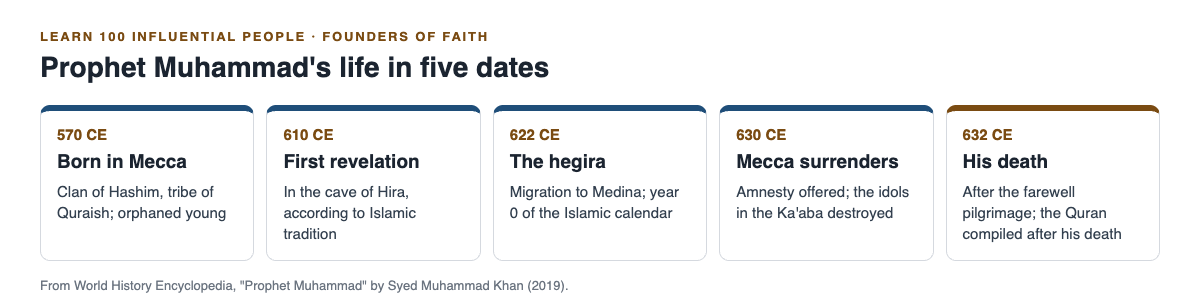
Five dates that hold the rest of the story together.
Medina: from preacher to leader
In Medina, Muhammad became the city's leader as well as its prophet. He revised its laws, built a new place of worship, the mosque of the Prophet, and set out a treaty of alliance and non-violence, which the article calls the Treaty of Medina.
Conflict with Mecca followed. The article gives the main events in this order:
- Badr, 624 CE: an army of 1,000 Meccans ran before 313 Muslims.
- Uhud, 625 CE: the Muslims were winning until their rearguard left its post to collect booty, and a Meccan cavalry attack turned the battle; Muhammad was injured.
- The Trench, 627 CE: a confederacy besieged Medina for around 30 days and withdrew.
After the siege, the Jewish tribe of Banu Qurayza was charged with betraying the treaty, and all its men were killed. The article says this event "has sparked incessant debate and discussions". Its author's own comment is that had the confederate plot succeeded, the Muslims would have met the same fate. That is his view, on an event the article itself calls debated; read more than one account before you take a side.
Return to Mecca and the end of his life
In 628 CE the Meccans turned the Muslims away from pilgrimage, and the two sides signed the Treaty of Hudaybiyya instead of fighting. When the Meccans broke it, the Muslim army approached Mecca in 630 CE, and the city surrendered. Muhammad offered the people amnesty and destroyed the idols in the Ka'aba.
By 631 CE Taif, the town that had driven him out, had submitted to his rule. In 632 CE he made his farewell pilgrimage to Mecca, where, the article says, he announced that the revelation of the Quran was complete. He died that year, after a brief illness, in his own house, with his wife Aisha beside him.
Why Prophet Muhammad's life still matters
By his death, the article says, he was the most powerful political leader in Arabia, and most of its tribes had converted to Islam. It adds that most of those conversions were political rather than spiritual, which mattered after he died. His revelations were compiled into the Quran after his death, and Islam became, in the article's words, "one of the three great monotheistic religions in the world today". The empire passed to the caliphs who followed him.
The article ends with its author's own praise of Muhammad's vision and skill. That is one writer's view; a good student notes it as a view and keeps the dated events separate from it, as with any source. For another founder of faith, read our post on who Zoroaster was.
A worked example: learn his life as a five-date timeline
A long life is easier to keep when you hang it on a few dates. Here is a 20-minute exercise, using the method from our guide on how to make a history timeline that sticks.
- Write five anchors (5 minutes). 570 born in Mecca; 610 first revelation; 622 the hegira to Medina; 630 Mecca surrenders; 632 his death.
- Hang events on them (8 minutes). Put Khadija's marriage (595) and the open preaching (613) between the first anchors; Badr (624), Uhud (625) and the Trench (627) after 622; Hudaybiyya (628) before 630.
- Mark tradition and judgment (4 minutes). Circle each item the source gives as tradition, such as Gabriel's appearance, and underline each line that is the author's opinion.
- Test yourself (3 minutes). Cover the page and say the five anchors aloud, then one event after each.
Repeat step 4 after a day and after a week. The timeline will hold.
Frequently asked questions
When was the Prophet Muhammad born and when did he die?
The World History Encyclopedia gives 570 CE for his birth in Mecca and 632 CE for his death.
What is the hegira?
It is Muhammad's migration from Mecca to Medina in 622 CE. The Islamic lunar calendar counts its years from it.
When was the Quran compiled?
Muslims believe it was revealed to Muhammad between 610 and 632 CE. The article says the revelations were compiled as a book after his death.
Why did Muhammad leave Mecca?
Mecca resisted his preaching, and after his uncle Abu Talib and his wife Khadija died in 619 CE he lost his clan's protection. In 621 CE the people of Yathrib, later Medina, invited him to lead them.
Get started
Muhammad is one of the founders of faith whose lives shaped the world. Learn 100 Influential People teaches the 100 people who most shaped human history, in war, philosophy, religion, art, science, engineering and economy, in short hands-on lessons: 46 lessons of about 9 minutes and 272 questions, with 38 cards that set out where researchers disagree. Every lesson lists its sources, and questions from lessons you finish come back, spaced out, up to 5 a day. Sign in with your email and an emailed code, and read what the site is for.
Comments
No comments yet.
Sign in or make an account to comment.