Questions to ask a grandparent about their childhood
The best questions to ask a grandparent are open questions that ask for a story, not a yes or a no: "What was a normal school day like for you?" works far better than "Did you like school?". Write eight to twelve of them, put the easy ones first, and plan one follow-up for each. This works for a history homework task or just for the family. Once you have the questions, our post on recording a school project interview as audio with a transcript shows how to keep every answer word for word.
For the interview itself, Cheap Recorder runs in Google Chrome and records your conversation with your grandparent on your own laptop with a timed transcript, so you can listen to the person instead of scribbling notes.
Questions to ask a grandparent to get started
Open with a few gentle questions. They settle both of you, and the answers give you a sentence to introduce your grandparent in a report or a family book.
- What was your full name as a child, and did anyone call you something else?
- Where did you grow up?
- Who was in your family when you were small?
- Is it okay if I record this for my project?
Ask the last one first, once the recorder is running, so their yes is at the start of the recording. Tell them who will hear or read it. The law on recording differs from place to place, so always tell people you are recording, and if it is for school, check your teacher's rules too.
Questions about their childhood
Ask about ordinary days. They lead to the best stories.
- What was a normal school day like when you were my age?
- What did your family do in the evenings?
- What has changed most in this town since you were young?
- What is something you used every day that people do not use now?
- Is there a day you remember clearly? What happened?
Questions about work, family and big moments
Once the childhood stories are flowing, move on to the rest of their life.
- What was your first job, and how much did it pay?
- How did you meet Grandma (or Grandpa)?
- What was my mum or dad like as a child?
- What news event do you remember hearing about as it happened?
- What do you wish you had known at my age?
If your grandparent grew up somewhere else, add: "What did you miss most when you moved?" and "What do you still cook or say from there?".
Follow-up questions that get the best answers
Your list is a starting point. The answer you will quote is usually the one that comes after a follow-up. Keep these few ready and use them whenever an answer is short:
- "Can you tell me more about that?" The simplest and most useful one.
- "What did that feel like?" Turns a fact into a memory.
- "Can you give me an example?" Turns a general answer into a scene.
- "Why do you think that happened?" Gets their view, not only the event.
Then wait. A few seconds of silence feels long, but people often fill it with the detail you were hoping for. Wait a moment before your next question too, so the lines in the transcript stay apart.
Record the answers so you can quote them later
You cannot write fast enough to keep a good answer word for word, and you stop listening while you try. Record instead. Here is a worked example with Cheap Recorder, using only the laptop and a quiet table.
- Sound only. Open the recorder in Chrome, switch off Record my webcam and do not pick a screen. With no screen and no webcam, it saves an M4A audio file.
- Transcript on. Live transcript is ticked by default under Options. Pick the interview's language in the menu beside it before you start, because the language is set when the recording begins.
- Folder and name. Press Choose folder..., allow Chrome to edit files there, and type a name such as
Grandma Lee childhoodinto Name this recording. That name is used for the file and its folder. - A 30-second test. Ask your grandparent to say their name, say a sentence yourself, stop and play it back. If their voice is faint, move the laptop or microphone closer and test again.
- The interview. Press Start recording, ask your permission question, then work through your list.
Afterwards the folder holds the M4A and a plain-text transcript with the time of each line, such as Grandma Lee childhood - transcript.txt. A transcript is only made while you record, so if it was off, it cannot be added later.
Two things to know. Labels follow sound sources, not voices, so if you both spoke into one microphone, every line has the same label and you add the names yourself. And while the live transcript is on, Chrome sends the microphone audio to Google to turn it into text; if the interview must not leave your laptop in any form, untick Live transcript and take notes by listening back.
Turn answers into quotes for a report or family book
Make a copy of the transcript and work on the copy. Search it for the answers you liked, then play that moment in the audio and check every word. Speech recognition slips most on names, places and numbers, so those need your ear.
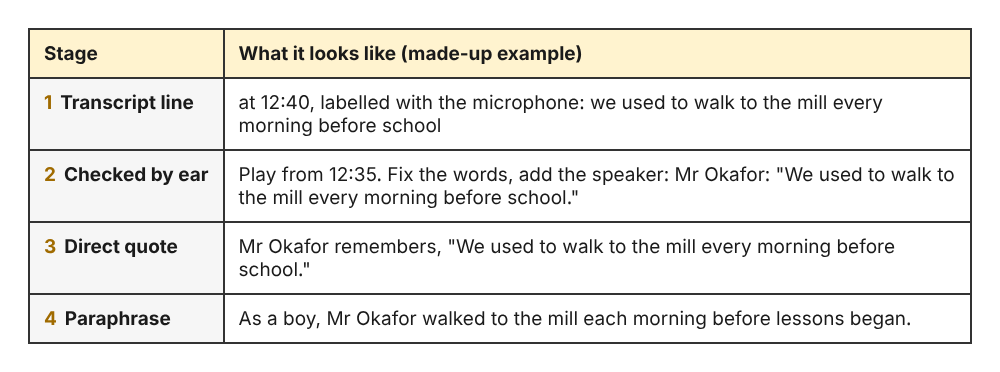
One answer, four stages: from the transcript line to a sentence in your report.
Use a direct quote when the exact words matter, such as a strong opinion or a vivid detail. Paraphrase the rest in your own words, and still say who told you. For schoolwork, ask your teacher how they want an interview listed in your sources.
Frequently asked questions
How many questions should I ask my grandparent?
Eight to twelve main questions is plenty for a 15 to 30 minute talk. Follow-ups will fill the rest, and you can always come back for a second session.
Should I send my questions to my grandparent first?
Sending the main topics ahead can help, as it gives them time to think and maybe find old photos. Keep your follow-ups for the day so the answers stay natural.
Can I interview a grandparent who lives far away?
Yes, over a video call. If the call is open in a Chrome tab, the recorder can pick that tab so the other side's voice is recorded too. The blog post on recording a school project interview covers it.
Does recording cost anything?
The Free plan needs no card and gives 12 hours of recording a month with the live transcript, which covers a long talk with a grandparent easily.
Get started
Pick the questions that fit your grandparent, add your permission question at the top, and plan one follow-up for each. Then run a 30-second test and record the interview. The live transcript guide explains each setting, and Cheap Recorder saves the audio and transcript in your own folder, ready to quote.
Screen recording that is cheap and easy.
Visit cheaprecorder.com↗
Comments
No comments yet.