Quick fix or deep fix: when each one is enough
Something breaks. You can patch it in five minutes or spend a weekend fixing it properly. Choosing between a quick fix or deep fix, and knowing when each one is enough, is one of the most useful judgment calls you can learn. Pick the quick fix too often and the same problem keeps coming back. Pick the deep fix every time and you burn hours on things that did not need them. This post gives you a simple way to decide, and a way to check later whether you decided well.
Quick fix or deep fix: the real difference
A quick fix treats the symptom. The dripping tap gets a tighter turn. The late invoice gets a reminder email. The crash gets a restart. It stops the pain now and costs little.
A deep fix treats the cause. You replace the worn washer. You change your invoice terms so clients pay on time. You find the memory leak that made the restart necessary. It costs more now, but the problem stops coming back.
Neither one is better in general. A quick fix is not lazy, and a deep fix is not always wise. The right choice depends on three things: what the problem costs you, how often it returns, and how far the damage spreads when it does. We will turn those into a test below.
When a quick fix is enough
A quick fix is often the right call. Use one when:
- The problem is rare. If it happened once in a year, a full investigation costs more than the problem ever will.
- The cost is small. A squeaky door is annoying. It is not urgent.
- You need time to think. A quick fix can buy you room to plan the real one. Stopping a leak with a bucket is fine if you call the plumber tomorrow.
- The thing is about to change anyway. No point rebuilding a process you will replace next month.
- You do not yet know the cause. Sometimes the honest move is to patch it and watch what happens next.
The danger is not the quick fix itself. The danger is forgetting that it was a quick fix. Two months later the restart no longer looks like a patch, and it starts to feel normal.
The Lean Enterprise Institute's page on the 5 whys puts the risk plainly. In its machine example, without asking why again and again, "managers would simply replace the fuse or pump and the failure would recur." Replacing the fuse is the quick fix. The missing strainer that let metal scraps in is the cause.
When you need a deep fix
Go deep when the quick fix stops paying for itself. Clear signs:
- It keeps coming back. The third time you apply the same patch, you are paying the cost of a deep fix in small pieces, without getting the benefit.
- The damage spreads. When one failure triggers others, a patch on the first one leaves the chain intact.
- Other people depend on it. A shared schedule, a family budget, a team system. Each repeat costs several people, not just you.
- The workaround has its own workarounds. When your fix needs fixing, you are layering patches on a cause you have not touched.
The carpool is a good example. One missed pickup gets a quick text. A pattern of missed pickups means the schedule itself is the problem, and every driver pays for it until someone fixes the schedule.
Signs your quick fix is hiding a bigger problem
Quick fixes are quiet. They make the symptom go away, which also makes the cause harder to see. Watch for these:
- You apply the same fix on a rhythm. Every Monday, every month end, every cold snap. A rhythm means a cause.
- Different problems share a fix. If restarting solves three unrelated issues, they are probably not unrelated.
- The fix works a little less each time. The tap needs a harder turn. The reminder email gets ignored more often.
- You stop mentioning it. When a workaround becomes routine, nobody reports the problem anymore, so nobody fixes it.
The second sign is easy to miss. Problems you treat as separate can share a root, and you only see it when you put them side by side.
A simple test: cost, recurrence and reach
Before you choose, answer three questions. Score each one low, medium or high.
- Cost. What does one occurrence cost you in time, money or stress? A few minutes is low. A lost day or a missed payment is high.
- Recurrence. How often does it come back? Once a year is low. Weekly is high.
- Reach. How far does the damage spread? Just you is low. Your household, your team or your clients is high.
Now read the scores:
- All low: quick fix. Move on.
- One high: quick fix now, and write down that a deep fix may be due.
- Two or more high: deep fix. The patch is costing more than the cure.
- Recurrence high on its own: look closer. Even cheap problems add up when they come back every week.
Here is a worked example. Your laptop fan runs loud and the machine slows down. Cost: medium, you lose maybe twenty minutes. Recurrence: high, it happens most afternoons. Reach: low, only you. One high score, so you close a few browser tabs as a quick fix, but you note that a deep fix is due. A week later it is still happening daily. That recurrence tells you to stop closing tabs and find out what is actually eating the memory.
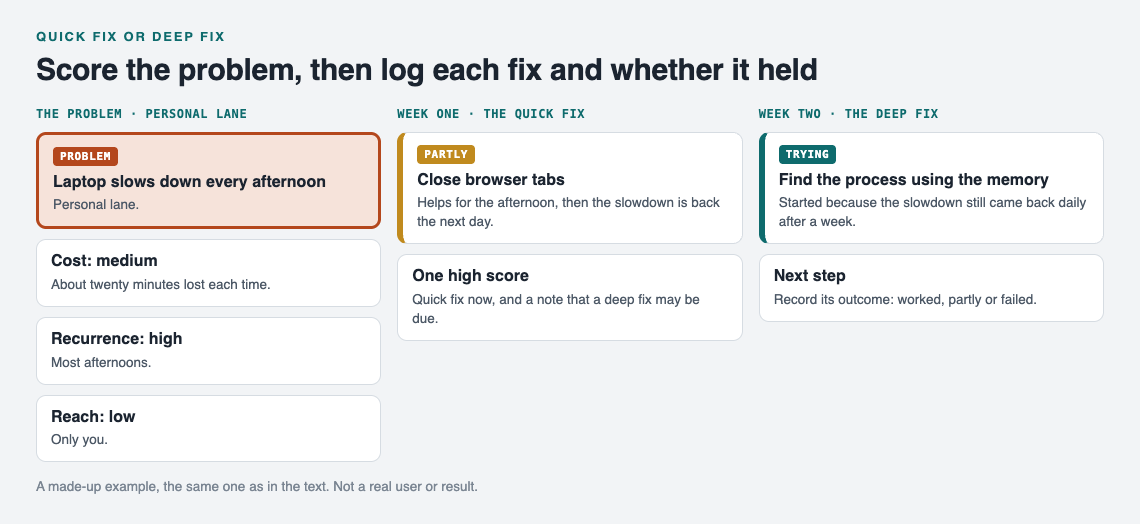
The worked example as it would sit on the graph. A made-up example, not a real user or result.
The test only works if you remember how many times something came back. Memory is bad at that. That is why the last step matters most.
Log every fix and check whether it held
The quick fix or deep fix question gets much easier when you can see your own history. You need three things recorded: the problem, what you tried, and whether it held.
Problem Graph fits this habit. It is a personal problem and solution journal drawn as a graph. Here is how the laptop example maps onto it:
- Write the problem in one line. "Laptop slows down every afternoon." Put it in a lane (personal, work, expert or scientific) and press Enter. It lands on the graph right away.
- Attach the quick fix as a solution. "Close browser tabs." Mark it as the one you are trying.
- Record the outcome. Worked, partly, or failed. Closing tabs probably gets "partly." That label is your note to yourself that a deep fix may be due.
- Add the deep fix when you get to it. "Find the process using the memory." Record its outcome too.
- Link related problems. If the slowdown and a dying battery and random freezes all show up, link them. Links work across lanes. As the product puts it, patterns show up on the map that never show up in a list.
The outcome labels are what make this useful for the quick fix question. A solution marked "partly" three times is a clear signal. A quick fix that failed stays on the map as failed. The home page says it well: "The graph is honest. A solution that failed three times stays on the map as a failed solution, and that is exactly what the next person needs to know." Often the next person is you, six months later.
The same habit works for any area of life. We have written about keeping a home repair log of every fix and whether it held, and a budget log of each money fix and its result. Both are this same pattern: one line for the problem, one entry per attempt, one outcome per attempt.
Your problems are private by default. Only you see them, and they follow you to any phone or computer you log in on. If a problem involves other people, like that carpool schedule, you can mark it as a main node and share it into a private network with the people involved. They see it, nobody else does. You can also make a main node public, and then other people can link their own problems to it and borrow solutions that worked. When someone else has shared a similar problem, the app shows you which of their solutions worked, and you can borrow one into your own graph with one tap.
Frequently asked questions
Is a quick fix always a bad idea?
No. A quick fix is the right choice when a problem is rare, cheap and contained. It only becomes a problem when you forget it was temporary and stop watching whether it holds.
How do I find the root cause of a recurring problem?
Write down every occurrence and every fix you tried, with the outcome. Then look for rhythms and for different problems that share the same fix, because those usually point to one cause underneath.
Can I do a quick fix now and a deep fix later?
Yes, and it is often the smartest move. The key is to record the quick fix as a patch so "later" actually arrives instead of fading away.
How many times should a problem come back before I dig deeper?
This post's rule of thumb is three. If the same quick fix has been needed three times, or marked as only partly working, you are already paying for a deep fix in installments.
Get started
Pick one problem you keep patching. Write it in a line, add the quick fix you have been using, and mark how well it held. Next time it comes back, you will have an answer to the quick fix or deep fix question instead of a guess. If you want to see how a full graph looks first, the app has a button to load an example set on an empty graph.
Try Problem Graph: it is free, and you can look around the public network without an account. Write one problem down in a line and attach the first thing you will try.
Comments
No comments yet.
Sign in or make an account to comment.