Ray Kurzweil: who he is and what he argues about AI
Ray Kurzweil is one of the best-known voices on where artificial intelligence is heading, and one of the most argued about. He invented machines for blind readers and musicians, then spent decades writing about a future in which people and AI merge. This post explains who Ray Kurzweil is and what he argues about AI, using Wikipedia's Ray Kurzweil article as its only source.
Who is Ray Kurzweil?
The article calls him an American computer scientist, author, entrepreneur, futurist and inventor, born on February 12, 1948. He grew up in Queens, New York City, and read science fiction as a boy. He wrote his first computer program in 1963, at 15. In high school he wrote to the AI researcher Marvin Minsky, then studied with him at MIT, graduating in 1970 in computer science and literature.
Machines for readers and musicians
His inventions came before his books. In 1974 he began work on a program that could read text in any normal font. He saw its best use as a reading machine for blind people, and on January 13, 1976 he unveiled the Kurzweil Reading Machine. After a 1982 meeting with the musician Stevie Wonder, he built synthesizers meant to sound like real instruments, and the K250 was unveiled in 1984.
The books
His first book, The Age of Intelligent Machines, came out in 1990. The Age of Spiritual Machines followed in 1999, and The Singularity Is Near in 2005. In How to Create a Mind (2012) he sets out his Pattern Recognition Theory of Mind: the idea that the neocortex is a hierarchy of pattern recognizers, and that copying this design in machines could lead to artificial superintelligence. His latest book in the article is The Singularity Is Nearer: When We Merge with AI (2024). We cover two of them in The Singularity Is Near and The Age of Spiritual Machines.
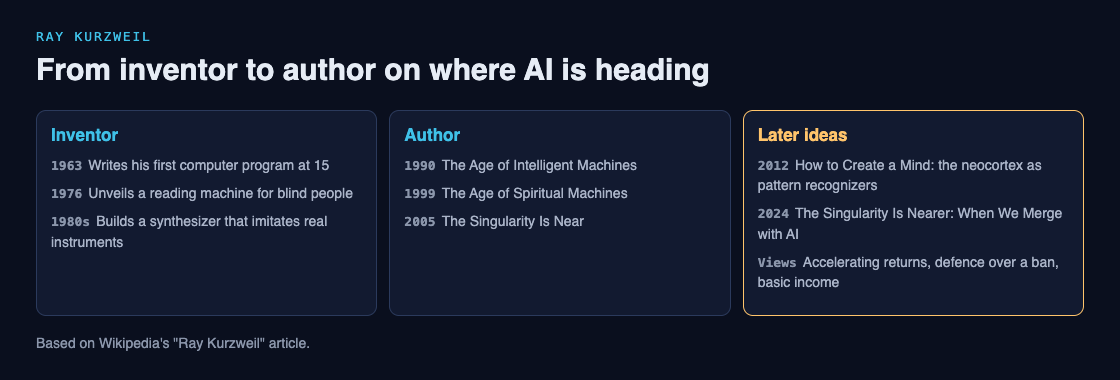
Kurzweil's path, as Wikipedia's article on him sets it out.
The law of accelerating returns
His central idea has a name. In 1999 he proposed the "Law of Accelerating Returns": the rate of change in many evolving systems, including technologies, tends to grow exponentially. In a 2001 essay he stretched Moore's law, the old observation about computer chips, across many kinds of technology. He used it to back John von Neumann's idea of a technological singularity, the point where change becomes too fast to follow. Our post on the technological singularity explains that idea, and the post on singularitarianism covers the people who build a worldview on it.
What Kurzweil argues about AI
The article gives him several linked beliefs.
- Human-level AI is close. He believes a machine will pass the Turing test by 2029. That test asks whether a machine can chat so well that people cannot tell it from a person.
- We will merge with it. He says humans will become a hybrid of biological and non-biological intelligence, with the non-biological part growing more dominant. He expects tiny medical machines called nanobots to fight disease and improve memory and thinking.
- The body is a model for AI. He sees the human body as thousands of "programs" and believes understanding them could be the key to building truly sentient AI.
- Abundance changes work. He backs universal basic income, a regular payment to every citizen. In a 2018 talk he said he expected it in the developed world in the early 2030s, and said the main worry would then be meaning and purpose.
He is also a prominent transhumanist, someone who hopes technology can extend and improve human life. See transhumanism and AI for that movement. In 2004 he joined the advisory board of the Machine Intelligence Research Institute; our post on MIRI covers what it does.
Danger, and the case against stopping
He is an optimist, but not a blind one. The article says he has stressed the extreme potential dangers of nanotechnology. He suggested that a bioterrorist could reprogram a virus to be more deadly, and said we have the scientific tools to defend against such an attack.
His answer is defence, not a ban. He argues that progress cannot be stopped, because stopping it would take a totalitarian system, and any attempt would push dangerous technologies underground and leave responsible scientists without the tools to defend. He called for "relinquishment at the right level" and a top priority on defensive technologies. His list includes a streamlined regulatory process, monitoring for new pathogens, temporary moratoriums, public awareness, international cooperation and the values of liberty, tolerance and respect for knowledge.
Others take a different line: some researchers ask for a pause. Our post on calls to pause AI sets out what they ask and who disagrees.
How his forecasts have fared, and what critics say
Kurzweil's forecasts are the reason people argue about him, so it helps to read the scorecard on both sides.
The case that he has been right
In The Age of Intelligent Machines he extended chess-program trends and said computers would beat the best human players by the year 2000. In May 1997 a computer beat the world champion. He also foresaw the Internet's growth in the 1990s, when only 2.6 million people used it, and said access would be wireless. In October 2010 he scored himself in a report called "How My Predictions Are Faring": of 147 forecasts, he counted 115 entirely correct, 12 essentially correct, 17 partially correct and 3 wrong, an accuracy of 86%.
The case that he has been wrong
Others scored him lower. A Newsweek writer criticized his forecasts for 2009, such as a 20-petaflop supercomputer and widespread speech recognition. Forbes judged those forecasts mostly inaccurate: seven incorrect, four partially correct and one correct. A writer in IEEE Spectrum faulted several that missed their dates.
Wider criticism targets the big idea. The AI thinkers Daniel Dennett and Rodney Brooks, and David Gelernter, have criticized his projections. The authors Neal Stephenson and Bruce Sterling doubt the singularity. The cognitive scientist Douglas Hofstadter called the books of Kurzweil and Hans Moravec "an intimate mixture of rubbish and good ideas." Jaron Lanier called his ideas "cybernetic totalism", and the physicist Theodore Modis says the thesis lacks scientific rigor. Each side has real points, and this post gives no verdict.
A worked example: keep a forecast scorecard
You can test any big forecaster the way the critics did. It takes about fifteen minutes.
- Pick three dated claims. From this post: computers beat the best chess players by 2000; a machine passes the Turing test by 2029; basic income in the developed world in the early 2030s.
- Check the date. For the first, the article says a computer beat the world champion in May 1997. The other two lie ahead, so mark them "open".
- Write what counts as success. "Passes the Turing test" can mean many things. Write your own test before you look at any result.
- Score honestly. Use four marks: right, partly right, wrong, open. Note who is doing the scoring: he scored himself 86%, others scored him lower.
- Ask what the score says. A good record on dates does not prove the larger idea, and a miss on dates does not disprove it.
Run the same steps on any forecast you read about AI, including ones you agree with.
Exploring the idea in Contain ASI
Contain ASI is a story strategy game for 1 to 4 players that runs in your browser and needs WebGL 2. Chapter 1, Before ASI, starts in January 2024 with four fictional AI labs in one race. As a researcher, research manager, CEO or government, you try for three years to keep every lab from crossing into recursive self-improvement before 2027.
The page says it is inspired by the AI 2027 scenario and that all its labs, people and events are fictional. It does not mention Kurzweil. It is a game, not a forecast, so treat it as a way to think about a fast race, not as a score for anyone's timeline.
Frequently asked questions
Who is Ray Kurzweil?
He is an American computer scientist, author, entrepreneur, futurist and inventor, known for reading machines for blind people, music synthesizers and books about AI and the technological singularity.
What is the law of accelerating returns?
It is his idea that the rate of change in many evolving systems, including technologies, tends to grow exponentially. He proposed it in 1999 and extended it in a 2001 essay.
What does Kurzweil say about AI risk?
He stresses dangers, mainly from nanotechnology and biotechnology, but argues that a ban would not work and that defensive technology, regulation and international cooperation are the better path.
How accurate are his forecasts?
He counted 86% of 147 as correct in a 2010 report, while critics at Newsweek, Forbes and IEEE Spectrum scored his forecasts lower.
Get started
Want to feel how hard it is to keep a fast race under control? Open Contain ASI in your browser and start a campaign as a researcher, research manager, CEO or government.
Comments
No comments yet.
Sign in or make an account to comment.