Relief army in a siege: when help came, and when not
A castle under siege could hold out for months, but it could not hold out for ever. The one thing that could change that was a relief army: a force from outside that came to lift the siege. Garrisons watched the road for it, and besiegers watched the same road with dread. English Heritage's pages on four castles show how much hung on it. Help came once. Three times it did not.
What a relief army was for
A siege is a race. The garrison has its stores, its wells and its walls. The besiegers have their numbers and their machines, but they also have to eat, and an army in a camp is expensive. A relief army was the way the race could turn. It might beat the besiegers in the field, or only threaten to, and make them leave.
Most of the time the pages do not show a relief army at all. They show a garrison that hoped for one, or gave up when the hope went. That is the useful part. The hope of help decided when a garrison held on and when it came to terms. Read our posts on starving a castle and how long a siege lasted for what ran out first. This post is about what the garrison was waiting for.
Pevensey, 1088: no prospect of help
In 1088 the Count of Mortain and his brother Odo held Pevensey against the king, William Rufus, in a war over who should rule England. English Heritage says Rufus led the siege himself, by land and sea. The castle's defences "resisted every assault". But after six weeks food was running short, and, in the page's words, "with no prospect of reinforcements from Robert" the rebels agreed a truce. Robert was the duke of Normandy they were fighting for.
The walls had not failed. The hope had. The count was even allowed to keep Pevensey. A garrison that had help coming could have waited. One that had none had six weeks of food and a king outside, and chose a deal.
Rochester, 1264: help that did come
The one case of help arriving is Rochester. In 1264, English Heritage says, Earl Simon de Montfort and rebel barons besieged it. The king's hall and other buildings in the bailey (the walled yard) were burned. The rebels took the bailey but could not take the keep, and "were eventually driven off by royal reinforcements".
Look at what the keep did. It did not win the siege. It lasted until the reinforcements got there. Soon after, though, the page says the garrison was forced to surrender after a royal army was beaten at the Battle of Lewes. The help had come, and then the bigger war went the other way, and the castle fell with it.
Pevensey shows the same war from the other side. After Lewes its royalist constable refused to give up the castle, and a siege followed. English Heritage says that in September local knights were called on to stop the garrison raiding the countryside, and that the siege was "only finally lifted in July 1265", the longest in medieval England on that page's count. It does not say why it lifted when it did, so we do not guess.
Kenilworth, 1266: waiting for help from France
Kenilworth is the plainest case of a garrison waiting. After the Battle of Evesham in August 1265, where Simon de Montfort was killed, some of his supporters held Kenilworth against Henry III. English Heritage says the harsh treatment of the defeated "probably convinced the garrison that they would be better off waiting for reinforcements to arrive from France", or that holding on would strengthen their hand in a bargain with the king.
They were ready to wait. Over 1,200 people, men, women, children and servants, had stocked enough food to last for months, and they had siege engines. The siege began on 25 June 1266 and lasted 172 days. The page tells no story of an army arriving from France. It tells of a king who tried hard, including barges hauled overland from Chester, and a garrison that turned down the peace terms of 31 October as too harsh.
What ended it was disease and starvation. In December the rest of the garrison submitted, with only two days of food left and dysentery among them. They were allowed to leave with their arms, horses and harness. The help they had waited for is the part of the story the page leaves out. See our post on castle stores for what that 1,200 people's supplies looked like.
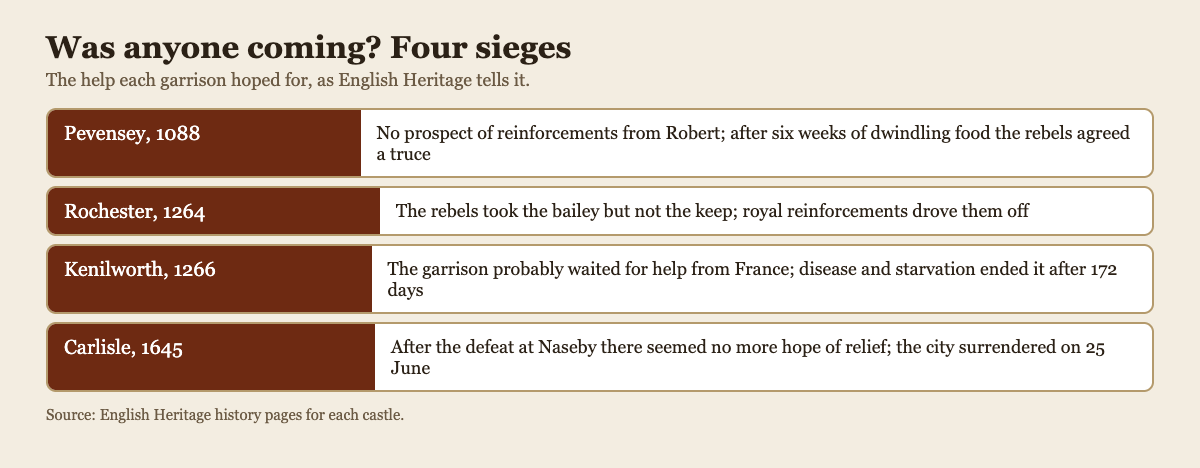
Four castles, one question: was anyone coming?
Carlisle, 1645: the day the hope died
Carlisle shows hope ending on one named day. In October 1644 a Parliamentarian army surrounded the castle with guns and earthworks "and settled down to starve the city out". English troops joined them in spring 1645. Food ran out: the horses were eaten, then the dogs and rats.
Then came the Royalist defeat at Naseby in June 1645. English Heritage says "there seemed no more hope of relief", and on 25 June the city surrendered. Carlisle had been besieged many times; our post on Carlisle's ten sieges counts them. Of them all, this one was ended by news from another field more than by anything at the walls.
A way to read the hope of help in any siege
You can use three questions on any castle history page. Here is the worked example, with the four castles above.
- Was anyone coming? Pevensey 1088: no prospect, said the page. Kenilworth: the garrison hoped for France, and the page names no arrival. Rochester 1264: yes, royal reinforcements.
- Did the garrison know it? At Carlisle the garrison learned of Naseby and the hope went with it. At Pevensey in 1088 the page says there was no prospect of help, and the rebels agreed a truce.
- What did the garrison still have? Food decides whether the answer matters. Pevensey had six weeks. Kenilworth had enough for months, and then two days.
Run them on your own castle page. A garrison that says no to the first, yes to the second and low to the third is about to open its gates.
In Two Towers: no army is coming
In Two Towers, a free medieval tower defense game that plays in your browser, the title screen says it plainly: "Two towers. One gate. Hold it as long as you can." There is no final stage, and if the gate falls the game is over. No relief army is on its way.
So you play the other side of this post. Your gold is your stores, and you spend it between attacks: repair the gate, reinforce it, or buy damage for your towers. The game's own tip for the king that leads every fifth stage reads: "A king leads every fifth stage: Reinforce the gate before it and save gold for Damage." That is the Kenilworth rule, to spend the stores before the hard day while you still hold them. The game gives you nothing to wait for, so you work out when to spend.
Frequently asked questions
What is a relief army?
A relief army is a force that comes to end a siege by driving off or threatening the besiegers. At Rochester in 1264, English Heritage says royal reinforcements drove the rebels off the castle.
Did a relief army usually arrive?
In the four English Heritage pages above, it arrived once, at Rochester. At Pevensey in 1088 there was no prospect of it, at Kenilworth the page tells of no arrival, and at Carlisle the hope ended after Naseby.
Why did garrisons wait for help that did not come?
The cost of giving up was high, and the stores were enough to wait. English Heritage says Kenilworth's garrison probably thought the harsh treatment of Montfort's supporters made waiting for reinforcements the better choice.
Does Two Towers have a relief army?
No. The game gives you two towers, one gate and gold to spend, and it has no final stage. You hold the gate as long as you can.
Get started
Pick one castle page from English Heritage and ask the three questions, then play Two Towers and see how long your gate holds when nobody is coming to help.
Comments
No comments yet.
Sign in or make an account to comment.