Restormel Castle: Cornwall's round castle and the Black Prince
Restormel Castle stands on a hilltop spur in the heart of Cornwall, and almost nothing about it looks like the castles you usually see. Its plan is a near-perfect circle. English Heritage calls it one of the most remarkable castles in Britain, and says it was built in the late 13th century as a luxurious retreat with a large hunting park. This guide follows Restormel from its first castle to the Civil War, using the history and description pages English Heritage publishes for it.
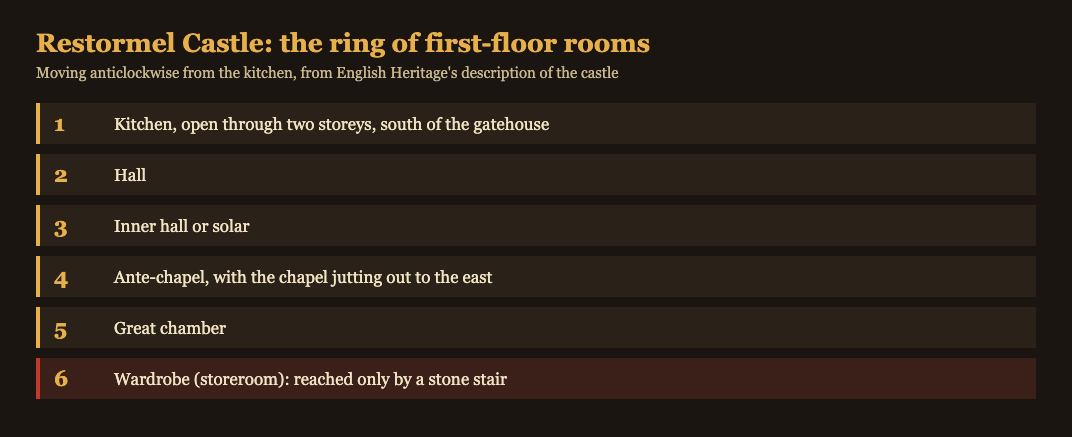
The ring of rooms inside Restormel's wall. The wardrobe, in red, had only a stone stair.
Where Restormel Castle began
The name comes from the Cornish Ros tor moyl, which means a bare hilltop spur. English Heritage says there is no detailed evidence for the castle before the 13th century, but one was almost certainly founded here in the 12th century, and perhaps even in the 11th. It overlooked a ford across the river Fowey, so it had some strategic use.
The archaeologist Ralegh Radford suggested in the 1930s that Baldwin fitz Turstan, son of the sheriff of Cornwall when Domesday Book was made in 1086, may have set up the first castle. English Heritage notes in its footnote that other places for the ford are more likely than the one his argument relies on. So the first builder stays a guess. If the castle did not exist by the 1140s, it may have been founded then, during the civil war of King Stephen's reign, as other Cornish castles were.
From the mid 12th century the land belonged to the Cardinham family, powerful landowners in central Cornwall. Fragments of the inner gate tower survive from this early phase. Three pits and the well, all cut into the bedrock of the courtyard, may be of a similar age.
The earls of Cornwall build a round castle
The story is better known from the mid 13th century. Simon de Montfort, the king's brother-in-law, owned the castle briefly from July 1265, but it went back to its old lords when he died in battle that year. In 1268 the Cardinhams' heiress, Isolda de Tracy, granted the town of Lostwithiel and the castle of Restormel to Richard, Earl of Cornwall and King of the Romans. They joined his castles at Launceston and Tintagel, and in 1270 he gained a fourth at Trematon. For his base at Launceston, read Launceston Castle: Cornwall's fortress, tin and Earl Richard.
Richard died in 1272, only four years after he gained Restormel. English Heritage thinks it more probable that his son Edmund built the present castle, since Edmund's work at Trematon is on record. The buildings cannot be dated exactly, but a grant issued at Restormel in 1293 and accounts of 1296 to 1297 suggest the main work was done by then. Edmund also moved his Cornish capital from Launceston to Lostwithiel, probably in the 1280s, and Restormel stood only a mile away. Edmund died in 1300 with no heir.
A shell keep with the mound taken away
English Heritage describes Restormel as a variant of the shell keep, which is a ring of stone wall that once stood on top of a mound. Restormel is unusual in three ways. It is large, 33.3 metres across. It is not on a high mound, but partly buried by an earth bank inside a deep ring-ditch. And it is late: this kind of building is usually linked to the 12th century, not the 13th. The page adds that only one other circular castle is known in medieval England.
Inside the wall, a ring of buildings faced the central courtyard. They were two storeys high, except the kitchen, which sat south of the gatehouse and was open through both storeys with a wide fireplace in its outer wall. Moving anticlockwise from the kitchen, the first-floor rooms were a hall, an inner hall or solar, the ante-chapel, and two more rooms thought to be the great chamber and a wardrobe, which means a storeroom. The ground-floor spaces were unheated and mostly storerooms. The wardrobe at the north-west corner could be reached only by a stone stair. For how a kitchen like this fed a household, see Castle kitchens: how a castle fed its household.
A castle built to be seen
The outer wall of the ring is well preserved, with a wall-walk and fragments of three cross-shaped arrowloops. But three large windows look south down the valley towards Lostwithiel, and only one faces north. English Heritage points out that such large windows would have been vulnerable to attack, which supports the view that Restormel was more a symbol of power than a fortress made to hold out. It also had a big hunting park, a garden and at least two hermitages. Weigh that against the ditch, the bank and the gatehouse, and you get a house that could look strong, rather than one planned around a siege.
The gatehouse stands to the west and the chapel to the east. The gatehouse was built in two phases, the inner part first, and once rose three storeys. A stone bridge now stands where there was a medieval drawbridge. For what a strong gatehouse did in a real siege, see Castle gatehouse: why it was a castle's strongest part.
The Black Prince, tin and the pewterer
In March 1337 Edward III made his son Edward, later known as the Black Prince, Duke of Cornwall, with a huge estate that included the old earldom's properties. That summer a survey called the Caption of Seisin was made, and it gives the fullest description of Restormel in its history. It records an inner ward, the one that still stands, with a hall and three chambers over cellars, a chapel and a stable for six horses. It also records a larger outer enclosure, now lost, with a great hall, three more chambers, a chapel, service buildings and stabling for 20 horses. A lead conduit brought water. The survey does not mention a kitchen, and many buildings were already decaying.
The first years of the Duchy of Cornwall were a high point. The prince issued many writs for repairs and for the park. English Heritage says more money was spent on the park boundary than on anything else at Restormel, which shows how highly hunting was valued. Lostwithiel was a key place for the Stannaries, the bodies that regulated tin, so the castle mattered to the economy. In 1346 the prince ordered that one of the only two pewterers working in the Duchy should be based at Restormel.
He stayed in August and September 1354, and again in the winter of 1362 to 1363, when he spent Christmas there. These are the only known times a member of the royal family lived at the castle. A fine Venetian glass beaker, found in pieces in the ditch in 1880, may have come with him.
Decline, and the last garrison
Repairs came now and then under Richard II, Henry VI and Edward IV. But Lostwithiel's river Fowey silted up with waste from tin-streaming on Bodmin Moor, so seagoing ships struggled to reach the town, and the castle declined with it. By the 1540s only the inner ward could be lived in, and the outer enclosure was "sore defaced". In 1584 the mapmaker John Norden described desolation, with plundering of lead, stone and timber already begun.
The Civil War gave Restormel one last turn as a fort. In summer 1644 a Parliamentarian army under Lord Essex took over the derelict castle. English Heritage thinks only part was used as a gun emplacement, probably the chapel above the valley and perhaps the gatehouse. The description page adds that the chapel's east window was blocked, probably in this war, to carry cannon on the chapel roof. On 21 August the royalist Sir Richard Grenville captured the castle, finding a garrison of 30 men, and days later Essex's army surrendered. Afterwards, surveyors thought it "not worth the taking down".
That was the last time Restormel worked as a castle. It became a picturesque ruin, and Queen Victoria and Prince Albert visited in 1846. The Office of Works took the ruins into state care on 6 March 1925, and English Heritage has managed the site since 1984.
What Restormel can teach a Two Towers player
Restormel shows that a castle can be built to impress rather than to resist. In Two Towers, a medieval tower defense game, nothing is built for show: you pick the two towers that guard the city gate, and if the gate falls, the game is over. Gold goes on upgrades, and you can buy two more towers for West Hill and East Hill, 150 gold for the first and 300 for the second. Restormel's windows looked out at a valley and invited a visitor to admire the view. A defender in the game puts the towers where the attackers will come. To plan the hills, read Two Towers hill towers: what to build on West Hill and East Hill. The game does not model a hunting park, a pewterer or a round castle.
Frequently asked questions
Why is Restormel Castle round?
It is a late variant of the shell keep, a ring of wall with buildings ranged round a courtyard. English Heritage says its plan is almost perfectly circular, and only one other circular castle is known in medieval England.
Who built Restormel Castle?
A castle was almost certainly founded here in the 12th century, or even the 11th. English Heritage thinks Edmund, Earl of Cornwall, son of Earl Richard, more probably built the present castle in the late 13th century.
Did the Black Prince live at Restormel Castle?
He stayed twice, in August and September 1354 and in the winter of 1362 to 1363, when he celebrated Christmas there. English Heritage says these are the only known times a member of the royal family lived at the castle.
Was Restormel Castle ever attacked?
English Heritage says there is no evidence it saw action in the Cornish risings of 1497, 1548 and 1549. In 1644 a Parliamentarian army held it, and Sir Richard Grenville captured it for the king on 21 August, finding a garrison of 30 men.
Get started
Restormel had a ring of rooms, a ditch and a gate. Your gate in Two Towers has two towers, and stages that grow stronger the longer you hold it.
Play Two Towers: it is free and plays in your browser on a computer or a phone.
Comments
No comments yet.
Sign in or make an account to comment.