Ricardo's comparative advantage: a simple explanation
If you want to understand Ricardo's comparative advantage, you only need one change in how you count cost. Do not ask who is faster. Ask what each side gives up. This post uses Ricardo's own wine and bread numbers, shows why a country that is better at everything still gains from trade, and sets out where economists add limits.
Ricardo's comparative advantage in one sentence
A side has a comparative advantage in a good when making it costs that side less, counted in the other goods it gives up, than it costs the other side. In the Econlib entry on comparative advantage, Donald Boudreaux puts it this way: what matters is "not absolute production ability but ability in producing one good relative to another."
That is the whole idea. The rest of this post is the numbers behind it.
Who was David Ricardo?
David Ricardo (1772 to 1823) did not start as an economist. According to David R. Henderson's entry on him, his family disinherited him for marrying outside his Jewish faith, and he made a fortune as a stockbroker and loan broker. At 27 he read Adam Smith's The Wealth of Nations and got excited about economics. He wrote his first economics article at 37 and spent his last fourteen years as a professional economist.
He opposed the Corn Laws, which restricted imports of wheat. In arguing for free trade, he formulated the idea of comparative costs, today called comparative advantage. Henderson calls it "the main basis for most economists' belief in free trade today." The principle is usually dated to his 1817 book, Principles of Political Economy and Taxation.
Cost means what you give up
Count cost in hours and the stronger side seems to win at everything. Count cost in the other good you could have made, and the picture changes. Every choice to make one thing is a choice not to make another, so every side gives up something.
Boudreaux shows this with two people on an island, Ann and Bob. Ann gives up half a banana for each fish she catches. Bob gives up a whole banana for each fish. So Ann is the cheaper fisher, and Bob, by the same arithmetic, is the cheaper banana gatherer. Any price of fish between half a banana and one banana leaves both better off. Such a price exists whenever the two have different costs for each good.
A worked example: Poorland and Richland
Here are the numbers from Henderson's entry. Poorland needs 5 hours of labour to make a bottle of wine and 10 hours to make a loaf of bread. Richland needs 3 hours for a bottle of wine and 1 hour for a loaf. Richland is better at both.
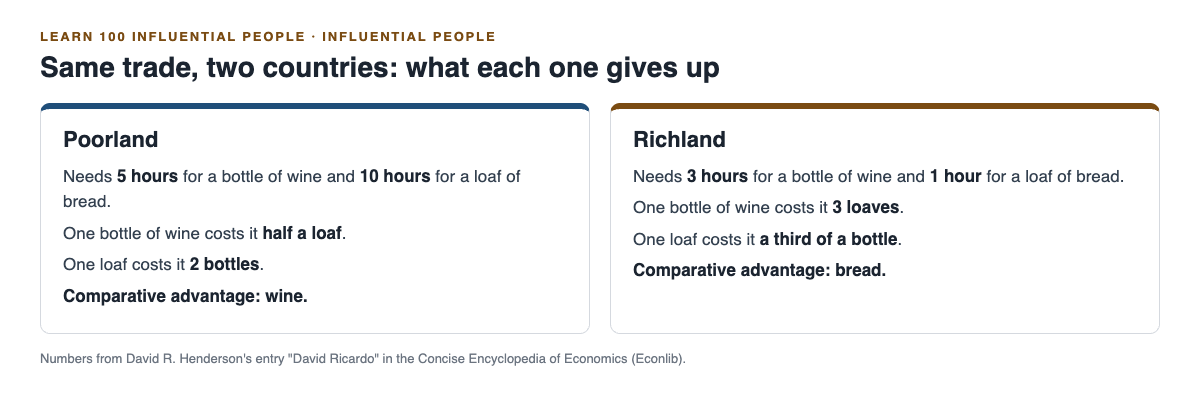
Now count what each gives up:
- Poorland gives up half a loaf for each bottle of wine, and 2 bottles for each loaf.
- Richland gives up 3 loaves for each bottle of wine, and only a third of a bottle for each loaf.
So Poorland has the comparative advantage in wine, and Richland has it in bread. Suppose they trade wine and bread one for one. Poorland moves 10 hours of labour out of bread. It loses one loaf, but those hours make 2 bottles of wine, which trade for 2 loaves. That is one extra loaf. Richland moves 3 hours out of wine. It loses one bottle and gains 3 loaves, trades 2 loaves for Poorland's 2 bottles, and ends up with one more bottle and an extra loaf.
Both gain, and neither gains at the other's expense. Richland would not trade otherwise.
Why the stronger side still trades
Many people balk here. If Richland can make everything with fewer hours, why trade at all? Alan Blinder answers with a lawyer. In his Econlib entry on free trade, he notes that some lawyers are better typists than their secretaries. The lawyer still does better to concentrate on law and leave the typing to the secretary.
He applies the same logic to nations. Even if China made everything more cheaply than the United States, he writes, some industries would show an overwhelming cost advantage and others only a slight one. Each country would make more of what it does best, the two would trade, and workers in both would have jobs. He adds that a country's wage level depends fundamentally on its labour force's productivity, not on its trade policy.
Boudreaux makes the broader point that the same principle explains all specialization and trade, with or without a border. Foreigners are willing to export only because they want to import.
Where economists add qualifications
The Poorland story is deliberately simple. Paul Krugman, in his essay "Ricardo's Difficult Idea", says the idea implies that trade between two nations normally raises the real incomes of both. He also lists reasons that gains may not come as easily as in the simplest model:
- External economies may mean too little investment in the sectors that compete with imports.
- Imperfect competition may lead to a strategic fight over industry profits.
- Because of distortions in a country's labour markets, imports may reduce wages or cause unemployment.
- Even if national income rises, the distribution of income may shift in a way that hurts large groups.
Krugman's own point is that these are extensions and qualifications to the model, and he argues that critics who dismiss the idea often do not grasp it first. Blinder, for his part, argues that protecting jobs from imports usually just swaps them: he cites an early-1990s study that put the cost at $1,285,000 a year for each luggage job preserved.
Readers can weigh these views differently. This post gives the arguments and leaves the verdict to you.
What else Ricardo left behind
Henderson credits Ricardo with more than trade. His 1815 essay set out what became the law of diminishing marginal returns: add more labour and machinery to a fixed amount of land, and each addition to output shrinks. His theory of rents says that as farmers move onto less productive land, the landowners, not the tenants, gain from the productive land. In 1809 he wrote that England's inflation came from the Bank of England issuing too many banknotes.
Henderson also quotes economist David Friedman on reading Ricardo's Principles: it feels like reaching the top of Everest and meeting "a hiker clad in T-shirt and tennis shoes." Ricardo got to complex conclusions without the maths economists now use.
If you want the thinker he read at 27, see our post on Adam Smith's invisible hand. For two later arguments about how far the state should step in, read Adam Smith vs Karl Marx and Keynes vs Hayek.
Frequently asked questions
What is Ricardo's comparative advantage in simple terms?
It says each side should make the good it gives up least to produce, then trade for the rest. In Ricardo's example both sides end up with more, even though one of them is better at everything.
What is the difference between absolute and comparative advantage?
Absolute advantage asks who needs fewer hours. Comparative advantage asks who gives up less of the other good. Boudreaux says what matters is the relative ability, not the absolute one.
Did Ricardo discover comparative advantage?
Econlib credits him with formulating it, and dates the principle to his 1817 book, Principles of Political Economy and Taxation.
Does everyone gain from trade under this idea?
The simple model says both sides gain. Krugman lists reasons that the real picture is harder, including shifts in who earns what within a country.
Get started
Ricardo is one of the people in the Thinkers of the Economy course in Learn 100 Influential People, beside Adam Smith, Malthus, Marx, Keynes, Hayek and Friedman. The lessons are about 9 minutes each, with questions that check what you read, cards that set out where researchers disagree, and a list of sources for every lesson. You sign in with your email and an emailed sign-in code, and you can read more on the about page.
Start Learn 100 Influential People: short hands-on lessons on the people who shaped history, with every side of the debate and the sources to read next.
Comments
No comments yet.
Sign in or make an account to comment.