Roaring Meg: the mortar at the siege of Goodrich
Roaring Meg is the name of a huge mortar, a short, fat gun that lobbed an exploding iron ball over a wall. English Heritage says it is the only surviving mortar from the English Civil Wars, and you can see it today in the inner courtyard of Goodrich Castle in Herefordshire. It was cast in June 1646, in the middle of a siege, to do something the besiegers' ordinary guns could not. This post follows that siege from the first raid to the surrender, using English Heritage's own pages, so you can see what the mortar did and what it did not.
Roaring Meg: what the mortar was
English Heritage says Colonel John Birch ordered the mortar cast in June 1646, reputedly by a local blacksmith in a forge near the castle. It fired "grenades": hollow iron balls filled with gunpowder, set off by a fuse that was meant to burn down just as the ball landed. English Heritage gives the shell's weight as 85 kg (200 pounds).
The name was not unique. English Heritage notes that several other large guns of the period were also nicknamed Roaring Meg. The Goodrich one is the survivor, and it is now shown at the north-east corner of the inner courtyard.
Goodrich in the war before the siege
At the start of the Civil War, Parliamentarians held Goodrich. In late 1643 they withdrew, and a Royalist garrison under Henry Lingen took over. In September 1644 he made the castle his permanent headquarters. English Heritage says the constable, Richard Tyler, was imprisoned and the farm buildings below the castle were burned.
The war turned in December 1645, when Parliament took Hereford. Lingen escaped across the frozen River Wye and went back to Goodrich. English Heritage says his garrison there numbered as many as 120 soldiers and 50 officers and gentlemen, mostly local men who knew the country and raided it. With the rest of the county lost, an attack on Goodrich was only a matter of time.
It started with a night raid. On 9 March 1646 men of Colonel Birch's force crept into the stables, which stood outside the main defensive ring. While a diversion kept the gates busy, they climbed the outer curtain wall, dug a hole in it, led the horses away and set the stables on fire. One account says there were 80 horses. English Heritage calls it a complete success but says it had little lasting effect: the Royalists replaced some of the horses and went on raiding.
Trenches, a letter and a new mortar
Birch came back on 1 June 1646. By then the king had been under house arrest since 13 May, and the Royalist headquarters at Oxford was talking about surrender, but Birch and Lingen still had a score to settle. English Heritage says Birch wanted nothing less than unconditional surrender.
The castle sits on a hill spur behind a wide rock-cut ditch, a strong position. English Heritage says it was not prepared for 17th-century siege warfare, but storming it directly was not an option. So Birch had his men dig trenches to shelter his artillery close under the walls. On 13 June, at 2pm, he wrote to Lingen asking for the castle and promising civility to the gentlemen who put themselves under his protection.
The siege went on. English Heritage says Birch's artillery cut off the spring that fed the castle and destroyed its water tanks, so the garrison had to rely on its well. The defenders could only throw stones down on the besiegers and ride out, and they lost many horses doing so.
Birch knew his cannon and his mines were not enough to breach such thick walls, and he had the mortar cast. On 18 June he wrote to the Speaker of Parliament that he was almost ready to "play upon them with a mortar piece, which I have cast here", and asked for a large amount of powder. English Heritage says the figure was 80 barrels.
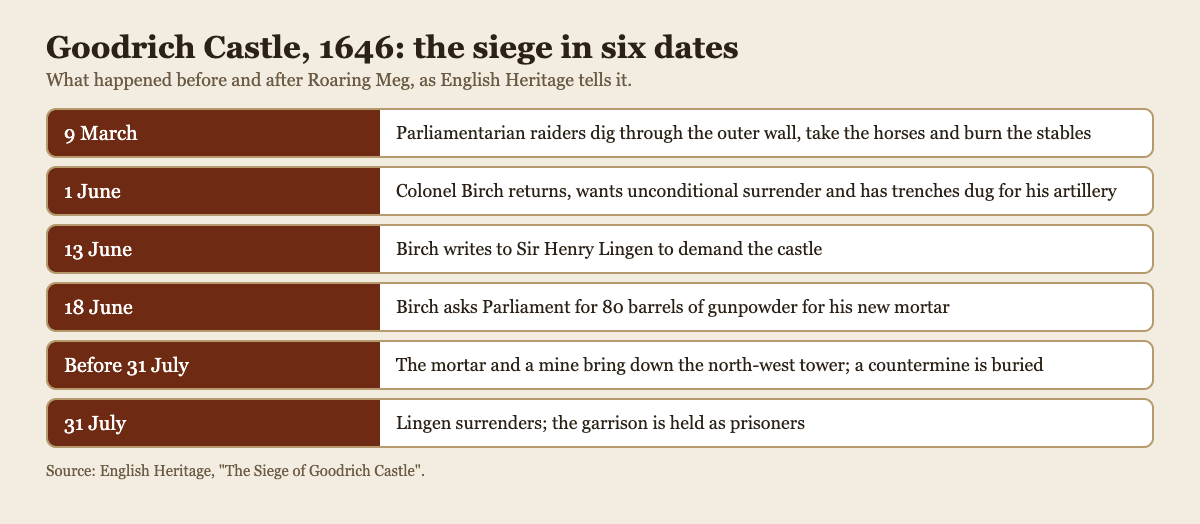
The siege in six dates, from English Heritage's account.
The Lady Tower and the surrender
Birch aimed at the north-west tower, called the Lady Tower, which English Heritage says was seen as one of the castle's weak points. Mortar fire damaged the top of the tower, and its rock footings were undermined by a mine.
The Royalists answered by digging a countermine from the tower's basement, under Birch's mine. English Heritage says this almost ruined Birch's operation. Birch moved the mortar to close range at night and brought much of the tower down, burying the countermine. The page adds that neither the mines nor the countermines have been found.
Reports from Parliament's side praised the mortar's effect, especially on that tower. English Heritage is careful here: whether or not they can be believed, it says, the sound of such a gun firing, followed by the blast of the shell, must have worn down the defenders. Its history page puts the surrender down to two threats together: undermining and the mortar.
On 31 July 1646 Lingen surrendered, hauling down his colours and flying a white flag. Birch gave nothing beyond mercy for their lives and would not let the Royalists march out with their arms. He treated them as prisoners. Tradition says the Parliamentarians played a tune on makeshift instruments as the garrison left, later known as "Sir Harry Lingen's Fancy".
After the siege: a ruin and a well
Birch said there was "noe whole room" left in the castle. Even so, Parliament wanted to be sure it could never be used again, so it ordered the castle made indefensible. By 1648 the battlements had been removed and the main defences damaged, and lead was stripped from the roofs that remained. This is the practice called slighting, and the slighting post explains why it happened to so many castles.
The mortar left a second mark. In the 1920s, workers clearing the courtyard found the castle's buried well. English Heritage says the well head had taken a direct hit, probably from a shell fired by Roaring Meg. At the bottom, 166 feet down, they found shell fragments among many objects from daily life in the courtyard. The castle wells post tells that find in full, and the starving post shows why cutting the water mattered so much.
A worked example: read any siege in four questions
You can use the Goodrich story as a pattern for any siege page. Ask four questions, in order, and write one line for each.
- Who held it, and with what? Goodrich: Lingen, as many as 120 soldiers and 50 officers and gentlemen, plus a well.
- What did the attacker cut off? The spring, the water tanks and many of the horses.
- What new thing did the attacker bring? A mortar cast on the spot, and a mine under the weak tower.
- How did it end, and what was left? Surrender on 31 July 1646, then a castle made indefensible.
Try it on a second siege, such as one of the castles in the Civil War castle sieges post. For the first great siege guns, read the bombard post.
In Two Towers: stones on a crowd
Two Towers is a free medieval tower defense game that plays in your browser, on a computer or a phone. Its title screen says "Two towers. One gate. Hold it as long as you can." You pick one of four towers for each side of the gate: Archer Tower, Trebuchet, Ballista or Fire Tower. None of them is a mortar, but the Trebuchet is the game's stone thrower, and its title-screen label is "Stones on a crowd".
The game's own tip for peasants says why that matters: "Peasants win by numbers: a Trebuchet or Fire Tower hits the whole crowd at once." Birch needed one very big shell to break one tower. You need many stones to break a crowd. Gold from each stage buys upgrades, and you can buy a tower for a hill too: 150 gold for the first and 300 for the second, in-game gold, never money. The Trebuchet post lists the four attackers it answers.
Frequently asked questions
What was Roaring Meg?
A huge mortar cast in June 1646 on the orders of Colonel John Birch to help Parliament take Goodrich Castle. English Heritage says it is the only surviving mortar from the English Civil Wars.
Where can you see Roaring Meg today?
English Heritage says it is displayed at the north-east corner of the inner courtyard at Goodrich Castle in Herefordshire.
Did Roaring Meg win the siege by itself?
Not alone. English Heritage says Birch also used cannon, mines and the loss of the castle's water, and that reports of the mortar's effect may not all be believable. Its history page names undermining and the mortar together.
What happened to Goodrich Castle afterwards?
It was left in ruin, and Parliament ordered it made indefensible. By 1648 the battlements were removed and the main defences damaged.
Get started
Read English Heritage's account of the siege with the four questions above, then try holding a gate yourself: Play Two Towers, pick your two towers, and see how many stages you last.
Comments
No comments yet.
Sign in or make an account to comment.