Rochester Castle history: three sieges and a keep
Rochester Castle history is a story of three sieges: 1088, 1215 and 1264. The castle stands in Kent, inside the walls of the Roman city of Rochester, where the road from east Kent to London crossed the river Medway. This post follows the castle through those three sieges, using English Heritage's history and description pages, and ends with what to look for on the keep today.
Rochester Castle history: the short version
English Heritage sums it up in a few lines. The castle was first built in stone by Gundulf, Bishop of Rochester, in the 1080s, and in 1127 Henry I handed it to the Archbishop of Canterbury, who began the great keep. That keep is 38 metres (125 feet) high and is described as the tallest of its kind to survive in Europe. The castle "endured three sieges", and in the famous one of 1215 a corner of the keep was destroyed.
- 1088: rebels held it for Bishop Odo, and William Rufus took it back after several weeks.
- 1215: King John took it from rebel barons by undermining the keep.
- 1264: Simon de Montfort's rebels took the bailey but could not take the keep.
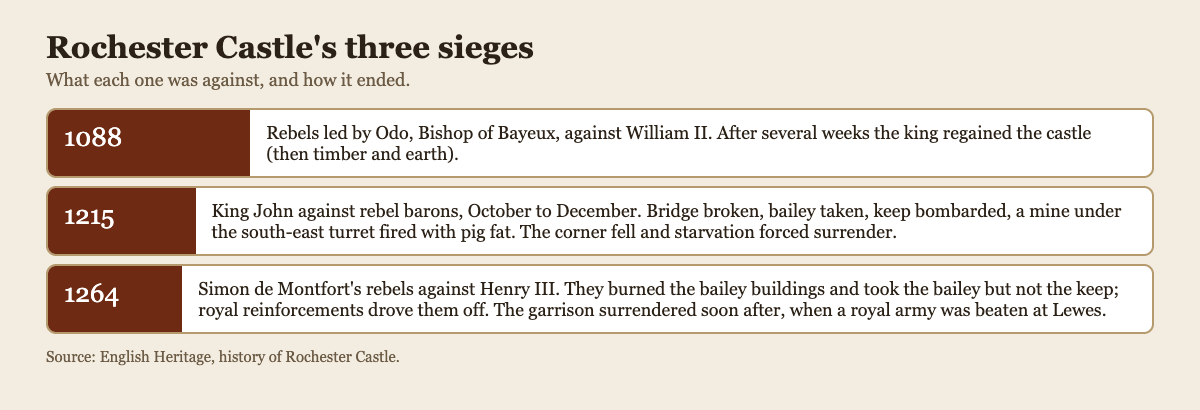
Three sieges, three endings, from English Heritage's history page.
A castle at a river crossing, the siege of 1088 and the great keep
The city began as a Roman settlement on the east bank of the Medway, and a major road crossed the river there. After the Norman Conquest of 1066 a royal castle of timber and earthworks was almost certainly founded in the south-west corner of the walled city, on land that had belonged to the Bishop of Rochester.
The king then asked Gundulf, Bishop of Rochester, to rebuild the defences in stone. Part of the castle's west curtain wall still stands from his work. For more on what a curtain wall does, see our post on the curtain wall.
The first siege came while the castle was still timber. In 1088 Odo, Bishop of Bayeux, the rebellious uncle of William II, took control of the city and castle. William laid siege and, after several weeks, regained them.
That is all the English Heritage page says about it, so that is all this post claims.
In 1127 Henry I gave the castle to William de Corbeil, Archbishop of Canterbury, on condition that he build fortifications there. The result was the great keep, which contemporaries called "outstanding" and "noble".
The keep is built of irregular Kentish ragstone, with the corners and arched windows cut from finely shaped Caen stone brought from Normandy. Its door was not at the bottom. The entrance was on the first floor, in a forebuilding against the north front, at the top of an outside stair. It opened into a waiting room, and an inner door guarded by a portcullis led into the keep itself.
Inside, the basement held storerooms and two ground-floor rooms were probably for the garrison. The main state rooms were on the second floor. If you want the general idea of what a keep was for, our post What was a castle keep for? walks through it.
The siege of 1215: King John and the mine
Between October and December 1215, King John besieged the castle to win it back from rebels. He first broke Rochester Bridge and captured the bailey. His army then used siege engines to bombard the rebels in the keep with stones, while miners attacked the south-east turret.
The miners had held up the tunnel with timber props, and the attackers burned them to bring the wall down. English Heritage says they used the fat from "40 pigs too fat to eat" to do it. The undermined masonry dropped, and the south-east corner of the keep came down.
The rebels fell back to the northern half of the keep's interior. The keep has an east-west spine wall that splits the inside into two halves, which fits that retreat, although the page does not say the wall decided it. Starvation soon forced the rebels to surrender. John's win did not last long. He died the next year.
We cover how siege mines worked, and how a defender answered them, in Undermining a castle.
The damage to the keep is still visible. The south-east turret is round, while the other three corner turrets are square. It was rebuilt in the 1220s after the original square tower collapsed in 1215.
John's son Henry III repaired the keep and added a group of residential buildings in the bailey, set down in many detailed writs. One wall of his two-storey chamber block still stands in the west curtain wall. He also had a round drum tower built at the south-east corner of the bailey. English Heritage does not say why the turret was rebuilt round, so do not take it as a rule that round corners resist mining. Look at it as the mark the siege left.
The round corner and the siege of 1264
In 1264 Simon de Montfort and the barons rebelling against Henry III besieged it. The king's hall and other buildings in the bailey were burned. The rebels captured the bailey but could not take the keep, and royal reinforcements eventually drove them off.
The relief did not settle the matter. Soon afterwards the garrison was forced to surrender when a royal army was defeated at Lewes. A keep that held its walls for the king still changed hands because of a battle elsewhere. Our post on relief armies looks at the same pattern in other sieges.
The fire of 1264 had a lasting effect. The royal hall and chambers in the bailey were never rebuilt, and the castle declined. In 1314 Elizabeth, wife of Robert Bruce, King of Scotland, was held there briefly as a prisoner.
Edward III and Richard II ordered repairs in the 14th century, and the two rectangular towers of the east curtain wall come from that time. From the 15th century the bailey was let to tenants. By the later 16th century the castle was no longer needed, and Elizabeth I allowed stone to be taken from the curtain wall to build the new fort at Upnor.
The castle played no part in the Civil Wars of 1642 to 1651, so it was never slighted (see why castles were wrecked on purpose). It seems a violent fire in the keep before the 1660s left it a ruin. Since then the inside has been a huge, roofless space. Samuel Pepys and Charles Dickens both wrote about the vast interior and the view from the top.
In 1870 Rochester Corporation leased the castle and later bought it, and opened the grounds as gardens. Since 1995 Medway Council has run both the keep and the Castle Gardens.
After the sieges, and what to look for on the keep today
- The one round corner. It is the south-east turret, rebuilt in the 1220s.
- The doorway high up on the north side, where the first-floor entrance and its forebuilding stood.
- The spine wall and the well shaft inside, and the deep sockets in the walls where the timber floors sat.
Check English Heritage's own page for opening times before you go, as the keep is managed by Medway Council.
Rochester's sieges in Two Towers
Two Towers is a medieval tower defense game that plays in your browser. It is not a history of Rochester, and it does not claim to be. But its attackers meet the same problems. The game describes a sapper as one that "digs under your strongest hill tower to silence it". Its tip for sappers reads "Archer Volley catches them off the road, and a Bell slows the dig."
The 1215 lesson is the same one: stop the diggers before they reach the foot of the wall. The game's ram tip is just as direct: "Rams hit the gate hardest: Reinforce the gate, and use Ballista bolts that ignore armor."
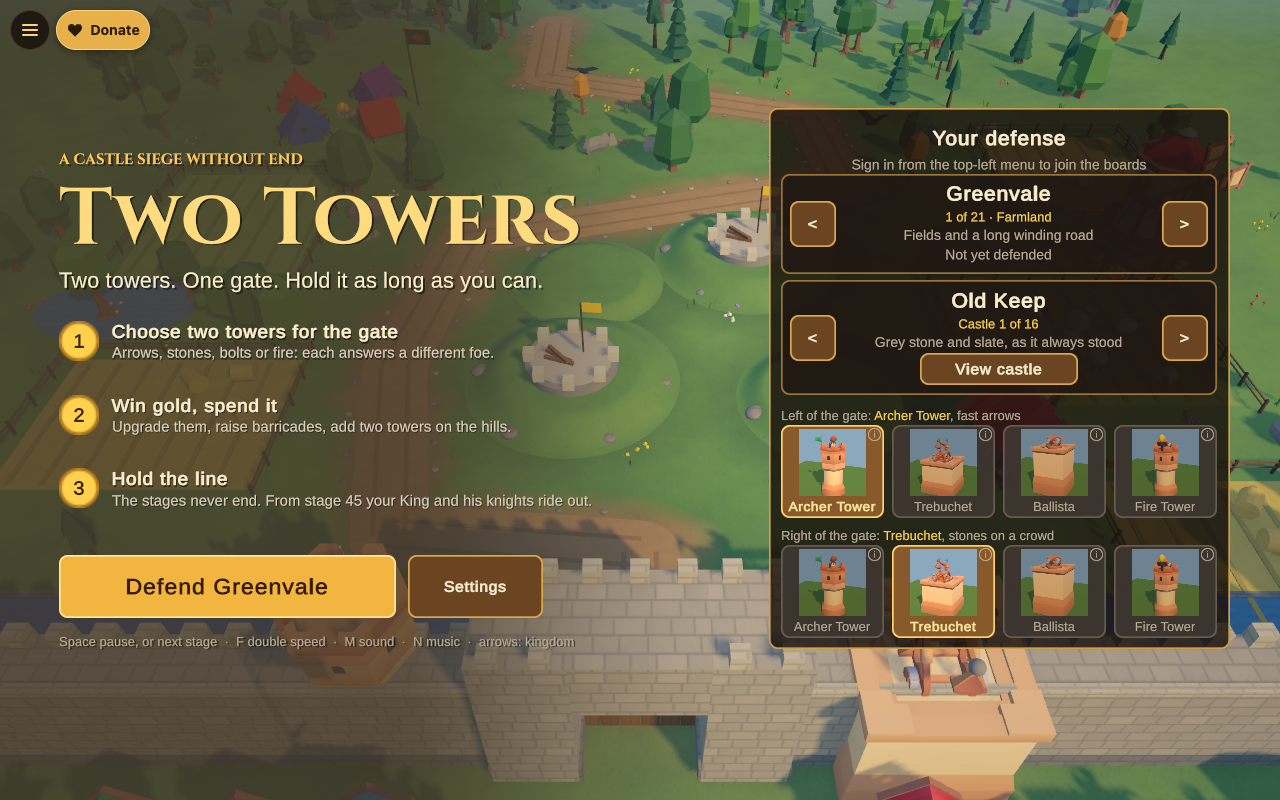
The Two Towers title screen, where you pick the two towers that guard the gate.
Frequently asked questions
Who built Rochester Castle?
Gundulf, Bishop of Rochester, built the first stone castle in the 1080s. The great keep was built after 1127, when Henry I gave the castle to William de Corbeil, Archbishop of Canterbury, on condition that he build there.
What happened at the siege of Rochester Castle in 1215?
King John besieged rebels there from October to December. His miners undermined the south-east corner of the keep and burned the props with pig fat, and the corner fell. The rebels fell back to the northern half and surrendered when starvation set in.
Why is one corner of Rochester's keep round?
The south-east turret was rebuilt in the 1220s, after the original square tower collapsed in the siege of 1215. The other corner turrets are square.
Did Simon de Montfort take Rochester Castle in 1264?
His rebels captured the bailey but could not take the keep, and royal reinforcements drove them off. The garrison surrendered soon after, when a royal army lost at Lewes.
Get started
If three sieges made you want to hold a gate yourself, try Two Towers. The page says it is free, with no ads. You pick the two towers that guard the gate from four kinds, spend the gold you win on upgrades, and buy two more for the hills. There is no final stage.
Comments
No comments yet.
Sign in or make an account to comment.