Root cause vs symptom: how to tell the difference
When something keeps going wrong, you first have to decide whether you are looking at the thing itself or at a sign of it. That is the core of root cause vs symptom. A symptom is what you notice. A root cause is the condition that, if you changed it, would stop the symptom from coming back. This guide gives you five practical tests, one worked example, and a simple way to record what you try so you can see which fixes held.
Root cause vs symptom: the short answer
A symptom is the visible effect. A root cause is the earliest point in the chain that you can actually change, and that would stop the effect if you did.
The quickest check is to ask: if I fix this, does the problem stop for good, or just for now? If it stops for now, you fixed a symptom. If it stops and stays stopped, you probably found the cause.
Two words in that definition do a lot of work:
- Earliest. Causes come in chains. The root sits upstream of the others.
- Change. A "cause" you cannot act on, like the weather or human nature, is not useful as a root cause. Keep going until you reach something you control.
The Lean Enterprise Institute's page on the 5 whys gives the classic case, from Taiichi Ohno. A machine stopped because a fuse blew. Asking why, again and again, led past an overload, a dry bearing and a weak pump to a worn shaft with no strainer to keep metal scraps out. Without asking why, the page says, managers would simply replace the fuse or the pump, and the failure would recur.
Why fixing symptoms feels productive but fails
Symptom fixes are fast, visible and satisfying. You restart the server, resend the email, clean up the spreadsheet. The red light goes green. You feel done.
Then it happens again next week, and the week after. Each fix takes ten minutes, so it never feels worth a deeper look, and the real cause keeps running underneath.
There is a second cost: you stop noticing patterns. Three annoyances can share one cause, but if each lives in a different to-do list, you never connect them.
Five tests to tell a root cause from a symptom
Run your candidate cause through these. A real root cause passes most of them.
- The recurrence test. If you remove it, does the problem stop coming back? Symptoms return. Causes, once fixed, do not.
- The "why else" test. Ask why this candidate happened. If there is a clear, changeable answer, you have not reached the root yet. Go one level up.
- The control test. Can you or your team actually change it? "Customers are impatient" fails. "We promise a reply in one hour but staff the inbox for four" passes.
- The spread test. Does it explain more than one problem? Root causes often show up behind several symptoms at once. If your candidate explains only the one thing in front of you, look for something broader.
- The removal test. Imagine the candidate gone. Walk forward through the chain. Does every link after it disappear? If some symptom survives, there is another cause you have not found.
None of these tests is perfect alone. Together they catch most wrong answers.
Worked example: tracing a recurring problem to its source
Say you run a small team, and your weekly sales report goes out late almost every Monday. Here is the chain, one "why" at a time.
- Symptom: The Monday report goes out late.
- Why? The numbers are not ready until noon.
- Why? Someone has to clean the order spreadsheet by hand first.
- Why? It is full of duplicate orders.
- Why? Two people enter the same phone orders, because both think it is their job.
- Why? Nobody was ever named the owner of order entry.
Now run the tests on "nobody owns order entry."
- Recurrence: Name one owner, and duplicates should stop, so cleanup stops, so the report is on time.
- Why else: Why was no one named? Because the role grew informally. That is still the same fix: name an owner.
- Control: Yes, you can assign it today.
- Spread: It also explains why two customers were double charged last month. One cause, two symptoms.
- Removal: With one owner, every later link goes away.
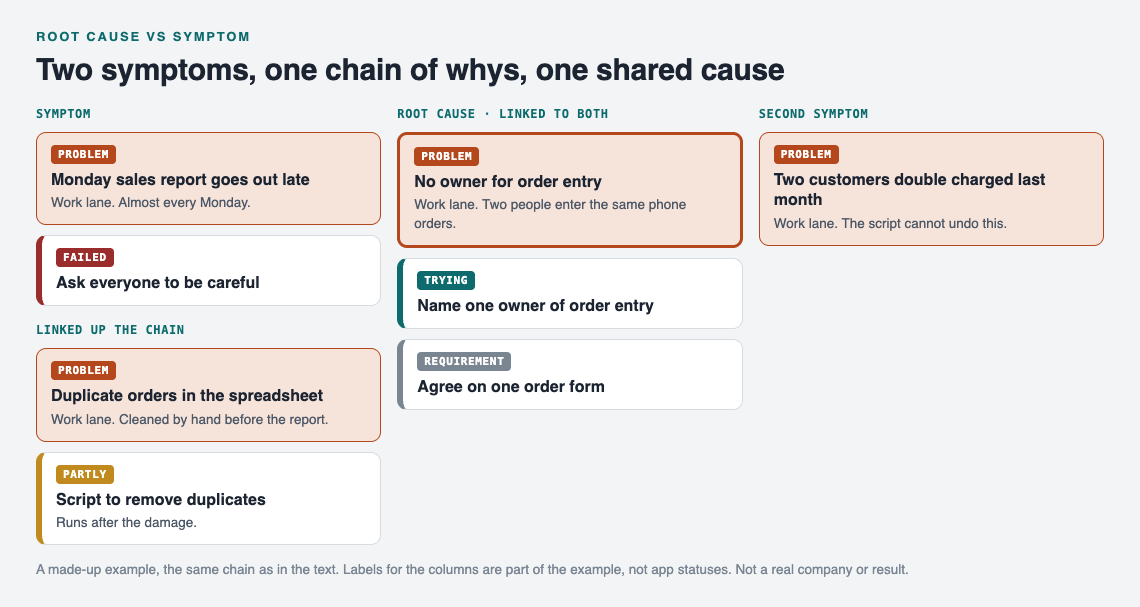
The made-up example above as a map: two symptoms linked to one shared cause.
Compare that with the fixes you were tempted to try first: start the report earlier, write a script that deletes duplicates, ask everyone to be careful. Each one treats a link in the middle of the chain. The script might even work, partly. But the double charges would keep happening, because the script runs after the damage.
This is why it helps to write down what you tried and how it went. If "script to remove duplicates" is recorded as partly worked, and "ask people to be careful" is recorded as failed, the record itself points you upstream.
Tools that help: 5 Whys, fishbone diagrams, and problem graphs
5 Whys
You just saw it. Ask why until the answer is something you control and the tests pass. As the Lean Enterprise Institute puts it, the number five is not the point; the point is to keep asking until the root cause is reached. Its weakness: it follows one line, so it can miss a second cause. For a fuller walk through, see our 5 whys example.
Fishbone diagrams
A fishbone diagram puts the problem at the head and draws "bones" for categories of cause, such as people, equipment, materials, environment and methods. You brainstorm candidates on each bone, then look at how they relate. It is good for spotting several causes at once. Its weakness: it is a one-time sketch, and it does not record what you tried or whether it worked. Our fishbone diagram example shows one filled in.
Problem graphs
A problem graph keeps problems, the solutions you try, and their outcomes on one map that grows over time. Problem Graph is built around this idea. Here is how the report example would look in it:
- Write the problem in one line:
Monday sales report goes out late. Put it in the work lane. It lands on the graph when you press Enter. - Add the problems further up the chain as their own nodes, such as
Duplicate orders in spreadsheetandNo owner for order entry, and link them to the first one. - Attach solutions to each. Start with ideas, mark the one you are trying, then record the outcome as worked, partly or failed.
- If a solution needs something before it can work, like "agree on one order form", add that as a requirement.
- Link the double-charge problem to
No owner for order entrytoo. Now the spread test is visible on the map: two symptoms, one shared cause.
The point is memory. The app's own line puts it well: "A solution that failed three times stays on the map as a failed solution, and that is exactly what the next person needs to know." You can also link problems across lanes, so a work cause that is quietly hurting your personal life shows up as a connection, not a coincidence. Your graph is private by default, so only you see it unless you choose to share.
If you are stuck, ask for suggestions: the AI proposes solutions based on what worked for others on similar problems. Treat them as ideas to test.
Common traps: proximate causes, multiple causes, and blame
Stopping at the proximate cause
The proximate cause is the last thing that happened before the symptom. "The report was late because the cleanup took too long" is proximate. It is true, and it is not the root. The "why else" test catches this.
Assuming there is only one cause
Many problems have two or three causes working together. If the removal test leaves a symptom standing, look for a second branch. A fishbone sketch or a few extra linked nodes on a graph help here.
Turning cause into blame
"Dana keeps entering duplicates" names a person, not a cause. Ask why the system let it happen. Usually the answer is a missing rule, a missing owner, or a missing check. Fix the system and the person stops being the problem.
Picking the cause you already wanted
If your first guess was "we need a new tool", every chain will somehow end there. Write the chain down before you decide.
Frequently asked questions
Can a problem have more than one root cause?
Yes. Many problems need two or more conditions at once, and removing any one of them may stop the symptom. Use the removal test on each candidate to see which ones matter.
How do you know when to stop asking why?
Stop when the answer is something you can change and fixing it would stop the problem from recurring. If the next "why" leads to something outside your control, step back one level.
Is a contributing factor the same as a root cause?
No. A contributing factor makes the problem worse or more likely, but removing it alone does not stop it. A root cause, once removed, stops the chain.
Should you ever treat the symptom first?
Yes, when the symptom is causing harm right now. Stop the damage first, then trace the cause. Just record the quick fix as a symptom fix so you remember to come back.
Get started
Pick one problem that keeps coming back. Write it down in one line, then add the first "why" as a linked problem. Attach the fix you have been using and mark how it went. After a few weeks, the map will show you which fixes held and which only bought time.
Try Problem Graph: it is free, and you can look around the public network without an account. Write one problem down in a line and attach the first thing you will try. In the app, Load example set shows how linked problems and outcomes look before you start.
Comments
No comments yet.
Sign in or make an account to comment.