Saxon Shore forts: Roman castles on Britain's coast
The Saxon Shore forts were a chain of Roman coastal forts, and English Heritage looks after several of them. Their walls are older than any medieval castle in Britain, yet castle builders kept coming back to them. This post reads four of these forts from English Heritage's own history pages: Reculver, Burgh Castle, Pevensey and Portchester.
Saxon Shore forts: what they were
English Heritage describes a string of forts running from the Solent to the Wash, known today as the Saxon Shore. They are thought to have worked as a defence against seaborne raiders, as naval bases and as defended trading centres. The name of the shore comes from a late Roman document, the Notitia Dignitatum. It is a list of military and civil commands across the whole empire, and it puts these forts under an officer called the Count of the Saxon Shore.
The Notitia should be read with care. English Heritage says the date of its western section is uncertain, usually the later 4th or earlier 5th century, and that some out-of-date information may have been included. For Burgh, the list gives a garrison of Stablesian cavalry, but the page says that when and for how long that applied is not known. The page for Pevensey adds that whether the forts were set up as one coherent defensive system is not clear.
Why Rome built forts on the coast
Portchester's page gives the reason in one line: the forts were built over the course of the 3rd century to meet the threat of Saxon pirates raiding the south coast. A fort at a harbour or river mouth gave soldiers and ships a base exactly where raiders came ashore.
There was a second pressure, told on the Portchester and Pevensey pages. Carausius was appointed to command the Roman fleet in the Channel about AD 285. When the emperor Maximian condemned him to death, he rebelled and proclaimed himself emperor in Britain and northern Gaul. In AD 293 Constantius Chlorus sent an army against him, and the same year his deputy Allectus assassinated him. Constantius reconquered Britain. Pevensey's page offers this as one explanation for a sudden burst of fort building: a ruler who stood against Rome had every reason to fortify the coast. It is an explanation, not a proven fact, and the page notes that when Constantius invaded in 296 there is no sign that the coastal forts played a part.
Two generations of wall
The four pages together show that the forts were not built to one plan.
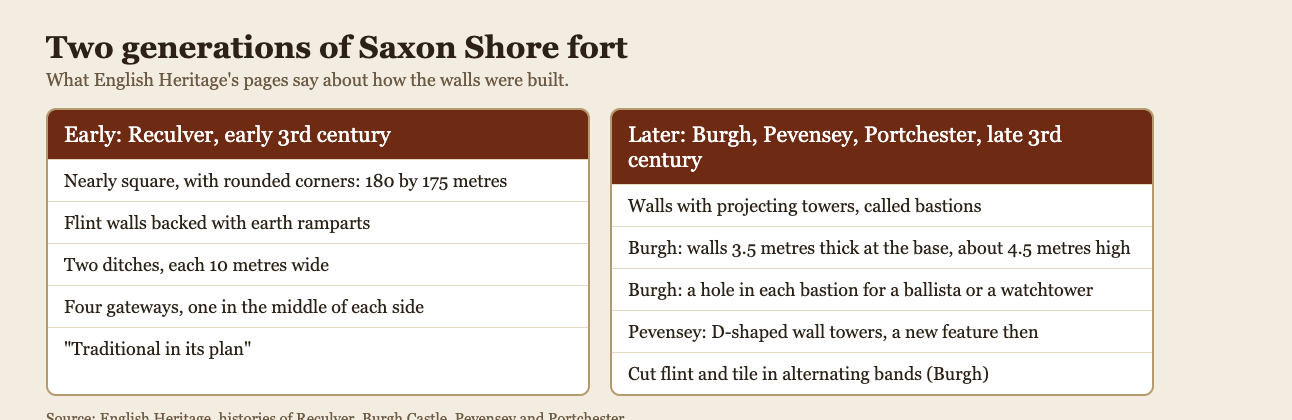
The early fort at Reculver and the later forts with projecting towers, as English Heritage describes them.
Reculver: the early plan
Reculver dates from the early 3rd century and guarded the northern end of the Wantsum Channel, a sea channel that once cut the Isle of Thanet off from the mainland. The fort was nearly square with rounded corners, 180 metres by 175 metres. Its flint walls were backed with earth ramparts and surrounded by two ditches, each 10 metres wide. English Heritage calls it one of the very earliest of the Saxon Shore forts and says it was traditional in its plan. It had four gateways, one in the middle of each side. The east gate was a single carriageway 2.7 metres wide under a masonry arch, with one guard chamber.
Burgh, Pevensey and Portchester: the new model
The later forts, the Reculver page says, were built to a new model with projecting bastions. Burgh Castle shows it best. Built in the late 3rd century above the Waveney estuary, it enclosed about 6 acres. Its walls were about 3.5 metres thick at the base and about 4.5 metres high, and bastions were added late in the building. Each bastion has a central circular hole, which English Heritage says was either for anchoring catapults called ballistae or for supporting timber watchtowers. The walls were faced with cut flint and tile in alternating bands.
Pevensey, built about AD 290 by tree-ring dating, shares D-shaped wall towers with Portchester, Burgh, Richborough and Lympne. English Heritage calls these a new feature of Roman fortifications at the time.
What happened to the forts
The walls outlived Rome, and each fort tells a different story about what came next.
- Reculver: by the 5th century the fort was disused. A monastery was founded inside it in 669, reusing the defences, and the church later got twin towers in the 12th century. The sea took the fort's north-west corner by 1781. The church was abandoned in 1807 and partly pulled down in 1809, but the towers were left as a sea-mark for ships.
- Burgh: Bede says that about AD 630 a king of the East Angles gave land inside a Roman fortress to St Fursa for a monastery. English Heritage says this may have been Burgh, though Caister is also a likely candidate. After the Norman Conquest the walls became the bailey of a motte-and-bailey castle.
- Portchester: people lived inside the walls for most of the time between the Romans and 1066. In 904 the Bishop of Winchester gave the fort to Edward the Elder, and it became a burh. After 1066 a castle was built in one corner of the fort.
- Pevensey: the Normans refortified the Roman wall. Our post on Pevensey Castle, a Roman fort that became a Norman castle tells the whole story.
There was also an end to the system itself. Burgh's page says the raids were checked fairly successfully for more than half a century. Then in AD 367 the Saxons, Picts and Scots attacked together, the forts began to be overrun and the count was killed.
How to read a fort in three questions
Take any site from this chain and ask three things. Here is the method on Reculver and Portchester.
- What shape is the wall? Reculver is nearly square with rounded corners, and the page calls it traditional in its plan, so it is among the earliest. Portchester's fort belongs with the forts that have bastions.
- Who lived inside after Rome? Reculver became a monastery. Portchester seems to have been occupied almost constantly to the end of Roman Britain, and a community stayed inside the walls for most of the time to 1066.
- What did the next owner add? At Reculver, a church and then two towers. At Portchester, a castle in one corner of the fort.
The answers show that a good wall was worth keeping. Our post on the curtain wall explains what a castle wall was for, and the one on the castle gatehouse shows how builders handled the weak point of any wall.
The opposite problem in Two Towers
The Saxon Shore asked one empire to guard a whole coast with a chain of forts, and nobody could be sure which landing place would come under attack. Two Towers turns this around. You have one gate and two towers to hold it, and every stage comes stronger, faster or in greater numbers than the last. There is no final stage. Between attacks you repair the gate or reinforce it with the gold you win, and every five stages your towers are rebuilt stronger, from Timber to Legendary. The coast had many places to guard and one wall style at a time. Your gate has only one place to hold, so everything goes into it.
Frequently asked questions
What does Saxon Shore mean?
It is the modern name for the string of Roman forts between the Solent and the Wash. A late Roman list, the Notitia Dignitatum, puts them under the Count of the Saxon Shore.
Which Saxon Shore fort is best preserved?
English Heritage says Portchester is the best preserved Roman fort north of the Alps. Burgh Castle's page calls it one of the best-preserved Roman monuments in the country.
Why did Saxon Shore forts have bastions?
English Heritage says the later forts were built to a new model with projecting bastions. At Burgh each bastion has a central hole, for anchoring ballistae or for a timber watchtower, and the page does not say which.
Did the Saxon Shore forts stop the raids?
For more than half a century the raids were checked fairly successfully, says Burgh's page. In AD 367 a joint attack by Saxons, Picts and Scots began to overrun the forts, and the count was killed.
Get started
Read the histories of Burgh Castle, Reculver and Portchester with the three questions above, then play Two Towers, a free browser game with no ads, and see how long you can hold one gate.
Comments
No comments yet.
Sign in or make an account to comment.