Scarborough Castle great tower: why half of it fell
The Scarborough Castle great tower is a huge square keep on a rock above the North Sea, and half of it is missing. English Heritage says the missing half went in 1645, when a five-month Civil War siege battered the tower until its walls sheared. This post tells how the tower came to be, what it was like to stand in, and what happened to it, using English Heritage's own pages.
Scarborough Castle great tower: what stands today
English Heritage describes a vast, square structure that stands over 90 feet (27 metres) high, with walls 12 feet (3.5 metres) thick and broad buttresses along its faces. Three levels of windows show on the outside. A fourth level, now blocked, shows inside the basement.
It is also an open shell. English Heritage says the siege of 1645 caused the collapse of the western wall, "leaving an open-sided masonry shell". A caption on its history page adds that the tower was left without floors, a roof or battlements. If you want to know what a great tower was for, the castle keep post explains the idea. This one follows a single keep to its end.
A tower built to show who owned the castle
The first tower here was not Henry II's. English Heritage says the founder was William le Gros, Count of Aumale, whom King Stephen made Earl of York in 1138. The chronicler William of Newburgh recorded that he enclosed the plateau with a wall and put up a tower at the entrance, on the site of the present great tower. Within a few years Henry II became king and demanded back all royal castles. Scarborough was built on a royal manor, so it passed to the Crown.
In 1159 Henry II began to rebuild the castle and planted a new town beneath its walls. English Heritage says about £650 was spent over the next ten years, "an enormous sum". The main cost was the great tower, built 1159 to 1169. Its page gives a reason that has nothing to do with war: the tower was most probably built as "architectural confirmation that the castle had changed hands". A tall tower told every ship and every townsman who the castle belonged to.
It was also a home. English Heritage says the tower's internal arrangements suggest a grand residence. Visitors once climbed a flight of stone steps along the south face, through a forebuilding, to the first floor. The stumps of a cross wall divide the first and second floors into two main rooms, and the walls were laced with passages and chambers. The way in from the castle's gate also ran right beneath the tower, through a gateway that is now lost.
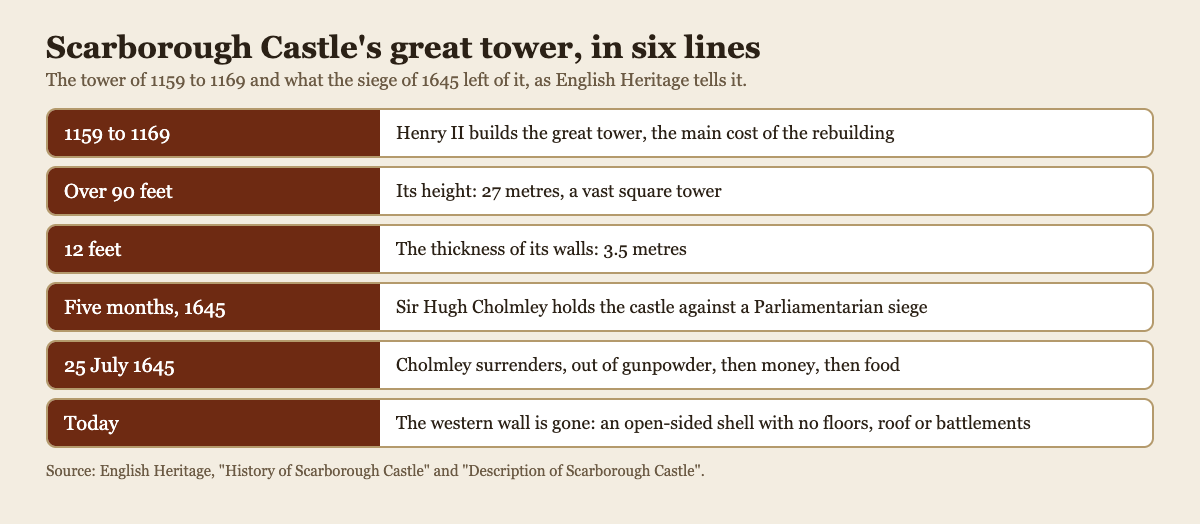
The tower in six lines, from English Heritage's pages.
From a Royalist base to a siege
The castle sits on a headland. English Heritage says it is protected on three sides by cliffs and the sea, and that on the fourth side, facing the town, there is a massive double ditch. The only way in is a great bridge across it, leading to a barbican and a gate. That is one gate to hold. The curtain wall post shows how a wall like this one worked.
Guns had hit the castle before. When the Pilgrimage of Grace broke out in October 1536, the constable, Sir Ralph Eure, was besieged inside. English Heritage says the castle was damaged by gunfire but held. In 1643 a South Steel Battery was built to command the harbour.
In September 1642 a local gentleman, Sir Hugh Cholmley, was commissioned to hold Scarborough for Parliament, but he was soon persuaded to change sides. For the next two years it served as an important Royalist base. English Heritage says it caught so much shipping that London suffered serious coal shortages. In early 1645 Parliamentarian forces closed in. After three weeks Cholmley pulled back from the town into the castle.
Five months of bombardment, and the half that fell
Here English Heritage's wording is plain. In the castle, Cholmley "resisted one of the bloodiest sieges of the Civil War" for five months. The bombardment was so intense that the massive walls of the great tower sheared and half the building collapsed.
The page does not say which gun fired which shot, or from where, and this post does not either. What it does say is how the siege ended. Cholmley ran out of gunpowder, then money, and finally food. He surrendered on 25 July 1645. The sequence is a useful one to remember. The tower fell in the middle of the siege, but the garrison gave up only when its supplies were gone. The starving a castle post tells how often that was the real ending.
The numbers show how much it took to bring the tower down: walls 12 feet thick, built in the 1160s. The bombard post traces how guns changed that. The castle had taken gunfire in 1536 and held. Five months of it in 1645 was a different test.
After 1645: another siege, a prison and a ruin
The castle did not stay quiet. On 27 July 1648 the Parliamentary garrison of 100 men under Colonel Boynton declared for the imprisoned king, after Parliament had failed to pay them. The castle was besieged again, and Boynton surrendered in December. Instructions were given that the castle should be slighted, but English Heritage says opposition from the town preserved it from destruction. The slighting post tells why so many castles were wrecked on purpose, and the Civil War castle sieges post sets Scarborough beside six others.
From the 1650s the castle served as a prison. English Heritage names George Fox, the founder of the Society of Friends (the Quakers), among those held there. The ruined tower stood by as a shell. There is one more survivor from the siege years: a well in the bailey, probably 12th century and over 46 metres deep, which English Heritage says can still be seen. The castle wells post says why a deep well mattered so much.
A worked example: read a ruined keep in four questions
The same four questions work on any damaged tower. Write one line for each, from the page you are reading.
- What stood here? Scarborough: a square tower over 90 feet high with walls 12 feet thick, built 1159 to 1169 as a residence and a statement of ownership.
- What was done to it? Five months of bombardment in 1645, after earlier gunfire in 1536.
- What failed? The western wall; the floors, roof and battlements went with it.
- What ended the siege? Not the tower: Cholmley ran out of gunpowder, money and food, and surrendered on 25 July 1645.
Try it on a second keep, such as the Tynemouth page in the Tynemouth Castle post. See whether the fourth answer there is also about supplies or about walls.
In Two Towers: one gate to hold
Two Towers is a free medieval tower defense game that plays in your browser, on a computer or a phone. Its title screen says "Two towers. One gate. Hold it as long as you can." You pick one of four towers: Archer Tower, Trebuchet, Ballista or Fire Tower. Scarborough had one bridge and one gate too, and a siege only ended when the garrison could not hold on.
The game labels the Trebuchet "Stones on a crowd" and the Ballista "Bolts through armor". In the game you are the garrison, and these two towers are how you stop the crowd at the gate. Gold from each stage pays for upgrades, and you can buy a tower for a hill too, 150 gold for the first and 300 for the second, in-game gold and never money. The Trebuchet post lists the four attackers that tower answers.
Frequently asked questions
Why did half of Scarborough Castle's great tower fall?
English Heritage says the bombardment during the siege of 1645 was so intense that the great tower's massive walls sheared and half the building collapsed.
How tall is the great tower?
English Heritage says it stands over 90 feet (27 metres) high, with walls 12 feet (3.5 metres) thick.
Who built the great tower?
Henry II built it between 1159 and 1169. English Heritage says it was most probably built to show that the castle had changed hands, from Count William le Gros to the Crown.
How did the 1645 siege of Scarborough end?
Sir Hugh Cholmley surrendered on 25 July 1645, after resisting for five months. English Heritage says he ran out of gunpowder, then money, and finally food.
Get started
Read English Heritage's two Scarborough pages with the four questions above, then try holding a gate yourself: Play Two Towers, pick your two towers, and see how many stages you last.
Comments
No comments yet.
Sign in or make an account to comment.