Self-explanation: explain each answer to learn it
Self-explanation means putting into your own words what a fact or a step means and how it connects to what you already know. It sounds like common sense, and study guides often list it next to asking yourself why. But the studies are more specific than the advice. In one comparison it clearly beat asking why, in another it helped less than testing yourself, and there are cases where it can get in the way. This guide covers what the research says, and how to add self-explanation to a practice quiz so you get the best of both.
What self-explanation is
When you self-explain, you stop after a piece of information and tell yourself what it means. Not a repeat of the sentence, but an answer to questions like these:
- What does this mean, in plain words?
- How does it connect to something I already know?
- What would change if this were not true?
It is close to elaborative interrogation, which means asking yourself why a fact is true. The difference is focus. Asking why looks for a reason. Self-explanation looks for meaning and connections, and it often includes a why along the way.
What the research on self-explanation shows
A large review of study methods by Dunlosky and colleagues (2013) rated self-explanation of moderate use. The authors saw promise, but had too little evidence from real classrooms to rate it higher. Practice testing and spreading study over days were the two methods they rated highly.
A few other studies help show where it fits.
- It beat asking why, in one study. O'Reilly, Symons and MacLatchy-Gaudet (1998) had 55 university students learn facts about the heart and blood vessels. Students who explained what each fact meant to them, and how it related to what they knew, remembered more than students who answered why each fact made sense, and more than students who repeated the facts aloud.
- Testing did better. Larsen, Butler and Roediger (2013) followed 47 first-year medical students for six months. Self-explanation while studying a review sheet helped, but repeated testing helped more. On the final test, students scored 40 percent on topics they practised by testing with explanations, 36 percent with testing alone, and 29 percent by studying with self-explanation.
- Extra practice can match it. In a study of 69 children in grades 2 to 4 solving equivalence problems such as 3 + 4 + 8 = _ + 8, McEldoon, Durkin and Rittle-Johnson (2013) found self-explanation prompts beat doing nothing extra, but against spending the same time on more practice problems the benefit was modest and showed up only on some measures.
Read together, the results suggest self-explanation is a useful add-on rather than a replacement for testing yourself. The highest score in the Larsen study came from combining the two, with testing alone close behind.
When self-explanation can backfire
A review by Rittle-Johnson and Loehr (2017) set out four limits, and each one changes how you should use it:
- It suits subjects built on principles. It is best suited to helping you use what you learned in new problems, in subjects guided by general principles or rules of thumb.
- Explaining your own choices can hurt. Under some conditions, explaining your own solution method or choice may reduce learning.
- It pulls your attention. Whatever you explain gets your focus, and other parts of the material can get less.
- Other methods can work better. Sometimes a different technique is the better use of the same time.
The practical answer to the second limit is simple: explain the right answer, not your own pick. That is the order the method below uses.
How to add self-explanation to a practice quiz
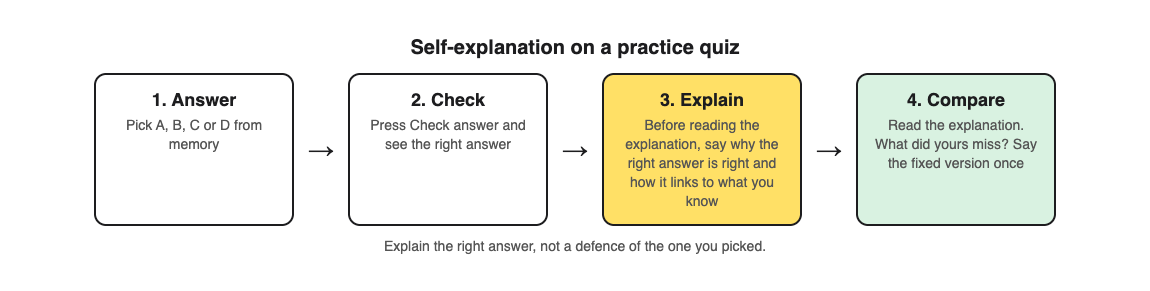
- Answer from memory. Pick an answer without looking at your notes. This is the testing part.
- Check it. See whether you were right, and what the right answer is.
- Explain the right answer. Before you read any explanation, say out loud or write one or two sentences on why the right answer is right and how it connects to something you already know. If you got it wrong, add what made the wrong choice look right.
- Compare. Now read the explanation. What did yours miss, or get wrong? Say the corrected version once.
This keeps the testing that the Larsen study found strongest, adds the explanation on top, and avoids defending your own answer.
Worked example: one question, four steps
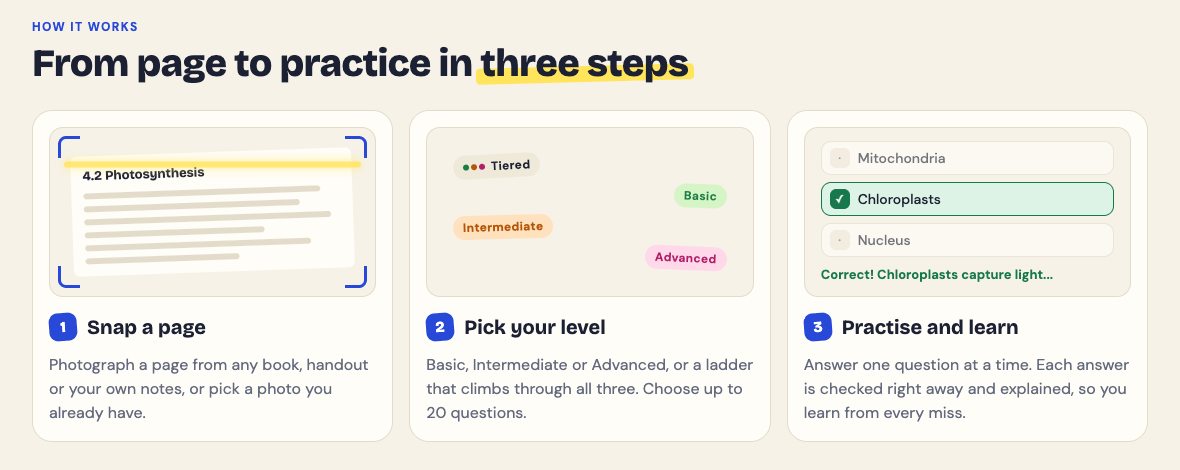
Say you are revising the heart from a textbook page. With Study Shot, you photograph the page, pick a level, and answer the questions one at a time. Each answer is checked right away and explained.
Here is one question run through the four steps.
- Answer. Say a question asks which chamber of the heart pumps blood out to the whole body. You pick the right atrium.
- Check. You press Check answer. The app shows Not quite. and the correct answer: the left ventricle.
- Explain. Before reading on, you say: "The left ventricle pushes blood out to the whole body, so it needs the most force. That is why its wall is the thickest. I picked the right atrium because I mixed up which side does what: the right side takes in blood from the body and sends it to the lungs."
- Compare. You read the explanation under the answer, one to three sentences, and check whether it says anything your explanation missed. If it mentions something you left out, say the full version once.
At the end, Look at these again lists every question you missed. Run the explain step again on each one, then retake the quiz on another day. For more on why the retake matters, see retrieval practice.
The questions are written by an AI model and can contain mistakes. If your explanation and the app's disagree, check the textbook page. Working out which one is right is self-explanation too, and Report a problem under the question lets you flag a wrong one.
Self-explanation or asking why?
Both are reasonable, and the evidence for each is limited. In the one direct comparison above, self-explanation did better, and asking why did no better than repeating the facts. The elaborative interrogation guide covers the mixed results for asking why. If you only have time for one, explaining the meaning and connections of the right answer covers the why as well.
Frequently asked questions
What is self-explanation in studying?
It means putting a fact or step into your own words and linking it to what you already know. You do it as you study, not after.
Is self-explanation better than testing yourself?
Not on its own. In one six month study, repeated testing helped more than self-explanation while studying, and the highest score came from testing with explanations, with testing alone close behind.
Should I explain my own answer or the right one?
Explain the right answer. A review of the research notes that explaining your own choices can reduce learning under some conditions.
Does self-explanation work for every subject?
A review of the research suggests it suits subjects guided by general principles best. In any subject, it works as an add-on to testing yourself rather than a replacement.
Get started
Try Study Shot: it is free to start. Photograph the page you are studying tonight, and on every question, explain the right answer in your own words before you read the explanation.
Comments
No comments yet.
Sign in or make an account to comment.