Self-Hosted LLM vs API: When Running Your Own Model Pays Off
The self-hosted LLM vs API question is really a question about who carries the fixed costs. With an API you pay per token and the provider carries the servers. With a self-hosted model you pay for the machines whether they are busy or not, and you carry the work too. For most early products the API is cheaper and faster to ship. Self-hosting starts to pay off when traffic is high and steady, or when privacy, latency or control rules the API out. Choosing between an open and a closed model is a different question, covered in our post on how to choose between open and closed AI models: open or closed is about the model, while self-hosted or API is about where it runs.
Age of AI Entrepreneur's AI Product Stack course has short hands-on lessons on model APIs, tokens and what a request costs, and on choosing between big, small, open and closed models, which give you the inputs to run this decision on your own numbers. You sign in with your email and an emailed code to open it.
What self-hosting an LLM actually means
Self-hosting means you run the model's weights on hardware you control. That might be a GPU server you rent by the hour, a machine in your office or a cluster in your own cloud account. Your app sends requests to your server, and your server returns the text.
Two things get mixed up here, so separate them. Open or closed is about the model: can you download the weights or not. Self-hosted or API is about where the model runs. A closed model is reached through its maker's service, not as a download. An open model can run on your server, but you can also call it through a third party's API. So "open" does not force you to self-host, and the open-versus-closed choice is a separate decision from this one.
What an API gives you that a server does not
An API gives you a model you can call in an afternoon, with no machines to run. You pay for the tokens you use. If nobody uses your product this week, the bill is close to zero.
You also get capacity on demand. A spike in traffic is the provider's problem. The same spike on your own server means slow responses or errors until you add machines.
The cost is that you depend on someone else's model, price and rules. They can change a model version, raise a price or alter a limit. The lesson "Building on Someone Else's Model" in the Distribution and Moats course looks at that risk. You sign in to open the course.
The real cost of a self-hosted LLM: GPUs, idle time and engineering hours
A self-hosted model has three costs, and people usually count only the first. A second machine for redundancy adds to the first one.
- The GPU. Whether you rent or buy, you pay for it around the clock.
- Idle time. A server that is busy for four hours a day still costs 24 hours a day. An API charges you only for the busy part.
- Engineering hours. Someone has to set up the serving software, test it, fix it and keep it running. If that person is you, the hours still have a price: they come out of building your product.
A simple break-even formula for self-hosted LLM vs API
You can estimate the break-even point on the back of an envelope. The idea is to find the monthly volume where the fixed cost of your own server equals what the API would charge for the same tokens.
break-even tokens per month = (server cost + engineering cost per month) / API price per token
Here is a worked example with made-up numbers. Do not treat them as real prices. Look up the current figures for the models you are actually comparing.
- Assume a GPU server costs $2,000 a month.
- Assume you spend about $3,000 a month of engineering time on it, counting your own hours at a fair rate.
- Assume the API charges $2 per million tokens, input and output blended.
The fixed cost is $5,000. Divide by $2 per million and you get 2,500 million tokens a month, or 2.5 billion. Below that volume, the API is cheaper. Above it, your own server starts to win, but only if one server can actually handle that volume. If it cannot, you need more machines and the formula starts again with a bigger fixed cost.
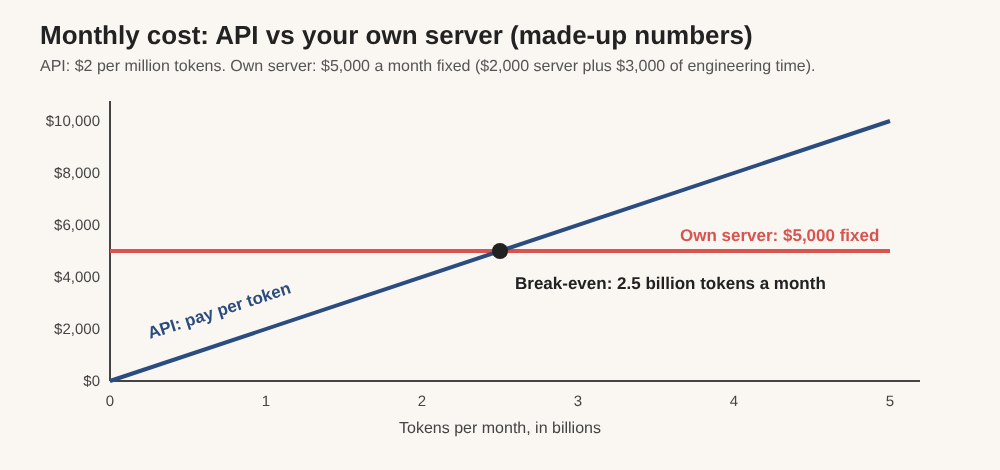
The worked example as a chart. The numbers are made up.
Three adjustments make the estimate honest:
- Use real utilization. If your server is busy half the time, your effective cost per token is double what the full-load figure suggests.
- Compare equal quality. A cheaper open model that answers worse is not a saving if you lose customers or add manual review. Test both on your own examples first.
- Count tokens properly. Long prompts, retrieved documents and retries all add tokens. The lesson "Model APIs, Tokens and What a Request Costs" in the AI Product Stack course shows how to work out what one request costs, and our blog explains how an AI API call is billed in tokens.
When privacy, latency or control justify running your own model
Sometimes cost is not the deciding factor. Three reasons can justify self-hosting even at low volume.
Privacy and data rules
If your customers' data cannot leave your own environment, an external API may be off the table. This can come from a contract, a regulation or a customer's policy. Check the actual requirement before you assume it. Many providers publish data-handling terms that may satisfy it, and your own server is not automatically safe either.
Latency
If the model has to answer in a very short time, or run near the user or on a device, a network round trip to someone else's data center may be too slow. A small model on your own hardware can fit that need.
Control
With your own model, nobody changes the version under you. You can pin it, fine-tune it and test it against the same eval set for as long as you like. That stability is worth a lot if your product breaks when the model's behavior shifts. For more on how to pick a model for the job, see this practical guide to choosing an LLM for your AI product.
Hidden work: updates, scaling, monitoring and security
The monthly bill leaves out the ongoing work. Plan for these jobs before you commit.
- Updates. New and better models keep arriving. Moving to one means testing it, redeploying it and checking nothing broke.
- Scaling. You decide when to add machines and how requests are shared between them.
- Monitoring. You need to know when the server is slow, down or giving worse answers. That means logs, alerts and a set of test cases you rerun.
- Security. The server, the keys and the data it handles are now yours to protect.
The monitoring job is easier if you built an eval set early. The Evals: Shipping AI That Works course covers building one and running AI in production, and our blog has a step-by-step post on how to build an eval set for an AI feature. You sign in to open the course.
A hybrid setup: start on an API, move one workload later
You do not have to choose once for the whole product. A sensible path looks like this:
- Start on an API. Ship fast, learn what customers use and keep your fixed costs near zero.
- Log what you send. Track tokens, cost and quality per feature, not just in total.
- Find the one workload that is big and steady. A single high-volume task, such as classifying incoming messages, is a better candidate than the whole app.
- Test an open model on that task. Run it against your real examples and compare quality and cost with the formula above.
- Move only that task. Keep the rest on the API, and keep the API as a fallback.
This keeps the risky, expensive work for the part of the product where it pays back.
Frequently asked questions
Is a self-hosted LLM cheaper than an API?
Only at high, steady volume. Below the break-even point, the API is usually cheaper because you pay nothing for idle time or for the engineering hours.
How much traffic do I need before self-hosting pays off?
It depends on your server cost, your engineering time and the API price. Use the formula in this post with your own figures. If you cannot name the monthly token count, you probably have not reached that point yet.
Can I run an LLM on a single GPU or my own laptop?
Smaller open models can run on modest hardware, which is fine for testing and learning. Serving real customers is harder, because one machine limits speed, capacity and uptime.
Does self-hosting remove vendor lock-in?
It removes lock-in to a model provider, but you take on others, such as your cloud or GPU supplier and the serving software you pick. You also become responsible for the work the provider used to do.
Can I switch from an API to my own model later?
Yes, and it is often the better order. Keep your prompts, your logs and an eval set so you can test a replacement on real examples before you move any traffic.
Get started
Before you rent a GPU, work out your monthly token count and your real engineering cost, then run the break-even formula. Next, read how to choose between open and closed AI models, then test the models you are considering on your own examples.
Age of AI Entrepreneur has short lessons on model APIs and request costs, and on choosing between big, small, open and closed models. You sign in with your email and an emailed code. The terms page says what an account includes.
Building a business in the age of AI, from a first project to a company.
Visit aientrepreneur.vlvd.net↗
Comments
No comments yet.
Sign in or make an account to comment.