Shared car problems: who drives, who fixes, and who pays
A car shared by two or three people works well until the tank is empty, a new dent appears, or the check engine light comes on and nobody acts. Then it turns into a fight about fairness. This guide covers shared car problems: who drives, who fixes each issue, and who pays for it. You will set up a schedule, give every problem one owner, split costs with a rule you agree on once, and keep a single list where every fix and its result stays visible.
Why shared car problems turn into arguments
A shared car argument can be less about the car than about memory. You remember filling the tank twice last month. Your sibling remembers paying for the oil change. Neither of you wrote it down, so both of you feel short-changed.
Three things make it worse:
- Nobody owns the problem. Everyone sees the warning light. Everyone assumes someone else will book the garage.
- Damage shows up late. A scratch found on Tuesday could have happened on Saturday. Without a record, it becomes your word against theirs.
- Old fixes get repeated. Someone tops up the coolant again, even though it leaked out last time, because nobody remembers that it already failed.
The fix for all three is the same. Write things down in one place everyone can see, and write the result next to each fix.
The most common shared car problems: fuel, damage, schedules, and repairs
Before you set rules, name the problems. This guide sorts them into four groups:
- Fuel. The car comes back near empty. Or one person always fills up and the others never do.
- Damage. New scratches, a cracked mirror, a stain on the seat, a parking ticket in the glovebox.
- Schedules. Two people need the car on Friday night. Someone keeps it an extra day without asking.
- Repairs and upkeep. Tires, oil changes, inspections, a noise nobody can place, insurance renewal.
Write each one as a single plain line. "Car returned under a quarter tank" is better than "fuel issues." A specific line is a problem someone can own and fix.
Who drives: setting a simple schedule everyone can see
A schedule only works if it is boring and visible. Keep it simple:
- Fixed days first. Give each person their regular days. For example, Ana gets weekday mornings for work and Ben gets weekends.
- Requests for the rest. Anything outside your fixed days gets asked for in the shared calendar or group chat at least a day ahead.
- A clear tie rule. If two requests clash, decide in advance who wins. Work and medical trips beat errands. The earlier request beats the later one.
- Return rules. Agree on a minimum fuel level, where the keys go, and that you mention any new damage before you hand the car over.
The return rules matter most. They turn "who drove last" from a guess into a fact, because the handover is when you check.
Who fixes: assigning an owner to every car problem
Every problem needs one name next to it. Not "we will sort it out." One person who books, calls, or buys. That person does not have to pay for everything. They just make sure it gets done.
A practical way to split it:
- The person who found it owns it for small things: a burnt out bulb, low washer fluid, a soft tire.
- One standing owner for each type of job for recurring things. Ben handles tires and inspections. Jo handles insurance and registration.
- A deadline for anything safety related. Brakes, warning lights and tires get fixed before the next long drive, whoever owns them.
Splitting costs fairly for gas, repairs, and insurance
Pick one rule for each cost and stop renegotiating it every month.
- Gas: pay for what you use. The simplest version is "return it at the level you got it." If that fails, split fuel by distance driven, using the odometer at handover.
- Repairs from wear: split evenly or by use. Oil, tires, brakes and batteries wear out from everyone's driving. Split them by an agreed share, such as equal thirds or by rough share of trips.
- Damage: the driver pays. If it happened on your trip, it is yours. This is why the handover check matters.
- Insurance and registration: fixed shares. These do not change with use, so agree on the split once.
- Tickets: always the driver.
Keep receipts in one place and settle up on a set date, such as the first of the month. If money is the part that keeps going wrong, the same idea of logging each fix and its result is covered in our post on budget problems.
One shared problem list: log each issue, fix, and result
This is the step that is easy to skip. Rules agreed in a chat thread get buried as the thread grows. You need one list that remembers what was tried and whether it worked. If you share rides rather than a car, our carpool problems guide covers the same idea for drivers.
Problem Graph is a problem and solution journal drawn as a map. You write a problem in one line, attach the solutions you try, and mark each one as worked, partly, or failed. Here is how a household of three might set it up.
Step 1: write the problems down
Ana opens the app in her phone's browser and types "Car returned under a quarter tank" into the personal lane. It lands on the graph when she presses Enter. She adds two more: "New scratch on rear bumper, nobody knows when" and "Check engine light on since Monday."
Step 2: attach what you try, with outcomes
Under the fuel problem she adds solutions as ideas:
- "Ask everyone to refill when below half" (marked failed after two weeks)
- "Return at the level you got it, note the level at handover" (marked as trying)
Under the check engine light she adds "Ben books the garage by Friday." When Ben tells her the garage fixed it and the light stayed off for a week, Ana marks that solution worked. Problem Graph also has requirement nodes, so she can attach what a solution needs to it, such as "spare key left in the drawer" under the garage booking.
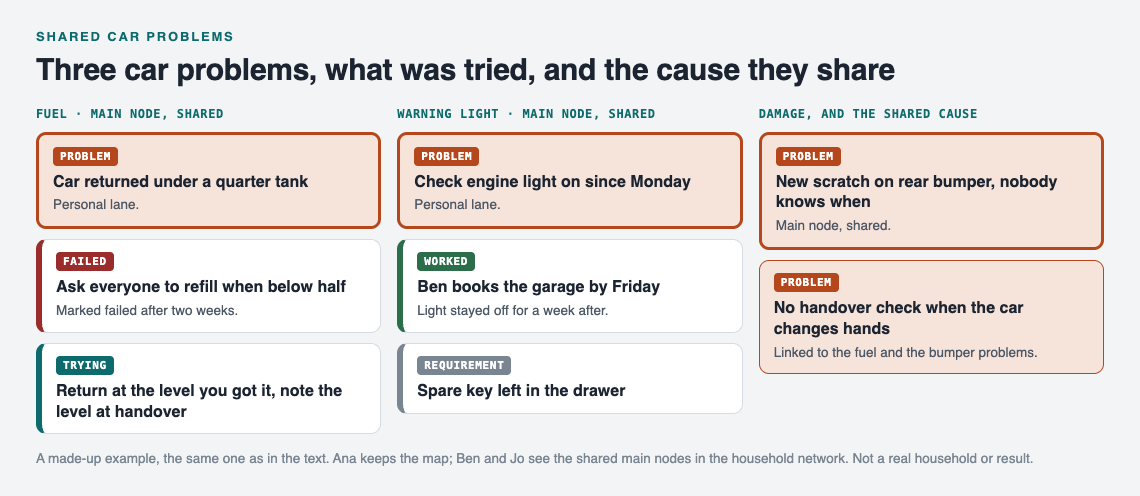
Ana's map from the example. A made-up example, not a real household or result.
The failed solution stays on the map. That is the point. Next time someone suggests "just ask everyone to refill," the record shows it was tried and did not hold. If your list is full of fixes like that, read our post on keeping a stop doing list.
Step 3: link problems that belong together
Ana adds a new problem, "No handover check when the car changes hands," and links both the bumper scratch and the low fuel problem to it. Seen on the map, the fuel problem and the damage problem point at the same cause. A list would not show that.
Step 4: share it with only the people who drive
Your problems are private by default. Only you see them. To share, Ana creates a private network for the household and sends the invite code to Ben and Jo. Anyone with the code can join, so send it only to them.
Only a problem marked as a main node can be shared. When she shares one, its solutions, their outcomes and their requirements go with it. A problem she only links to it stays in her private graph. So she marks each car problem she wants the others to see as a main node and shares it into the network. Ben and Jo can filter the app to show Network items and use the List view when the map gets busy.
The pages describe sharing, linking and borrowing, not reminders or chat, so agree on when you will check the list, for example at each handover and at the monthly settle up.
Step 5: borrow and ask
Problem Graph can show you similar problems other people have shared and which of their solutions worked. You can borrow one into your graph with one tap, and it keeps a link to where it came from. You can also ask the AI for suggestions grounded in what worked for others. Treat those as ideas to try, then record the real outcome yourself.
Frequently asked questions
Who should pay for repairs on a shared car?
Split repairs caused by normal wear, such as tires, brakes and oil, by an agreed share. Damage from a specific trip is paid by whoever was driving. Agree on both rules before the first repair, not during it.
How do you track who drove the car last when damage appears?
Do a quick walk around at every handover and log anything new right away, with the date and driver. If the car was clean at your handover and damaged at the next one, the trip in between is clear.
What should go on a shared car maintenance checklist?
Include fuel level, tire pressure, warning lights, oil change date, inspection and registration dates, insurance renewal, and any new damage. Give each recurring item one owner.
How do you stop the same car problem from coming back?
Record every fix you try and whether it worked, partly worked or failed. When the problem returns, look at what already failed and try something different instead of repeating it.
Get started
Start with the one car problem that causes the most arguments in your household. Write it as one line, attach the fix you will try this week, and give it an owner. Once it is on the map, share it with the other drivers through a private network.
If the app is empty when you open it, the app page has a "Load example set" button so you can see how problems, solutions and outcomes look before you add your own.
Try Problem Graph: it is free, and you can look around the public network without an account. Write one problem down in a line and attach the first thing you will try.
Comments
No comments yet.
Sign in or make an account to comment.