Shields in Action Games: Timed, One-Hit and Recharging
You pick up a glowing ring, and for a few seconds nothing can hurt you. That is the simplest picture of shields in action games. A shield stops damage before it reaches your health. This guide explains the main kinds of shields and how they differ from health. Then it walks through the four shields in a browser tank game, with exact times taken from the game's code, so you can use each one on purpose.
What shields in action games do
A shield is a layer of protection that sits on top of your health. While it is up, hits that would hurt you are stopped. When it ends, the next hit counts again.
The key word is layer. A shield does not replace your health or your lives. It buys you a short window to act, to move or to recover from a mistake.
Health is the other half of the picture. Wikipedia's page on health in games) describes it as a value that sets how much damage a character can take.
Three common shield rules: timed, one-hit and recharging
Shields can follow different rules. Here are three, and the games below use all of them. Knowing which rule you have changes how you play.
- Timed. The shield lasts a set number of seconds. It does not matter how many hits land. When the clock runs out, it is gone.
- One-hit. The shield stops a single hit, then breaks. Time does not wear it down. The hit does.
- Recharging. The shield breaks, then comes back on its own after a wait. You do not have to find it again. You just have to survive the gap.
A timed shield rewards using it now. A one-hit shield rewards care, because one mistake spends it. A recharging shield rewards counting, because you need to know when it returns.
Shields vs health: what is the difference
The two are easy to mix up, so here is a plain split.
- Health is how much damage you can take. It is the base layer, and losing it all costs you a life.
- A shield is extra and short-lived. It ends on a clock, after a hit, or both.
Some games blur the line by letting health come back on its own. The same Wikipedia page notes that some games regenerate health when the character takes no damage for a while. It also notes that games can show health as icons, and a shield is one of the icons it lists. A recharging shield follows the same idea, but only for the extra layer on top.
A simple test helps. If it ends on its own or comes back after a wait, it is probably a shield. If it is just how much you can take, it is health.
How a game shows you a shield
You need to know when your shield is up. A game can draw it on your character as a ring or a glow, and warn you before it ends with a blink or a flicker. Both Tank City games do both.
That warning matters more than the shield itself. When the ring starts to flicker, stop taking risks. A shield is close kin to invincibility frames, the short moments in which a hit cannot land. The difference is mostly length and how you get it.
The four shields in Tank City Reboot
Tank City Reboot is a site with two original tank games that play in your browser. They are inspired by the 8-bit tank classics of the Family Computer. Your antivirus tank guards a CPU core, and each power-up is named for a real computing idea. All the times below come from the game's code.
The arrival shield in the first game
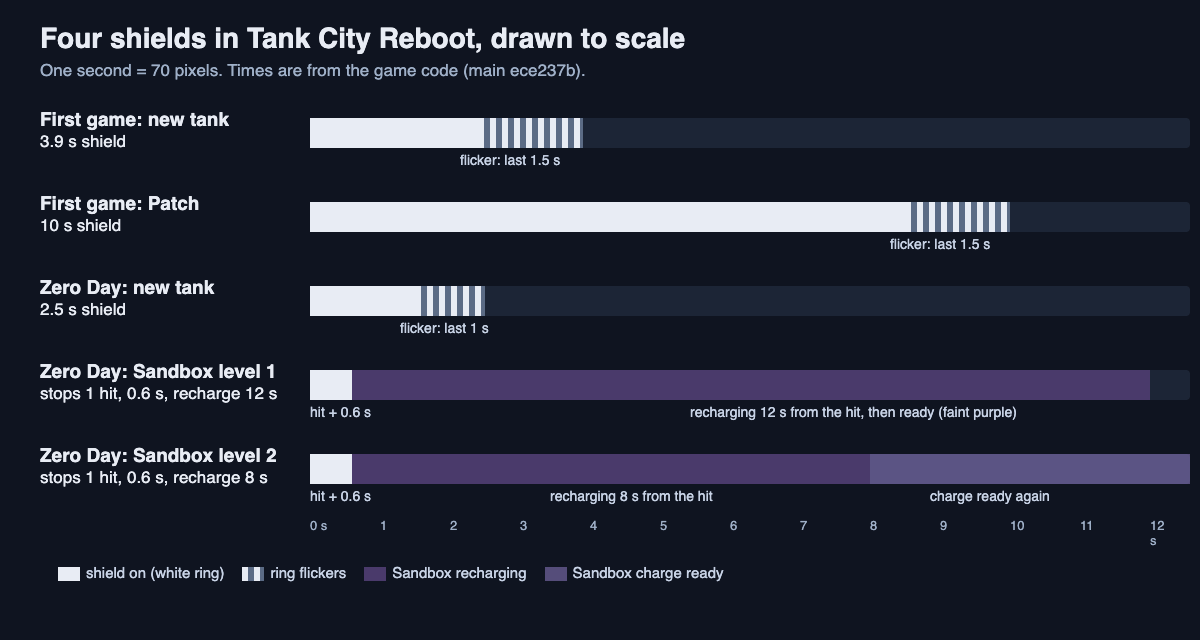
Each new tank you get arrives with a 3.9 second shield. While it lasts, enemy shots that hit your tank are stopped. The ring flickers in its last 1.5 seconds. This is a timed shield, and it covers the moment you respawn.
The Patch: a 10 second timed shield
The Patch power-up gives your tank a 10 second shield. It works the same way: enemy shots that hit you are stopped, and the ring flickers in the last 1.5 seconds. The name comes from software. The game's card says: "A patch is a software update that closes a security hole." For more on what each pickup does, see tank game power-ups.
The arrival shield in Zero Day
In Tank City Zero Day, a new tank arrives with a shorter 2.5 second shield. The ring flickers in its last second. You get less time, so move to cover quickly.
Sandbox: a one-hit shield that recharges
Zero Day's Sandbox upgrade is described in the game as "A shield that stops one hit and recharges." You can take it up to 2 levels. It stops one hit, then gives you 0.6 seconds of shield. It recharges in 12 seconds from the hit, or 8 seconds at level 2. The game's card explains the real idea: "A sandbox runs untrusted code where it cannot touch the rest of the system."
The ring tells you which shield you have. A white ring means a timed shield is running. A faint purple ring means only the Sandbox charge is ready.
A worked example: counting the Sandbox gap
Say you are in Zero Day and you have just taken Sandbox at level 1. Here is how the numbers play out.
- Your ring is faint purple. That means the Sandbox charge is ready.
- An enemy shot hits you. Sandbox stops it, so you lose nothing.
- You now have 0.6 seconds of shield. Use that moment to turn away from the shot.
- The charge is now spent. The recharge starts at the hit, so it is back 12 seconds later. During that gap, the next hit counts, so play safe and stay near cover.
- If you raise Sandbox to level 2, the gap drops from 12 seconds to 8. That is a third less time without a charge.
Compare that with the Patch in the first game. The Patch gives you 10 seconds no matter how many shots land. So the Patch is the time to push forward. The Sandbox is insurance for one mistake, followed by a wait you must count.
Other ways to stay safe: the core wall and the dash
Your tank's shield does not cover the CPU core. The core has its own kind of protection. The Firewall rebuild power-up turns the wall around the core to silicon for fifteen seconds. Think of it as a timed shield for your base rather than for you.
Zero Day also has a dash. You cannot be hit mid-dash. It is not called a shield, but it does the same job for a very short moment, and you choose when it happens.
Put together, the games give you every rule from earlier. The arrival shields and the Patch are timed. Sandbox is one-hit and recharging. Firewall rebuild protects something other than your tank.
Frequently asked questions
Do shields recharge on their own?
Some do and some do not. Timed shields end and are gone. In Tank City Zero Day, the Sandbox upgrade recharges in 12 seconds, or 8 at level 2.
Is a shield the same as health?
No. Health is how much damage you can take, while a shield is an extra layer on top that ends on a clock or after a hit.
How long does the Patch shield last?
The Patch gives your tank a 10 second shield in the first game. The ring flickers in its last 1.5 seconds as a warning.
Does my tank shield protect the CPU core?
No. The core needs the Firewall rebuild power-up, which turns the wall around it to silicon for fifteen seconds.
Get started
The best way to learn shield timing is to feel it. Grab a Patch in the first game and push forward for ten seconds. Then try Zero Day, take Sandbox, and count its recharge between hits.
Play Tank City Reboot in your browser on a computer or a phone.
Comments
No comments yet.
Sign in or make an account to comment.