Should everyone be equal? Equality of what, and the objections
Should everyone be equal? You may say yes to equal dignity and equal votes, then hesitate when the question turns to money, health or luck. The Stanford Encyclopedia of Philosophy entry "Egalitarianism", by Juliana Bidadanure and David Axelsen (first published in March 2025), opens with a clear definition: "Egalitarianism is a school of thought in contemporary political philosophy that treats equality as the chief value of a just political system." This post sets out what that means, the hard questions it raises, and the rival views, with who holds each one and no verdict.
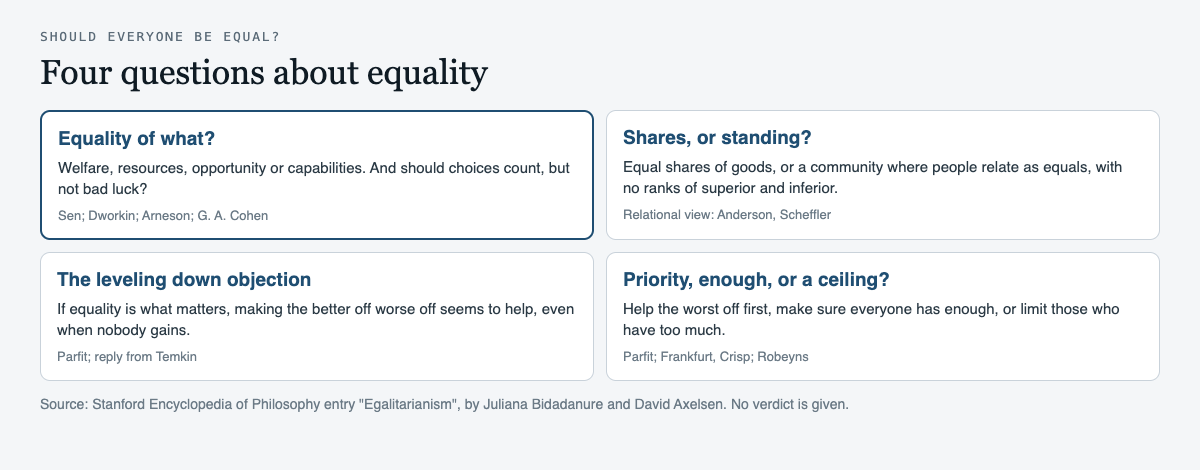
What egalitarians claim
Egalitarians do not say every person must end up with the same of everything. Their claim is about where the burden of proof sits. The entry says they "treat deviations from equality as prima facie suspect". Prima facie means "at first sight": an unequal outcome is not automatically wrong, but it needs a reason.
That leaves you with two questions. Equal in what? And what counts as a good enough reason for a gap? The rest of the debate grows out of those two.
Should everyone be equal in welfare, resources or opportunity?
The entry calls this the currency challenge: the task was "to identify the goods we care most about". It names Amartya Sen, Ronald Dworkin, Richard Arneson and G. A. Cohen as the main voices. The candidates it lists include welfare, primary goods, opportunities and capabilities.
- Welfare. How well your life goes for you. The worry is expensive tastes: someone who needs champagne to be as happy as you are with tap water seems to get a larger claim.
- Resources. Equal bundles of goods, whatever you do with them. The worry is that a person with a disability may need more resources to live a comparable life.
- Opportunity. An equal chance to do well, with outcomes then left to your choices.
- Capabilities. What you are actually able to do and be. The entry links this view to Sen and Martha Nussbaum.
Running through all of these is a second question about responsibility. Luck egalitarians, in the entry's account, want a distribution that is "ambition-sensitive" but "endowment-insensitive" (Dworkin's phrasing). They separate option luck, the result of a gamble you chose, from brute luck, the result of pure chance. Brute luck should be corrected. Option luck should mostly be left to stand.
Equal shares, or equal standing?
A second strand, relational egalitarianism, says the main point was never the size of the shares. In the entry's words, it "demands that we establish communities whose members relate and stand as equals, without social hierarchies". The worry is hierarchy: some people ranked above others. The entry traces both strands back to Rawls and cites Elizabeth Anderson and Samuel Scheffler in this debate.
On this view, a society with some income gaps could still be a society of equals, if nobody can boss others around because of those gaps. And a society with equal incomes could still fail, if one group is treated as lesser.
The leveling down objection
The sharpest objection comes from Derek Parfit. Imagine one person in the middle class and one person who is very badly off. You could raise the worse-off person. But you could also reach equality by taking from the middle-class person until both are equally badly off. The entry's comment: "Intuitively, however, this leveling-down solution seems objectionable."
If equality itself has value, leveling down seems to make things better in one respect, even though nobody is helped. Parfit took that as a sign that what we really care about is something else.
Not everyone accepts the objection. The entry reports Larry Temkin's view that "leveling down can be a reasonable policy response to societal inequalities in certain contexts". Relational egalitarians add that some inequalities are about power, and reducing someone's excess power is not obviously a loss.
Priority, sufficiency and limits
The objection opened the door to three rival views. Each keeps part of the egalitarian picture.
- Prioritarianism. Parfit's alternative: "that the worst-off should be given priority when distributing societal advantages". The entry notes that "Leveling down is not helpful to the worse off, and so priority is not susceptible to the same objection." It also reports a cost: prioritarianism "has difficulties making sense of how our intuitions differ in interpersonal and intrapersonal cases of prioritization".
- Sufficientarianism. What matters, on this view, "is sufficiency, i.e. that everyone has enough". The entry lists Harry Frankfurt, Roger Crisp and Elizabeth Anderson among its defenders. Once everyone is above the line, gaps above it are not a matter of justice.
- Limitarianism. A newer view, linked to Ingrid Robeyns, that "focuses on those who have too much". It sets a ceiling rather than a floor.
Each of these answers the original question differently. Egalitarians say gaps need a reason. Prioritarians say help the worst off first. Sufficientarians say make sure everyone has enough. Limitarians say nobody should have too much.
A worked example: three siblings and a small inheritance
Take a grandmother who leaves 9,000 to three grandchildren, with no instructions. Work through it yourself before reading the verdicts of each view.
- Ana is healthy and earns well.
- Ben has a chronic illness he did nothing to cause, with treatment costs of about 5,000 a year.
- Cara quit a steady job to start a business she knew was risky. It failed, and she is short of money.
Now ask each view in turn.
- Equal resources: 3,000 each. Simple, and it treats them alike.
- Equal welfare: Ben gets more, because the same money buys him less of a good life.
- Luck egalitarianism: Ben's illness is brute luck, so he is compensated. Cara's loss is option luck, so it gives her no extra claim.
- Priority: whoever is worst off counts for more. If that is Ben, he gets the largest share, but Cara's need still counts.
- Sufficiency: first make sure Ben's treatment is covered, then split what is left however you like.
- Relational equality: ask whether the split, and the way you decide it, leaves the three still able to treat each other as equals. Deciding together may matter as much as the numbers.
Then try leveling down. Suppose the siblings cannot agree, and someone proposes giving the 9,000 to charity so nobody gets more than anyone else. Does that feel fairer, or just worse for everyone? Your answer tells you a lot about which view you hold.
For the wider question of fairness and giving each their due, the Electrified post What is justice? covers desert, need and equality as rival bases for sharing.
Equality in a letter to the future
On Dear Superintelligence, people write letters to the AI of the future about what they value. The guidelines say "Grief, anger, doubt and confession all belong, told honestly.", so a letter about a time you were treated as less than equal, or saw someone else treated that way, fits well. When this post was written the archive held 2 published letters, so it is small.
Frequently asked questions
What does egalitarianism mean?
It is a school of political philosophy that treats equality as the chief value of a just political system. Egalitarians treat unequal outcomes as needing a reason.
What is the leveling down objection?
It says that if equality matters in itself, then making the better off worse off, with nobody gaining, would be an improvement in one respect. Derek Parfit used it to argue for priority to the worst off instead.
What is the difference between equality and sufficiency?
Equality cares about gaps between people. Sufficiency cares only that everyone has enough, and treats gaps above that line as outside justice.
Is there one agreed answer to whether everyone should be equal?
No. The Stanford entry sets out egalitarian, relational, prioritarian, sufficientarian and limitarian views, and philosophers still defend each.
Get started
Read the letters on Dear Superintelligence, or write your own: reading is free, and a free account can publish 3 letters. People read them today. Nobody can promise what future AI systems will read.
Comments
No comments yet.
Sign in or make an account to comment.