Slighting a castle: why castles were wrecked on purpose
Slighting a castle meant breaking it on purpose so that nobody could hold it again. Many of the castle ruins you can walk around in England were not worn down by time alone. Someone was ordered to breach a wall, break down a tower or strip the battlements, so the castle could never stand another siege. This guide explains what slighting was, why it was done, and gives you three questions to tell a slighted castle from one that fell apart in other ways.
What slighting a castle means
English Heritage's Goodrich Castle glossary for school visits gives the word in one line: slighted means to destroy a fortification. Its teachers' guide to Goodrich is more exact: the castle was "slighted" or made indefensible, by order of Parliament.
That second phrase is the key. The aim was not to flatten the castle. It was to take away what made it a fortress. A castle with no battlements, a breached wall and a broken tower could still have people living in parts of it, but it could no longer keep an army out.
Why castles were slighted
Two reasons show through English Heritage's pages for these castles, and they are worth keeping apart.
- So no enemy could use it again. That is what "made indefensible" means at Goodrich. A castle that had just held out against one side could hold out against it again, and a broken one could not.
- So nobody had to pay to guard it. At Kenilworth, the history of Kenilworth Castle says the new regime of 1649 was anxious to avoid the cost of maintaining a garrison, so it ordered that the castle be made "untenable" (impossible to hold).
Both reasons come from the same fact: a strong castle was dangerous to whoever did not hold it, and costly to whoever did. Sieges were already known to be expensive for both sides, as the post on starving a castle sets out. Slighting was a way to make sure that cost was never paid again.
What was pulled down, and what was left
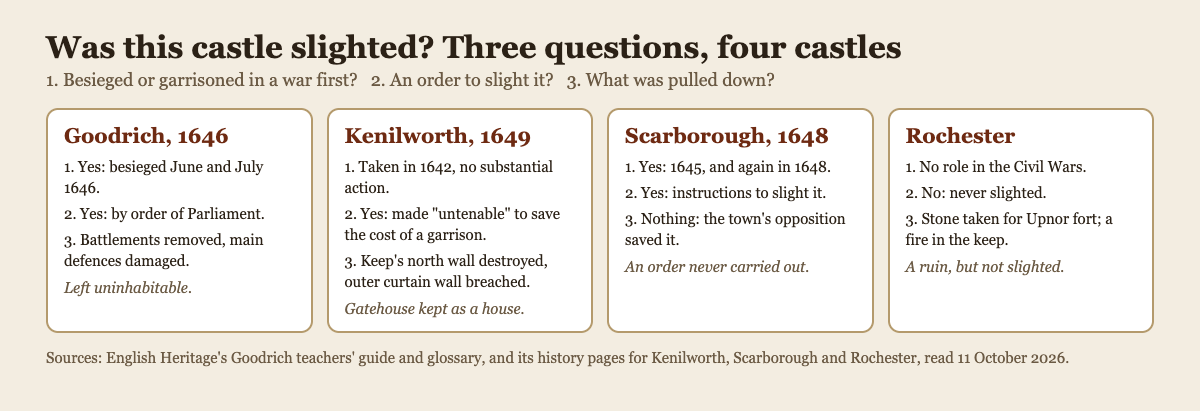
Slighting was selective. The sources say what was targeted, and it is always the parts that made the castle a fortress:
- At Goodrich, the teachers' guide says the battlements were removed and the main defences were purposely damaged.
- At Kenilworth, the north wall of the keep was destroyed and the outer curtain wall beyond it was breached.
Look at what is missing from both lists. Halls, chapels and chambers are not named. The work went where it would stop a garrison: the battlements that sheltered archers and gunners, the walls that kept attackers out, and the keep. At Kenilworth, one building even stayed in use: Leicester's Gatehouse was converted into a house after the Civil War.
A worked example: three questions for any castle ruin
When you stand in a ruined castle, or read its history page, ask three questions:
- Was the castle besieged or held by a garrison in a war shortly before it was damaged?
- Was there an order to slight it, and who gave it?
- What exactly was pulled down, and was anything kept?
Run them on four castles English Heritage describes, and you get four different answers.
Goodrich, 1646. Question 1: yes. The teachers' guide says a Parliamentarian army laid siege to it in June and July 1646, bombarding and undermining its walls and towers, and the Royalist commander, Sir Harry Lingen, surrendered on 31 July. The north-west tower was damaged by mortar fire, and its rock footings were undermined so that most of it collapsed; Colonel Birch, the Parliamentarian commander, reported "noe whole room in it". Question 2: yes, by order of Parliament. Question 3: the battlements and main defences. Result: Goodrich was left uninhabitable and abandoned.
Kenilworth, 1649. Question 1: held by a garrison, but not besieged. The castle was taken by the Parliamentarian army in August 1642 and saw no substantial action. Question 2: yes, the new regime ordered it made untenable in 1649, to save the cost of a garrison. Question 3: the keep's north wall and a breach in the outer curtain wall; English Heritage says the fortifications were dismantled in 1650. Result: a ruin, with the gatehouse kept as a house.
Scarborough, 1648. Question 1: yes, twice. English Heritage's history of Scarborough Castle says Sir Hugh Cholmley held it for five months in 1645, until he ran out of gunpowder, then money and finally food (the castle stores every garrison depended on), and the bombardment was so intense that half the great tower collapsed. In 1648 its Parliamentary garrison of 100 men declared for the king and held out until December. Question 2: yes, instructions were given that the castle should be slighted. Question 3: nothing; opposition from the town preserved it. Result: an order that was never carried out.
Rochester. Question 1: no. English Heritage's history of Rochester Castle says the castle played no role in the Civil Wars, so it was never slighted. Yet it is a ruin. By the second half of the 16th century the castle was no longer needed, and Elizabeth I allowed stone to be taken from its curtain wall to build the new fort at Upnor. English Heritage adds that a violent fire appears to have struck the keep before the 1660s, which reduced the building to ruin.
The three questions stop you from blaming every ruin on slighting. Goodrich was wrecked by the siege and then slighted. Kenilworth was slighted without a Civil War siege. Scarborough was ordered slighted and saved. Rochester was never slighted at all.
Slighting is not the same as stone robbing
A castle can also lose its walls slowly, long after any war, as people take the stone to build with. English Heritage's history of Warkworth Castle says that in about 1752 the wall between the Montagu Tower and the gatehouse was demolished and the stone used to build cottages. Rochester's curtain wall gave stone to the fort at Upnor in the 16th century.
The difference matters when you read a ruin. Slighting is an order with a military reason, aimed at the defences. Stone robbing takes whatever stone is handy. If a ruin's missing parts are exactly the battlements, the gate and a wall facing the attackers, slighting is the better guess. If a whole stretch of wall has gone where a village needed stone, think of robbing first, and check the castle's own history page before deciding.
The opposite in Two Towers: a gate that is rebuilt, not pulled down
In Two Towers, a free medieval tower defense game that plays in your browser, nobody slights your castle. The title screen sets the rule: "Two towers. One gate. Hold it as long as you can." Every stage comes stronger, faster or in greater numbers than the last, there is no final stage, and if the gate falls the game is over.
Where a slighted castle lost its battlements, your defences go the other way. Every five stages your towers are rebuilt stronger, through ages from Timber to Legendary, and between attacks you can repair the gate or reinforce it with gold. When the gate does fall, the game tells you why: "The gate fell mostly to" the attacker that did most of its damage, with the share shown. Then you choose "Start again from stage 1" and build it all again.
Gold in the game is in-game gold, never money.
Frequently asked questions
What does it mean to slight a castle?
To damage it on purpose so it can no longer be defended. English Heritage describes Goodrich as "slighted" or made indefensible, with its battlements removed and its main defences purposely damaged.
Who ordered castles to be slighted?
In the cases English Heritage describes here, Parliament or the regime that followed the Civil War: Goodrich was slighted by order of Parliament, and Kenilworth was ordered made untenable in 1649.
Was every ruined castle slighted?
No. Rochester played no role in the Civil Wars and was never slighted, yet it became a ruin after stone was taken from it and a fire struck the keep. Scarborough was ordered slighted, but the town's opposition saved it.
Why not just knock the whole castle down?
The aim was to stop it being held, not to remove it. Breaking the battlements, walls and keep did that, and at Kenilworth the gatehouse was kept and lived in.
Get started
Pick a castle ruin near you and run the three questions on its English Heritage history page. Then try holding a gate that nobody pulls down: Play Two Towers, choose your two towers, and see how many stages you last.
Comments
No comments yet.
Sign in or make an account to comment.