Socrates vs Plato: what is the difference between them?
Socrates vs Plato is a strange pairing, because most of the "Socrates" you can read was written by Plato. Socrates wrote nothing himself. Plato wrote dialogues in which Socrates does most of the talking. So the real question is where the teacher ends and the student begins. This guide sets out who each man was, why the line is hard to draw, how scholars draw it, and one worked example you can try yourself.
Socrates vs Plato: the short answer
Socrates was a questioner in Athens who asked people how they should live. Plato was his student, and a writer whose dialogues take on ethical, political, metaphysical and epistemological questions. The Stanford Encyclopedia of Philosophy entry on Plato says philosophy as it is often conceived "can be called his invention."
- Socrates is known for questioning people about how to live. On one widely used reading, he was "a moralist but (unlike Plato) not a metaphysician or epistemologist or cosmologist."
- Plato is known for the forms, a realm of things that are "eternal, changeless," and for the view that the soul is a different sort of thing from the body.
The same entry admits the hard part: "it is not easy to say where to draw the line between him and his teacher."
Who was Socrates?
World History Encyclopedia says that in 399 BCE Socrates was charged with impiety. The accusation was "denying the gods recognized by the state and introducing new divinities" and "corrupting the young." He was convicted and executed.
His life's work, says the Stanford entry on Socrates, was "the examination of people's lives, his own and others'." At his trial, as Plato tells it, he says "the unexamined life is not worth living for a human being." He questioned people about courage, love, reverence, moderation and the state of their souls.
World History Encyclopedia tells the story behind it. His friend Chaerephon asked the Oracle at Delphi if anyone was wiser than Socrates, and the Oracle answered "None." Hoping to prove it wrong, Socrates questioned people who were held to be wise.
No one doubts he lived. World History Encyclopedia says "Socrates' historicity has never been challenged." What he taught is the problem.
Who was Plato?
Plato was a student of Socrates and featured him in almost all of his dialogues. World History Encyclopedia says he heard Socrates in the market, gave up plans for a political or literary career, and burned his early work. After Socrates was executed, Plato traveled, visiting Egypt and Italy among other places. Then he came home to write and to found the Academy in Athens, "traditionally considered the first university in the Western world."
The Stanford entry calls him "one of the most dazzling writers in the Western literary tradition." But there is a twist. In his dialogues, Plato never speaks to you in his own voice. The entry says "he does not himself affirm anything in his dialogues." His characters do all the arguing.
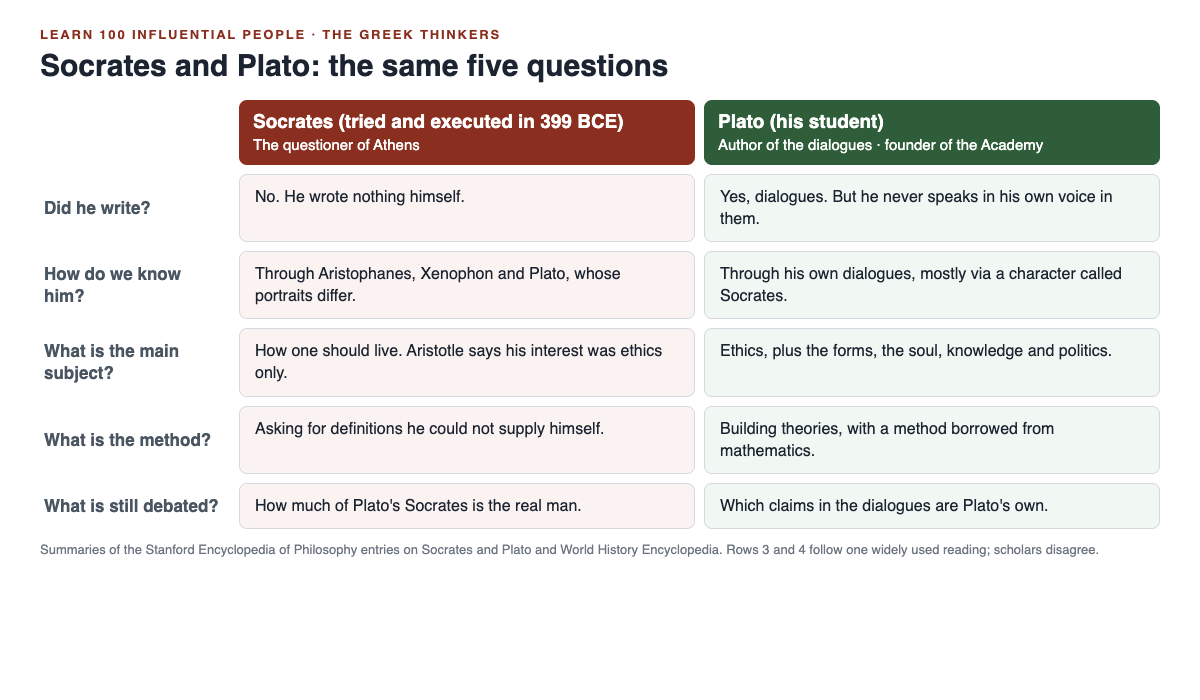
The Socratic problem: three sources that disagree
The difficulty of telling the historical Socrates apart from the Socrates in other people's books is called the Socratic problem. Three portraits survive whole, and they differ.
- Aristophanes, the comic playwright, put Socrates in his play Clouds. The Stanford entry on Plato says the play is mostly "an attack on a philosophical type" rather than a picture of Socrates himself.
- Xenophon, a soldier and historian, shows "a practical and helpful advisor." Some have argued it may be more accurate than Plato's. Others note that his memoirs are "pastiches, several of which simply could not have occurred as presented."
- Plato draws individual Athenians in a way that matches archaeological and literary evidence remarkably well. Yet he "may have shaped the character Socrates (or other characters) to serve his own purposes."
The complaint is old. According to Diogenes Laertius, Phaedo, another student of Socrates, said Plato "placed his own ideas in Socrates' mouth." And Plato's Socrates does not always agree with himself. He opposes hedonism in the Gorgias, and supports it in the Protagoras.
How scholars draw the line
Here are the main positions, set out with no verdict.
- Plato changed over time. Gregory Vlastos held that Plato's views developed as he wrote. On this reading, a group of early dialogues, including the Apology, Crito, Euthyphro, Laches and book 1 of the Republic, shows the historical Socrates at work. Later, "Plato puts into the mouth of Socrates only what Plato himself believes." Vlastos even listed ten Socratic theses that clash with ten Platonic ones, a list others contest.
- Read each dialogue as art. Literary contextualists see Plato as "an artist of surpassing literary skill." For them, the ambiguities in the dialogues are intentional, so each dialogue should be read as a whole. On this view there is no Socratic problem to solve.
- The order is not known. John Cooper argued that sorting dialogues into early and middle periods presumes an order of writing "when in fact no such order is objectively known."
- Plato had ideas from the start. The Stanford entry on Plato finds it unrealistic that Plato began writing with no ideas of his own. It treats moves even in early dialogues "as Platonic inventions." The habit of searching for definitions "may have been Socratic in origin."
If you want another pair of teachers whose real words are hard to recover, see our guide to Confucius vs Laozi.
What each is known for
Socrates. Aristotle describes him as interested only in ethics, and as asking for definitions he could not supply himself. In the Apology, he leaves questions "in the sky and below the earth" to "wiser heads." He also says that no one knows what becomes of us after we die.
Plato. On the developmental reading, in dialogues such as the Phaedo and the Republic, the speaker called Socrates goes further. He argues for the immortality of the soul and for the forms of beauty, justice and goodness. He uses a method "borrowed from mathematics." When the topics turn to the cosmos or to constitutions, Plato hands the lead to other speakers, and Socrates is absent from the Laws.
Worked example: sort the claims in the Republic
You can try the scholars' reasoning on one book. Take Plato's Republic and follow these steps.
- List a few claims. Book I searches for a definition of justice and does not settle it. Later, Socrates argues that justice in the soul "consists in each part of the soul doing its own." Later books put the theory of forms at the center and divide the self into three parts.
- Set your test. Use Socrates' own speech in the Apology and Aristotle's description: ethics only, and questions he could not answer himself.
- Sort under the developmental reading. The search in Book I fits the test, so mark it "likely Socrates." The Stanford entry calls Book I "a portrait of how the historical Socrates might have handled the search for a definition of justice." The forms and the self in three parts go beyond the test, so mark them "Plato's own."
- Sort again under the other readings. A literary contextualist would not split the book at all, but read it as one work. Following the Stanford entry on Plato, you would treat even Book I's arguments as likely Plato's work, keeping only the habit of seeking definitions as possibly Socratic.
- Write down the reading you used. Your sorted list is only as good as its method, so name the method next to it.
Notice what happened. The same passage lands in different columns depending on the reading. That is the Socratic problem in one exercise.
Frequently asked questions
Did Socrates write anything?
No. Most of what we know of him comes from Plato and, less so, from Xenophon.
Was Plato a student of Socrates?
Yes. He studied with Socrates until the trial and featured him in almost all of his dialogues.
What is the Socratic problem?
It is the difficulty of telling the historical Socrates apart from the Socrates in the works of the authors who wrote about him. Scholars still disagree on how to solve it, or whether it needs solving.
Which dialogues are closest to the real Socrates?
On the developmental reading, dialogues such as the Apology, Crito, Euthyphro and Laches. Other scholars doubt that the order of the dialogues can be known.
Get started
Socrates and Plato both appear in The Greek Thinkers, a Basic course on Learn 100 Influential People, alongside Aristotle, Euclid, Archimedes and Hippocrates. Basic courses cover "The best-known names, no background needed." Lessons take about 9 minutes. Like this guide, the site does not pick a side: cards set out where researchers disagree, and every lesson lists its sources. Sign in with your email and an emailed code. Accounts are for people aged 13 or older.
Start Learn 100 Influential People: short hands-on lessons on the people who shaped history, with every side of the debate and the sources to read next.
Comments
No comments yet.
Sign in or make an account to comment.